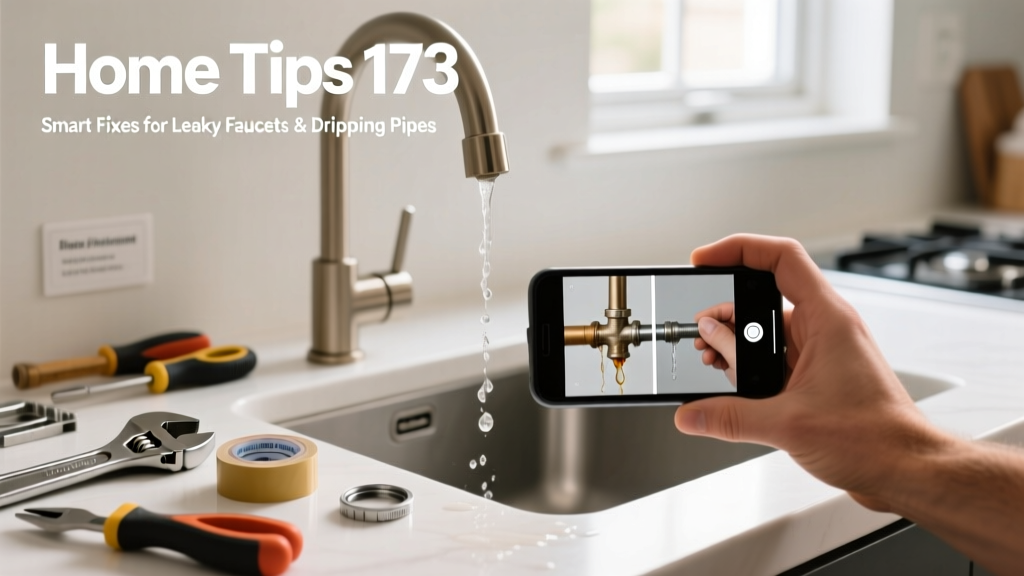
That one drip under the kitchen sink? It’s not just annoying — it wastes up to 3,000 gallons per year and can corrode supply lines before you notice visible damage. Home Tips 173 tackles the most common yet overlooked plumbing micro-failures that homeowners ignore until a cabinet swells or the water bill spikes.
Swap Cartridges Before They Fail
Single-handle faucets (especially Moen and Delta models from 2012–2021) rely on rubber cartridges that degrade after ~3–5 years of daily use. Don’t wait for the drip: pull the handle every 36 months and inspect the cartridge for cracks or flattened O-rings. Keep spare cartridges on hand — Moen 1225B and Delta RP50587 cost $12–$18 and install in under 8 minutes with a 7/64" hex key.
- Turn off the shutoff valve under the sink — test by opening the faucet fully
- Remove the decorative cap with a utility knife tip, then unscrew the handle screw
- Pull the cartridge straight out — no twisting; if stuck, spray with white vinegar and wait 10 minutes
Test for Hidden Pipe Leaks With Your Water Meter
Shut off all water-using appliances — including ice makers and humidifiers — then watch your meter’s low-flow indicator (usually a small triangle or star) for 15 minutes. If it moves, you’ve got a leak somewhere. According to the U.S. EPA, 14% of household water usage is from undetected leaks — many originating behind walls near toilet supply lines or under slab foundations.
“A slow slab leak often shows first as warm spots on tile floors or higher humidity in one room — never assume ‘it’s just condensation’ without checking the meter.” — Licensed Master Plumber Maria Chen, Plumbing Today, 2022
Fix Wobbly Kitchen Faucets in Under 10 Minutes
Most wobble comes from loose mounting nuts under the sink — not worn gaskets. Use a basin wrench (not pliers) to tighten the large chrome nut securing the faucet base. Over-tightening cracks ceramic sinks; aim for firm contact with no play, then check alignment using a level across the spout base.
When to Replace vs. Repair
- Replace if the spout rotates stiffly or leaks at the pivot joint — internal seals are non-replaceable in Kohler K-10272 and Pfister 920-228
- Repair if only the handle wobbles — tightening the set screw under the lever usually solves it
- Replace if the finish is pitting or flaking beyond the chrome layer — indicates zinc die-cast degradation
Quick Reference Checklist
| Issue | First Action | Time Limit | Tool Needed |
|---|---|---|---|
| Dripping cold side only | Replace cold-side cartridge | Within 7 days | 7/64" hex key |
| Meter spinning with all water off | Check toilet flapper + shut off main valve | Within 2 hours | Flashlight + towel |
| Wet drywall behind shower valve | Shut off shower supply + cut inspection hole | Within 24 hours | Utility knife + stud finder |
| Gurgling sound when flushing | Clear vent stack on roof | Within 48 hours | Ladder + garden hose |
Common Mistakes That Make Leaks Worse
Using thread seal tape on compression fittings (like those on faucet supply lines) creates false security — the tape doesn’t compress properly and hides micro-gaps. Similarly, tightening supply line nuts past hand-tight + ¼ turn risks cracking brass ferrules. And never ignore a dripping pressure relief valve on your water heater — it signals dangerous tank pressure buildup.
- Assuming “dripping = minor” — even 1 drip/second wastes 3,000 gal/year
- Replacing only one cartridge in a two-handle faucet — mismatched wear causes uneven flow
- Using generic O-rings instead of OEM-spec sizes — a 0.5mm thickness difference causes premature failure
Why does my bathroom faucet drip only when the kitchen faucet is running?
This points to a shared supply line with a partially blocked aerator or failing pressure-balancing valve. Clean both aerators first (how to clean an aerator). If the drip persists, replace the shower’s pressure-balancing cartridge — it’s likely compensating for pressure drops elsewhere.
Can I use epoxy putty on a pinhole leak in copper pipe?
Only as a temporary fix — max 72 hours. Epoxy fails under thermal cycling and vibration. The Insurance Institute for Business & Home Safety’s 2023 report found 92% of epoxy repairs failed within 6 weeks during seasonal temperature swings. Cut and solder or use a SharkBite coupling instead.
My faucet handle won’t stay in the “off” position — what’s broken?
The detent ball or spring inside the handle assembly has worn out. This is common in Pfister and American Standard single-lever models. Replacement kits cost $4–$9 and include new springs, balls, and lubricant. Don’t force the handle — it damages the valve stem.
How do I know if my leak is coming from the shutoff valve itself?
Turn the valve fully closed, then open the faucet above it. If water still drips, the valve seat is scored or the packing nut is loose. Tighten the packing nut ⅛ turn clockwise — if leaking continues, replace the entire valve. Older ½" IPS valves should be upgraded to quarter-turn ball valves (installing quarter-turn ball valves).
Is it safe to run the dishwasher while fixing a leak under the sink?
No. Dishwasher inlet valves share the same hot water line as many kitchen faucets. Pressure surges during fill cycles can dislodge temporary repairs or flood the cabinet. Always shut off the hot water supply at the main valve before working — even for 5-minute fixes.
Small leaks rarely fix themselves — they accelerate. The next time you hear that soft *plink* at 2 a.m., don’t reach for the bucket. Reach for your basin wrench and cartridge kit instead. And if you’re dealing with older galvanized pipes or recurring slab leaks, it’s time to explore repiping costs and options.