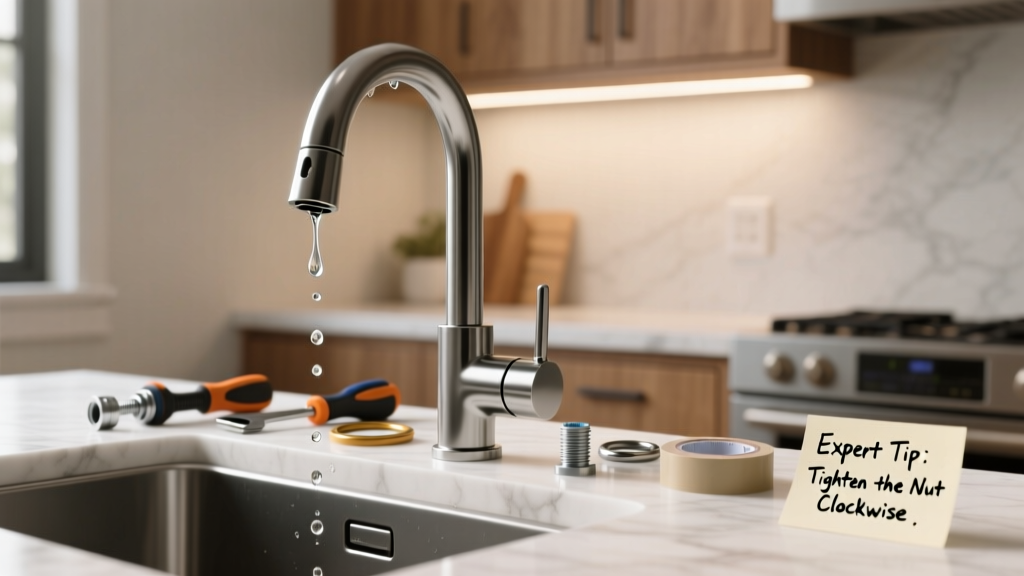
If your kitchen faucet drips once every 3 seconds, you’re wasting nearly 3,000 gallons of water per year—and paying for it. Home Tips 171 tackles the most common, costly, and overlooked plumbing annoyances that homeowners ignore until the ceiling stains or the water bill spikes.
Swap Cartridges Before They Fail
Single-handle Moen and Delta faucets use replaceable cartridges that wear out after 5–7 years—not decades. When flow feels sluggish or temperature control drifts, don’t wait for total failure. Most cartridges cost $12–$22 and install in under 20 minutes with a 5/32″ Allen wrench and needle-nose pliers.
- Turn off the supply valves under the sink (not just the main shutoff)
- Open the faucet fully to relieve pressure before disassembly
- Take a photo of the cartridge orientation before removal—it’s easy to reinstall backward
Pro tip: Keep one spare cartridge on hand for each bathroom faucet. According to the U.S. EPA, 14% of household water usage is from leaks—many traceable to worn cartridges.
Find Hidden Leaks With Your Water Meter
You don’t need dye tablets or infrared cameras. Turn off all water-using appliances—including ice makers and humidifiers—then watch your meter for 15 minutes. If the low-flow indicator (a small triangle or star) moves, you’ve got a leak somewhere.
Common culprits: toilet flappers (replace every 3 years), buried irrigation lines, and slab leaks behind baseboards. A 2023 report from the Insurance Institute for Business & Home Safety found that 68% of slab leaks go undetected for over 90 days—causing mold and structural rot before surfacing.
"If your meter spins while everything’s off—even slightly—you have a leak. Don’t assume it’s 'just condensation.' That spin adds up to $100+ per month in wasted water and sewer fees." — Ken R., licensed master plumber, 28 years’ experience
What to check first when the meter spins
- Toilet tank: Add food coloring to the tank; if color appears in the bowl in 10 minutes, replace the flapper
- Water heater pressure relief valve: Look for dampness or mineral deposits around the discharge pipe
- Outdoor spigots: Even frost-free models can weep at the stem if the internal washer compresses unevenly
Stop Dripping Without Replacing the Whole Faucet
Most compression-style faucets (common in older homes) drip because the rubber washer wears thin—not because the valve seat is ruined. Replace the washer ($1.29 at any hardware store), then reseat the valve using a $9 valve seat dresser tool. Skip this step, and the new washer will fail in weeks.
For ceramic-disk faucets, clean sediment from the disk channels with white vinegar and a soft toothbrush—never steel wool. Mineral buildup mimics wear and causes inconsistent sealing.
Washer replacement checklist
- Match washer size and shape exactly—measure diameter and stem thickness with calipers
- Use silicone grease (not petroleum jelly) on the stem threads to prevent seizing
- Tighten the packing nut only until resistance increases—overtightening cracks the stem
Quick Reference Checklist
| Priority | Action | Time Required |
|---|---|---|
| 1 | Check toilet flapper with food coloring test | 5 minutes |
| 2 | Inspect under-sink supply lines for bulges or green corrosion | 3 minutes |
| 3 | Test meter with all water off for 15 minutes | 15 minutes |
| 4 | Replace faucet cartridge or washer | 15–25 minutes |
| 5 | Call a plumber only if meter spins AND no visible source is found | — |
Common Mistakes
People waste time and money by assuming all drips require full faucet replacement—or worse, ignoring them entirely. The top three errors:
- Using generic ‘universal’ washers that don’t match stem taper—leads to cross-threading and stripped valves
- Skipping the valve seat dressing step on old compression faucets, causing premature washer failure
- Turning off only the hot or cold supply valve when replacing a cartridge—water can still bleed through the opposite line
Also, never wrap Teflon tape clockwise *and* counterclockwise on the same fitting—it bunches and leaks. Wrap only clockwise, 3–4 wraps max, and stretch slightly as you wind.
Why does my faucet drip only when the dishwasher runs?
That’s likely a pressure imbalance. Dishwashers draw large volumes quickly, dropping line pressure. If your faucet’s internal seals are compromised—even slightly—they’ll weep during those dips. Fix the seal first; if it persists, install a pressure-balancing valve pressure regulator.
Can I use epoxy putty to fix a pinhole leak in a copper pipe?
Yes—but only as a temporary patch (max 6 months). Epoxy doesn’t bond reliably to wet or oily surfaces. Dry the area thoroughly, sand bare copper, and apply putty within 2 minutes of mixing. For permanent repair, solder or use a compression repair clamp.
My shower head drips for 90 seconds after turning off—normal?
Yes—if it stops within 2 minutes. Gravity drains residual water from the arm and head. If dripping lasts longer or worsens, mineral buildup is blocking the internal anti-drip valve. Soak the head in vinegar overnight, then flush with water before reinstalling.
Why does my bathroom faucet drip more in winter?
Cold temperatures cause metal components to contract slightly, widening microscopic gaps in worn seals. It’s not ‘dry air’—it’s thermal expansion mismatch. Replace the cartridge or washer; don’t adjust packing nuts seasonally.
Is a dripping outdoor spigot dangerous?
Yes—if it freezes. Water expands 9% when frozen. A slow drip can freeze inside the valve body, cracking brass or breaking the internal stem. Shut off the interior shutoff valve and open the spigot to drain before first frost. See our guide on winterizing outdoor faucets.
Fixing drips isn’t about perfection—it’s about catching small problems before they become $5,000 drywall replacements. Most repairs take less time than waiting for a plumber’s appointment slot. And unlike many home projects, these pay for themselves in water savings within 3 months—especially if you track usage with your utility’s online portal.