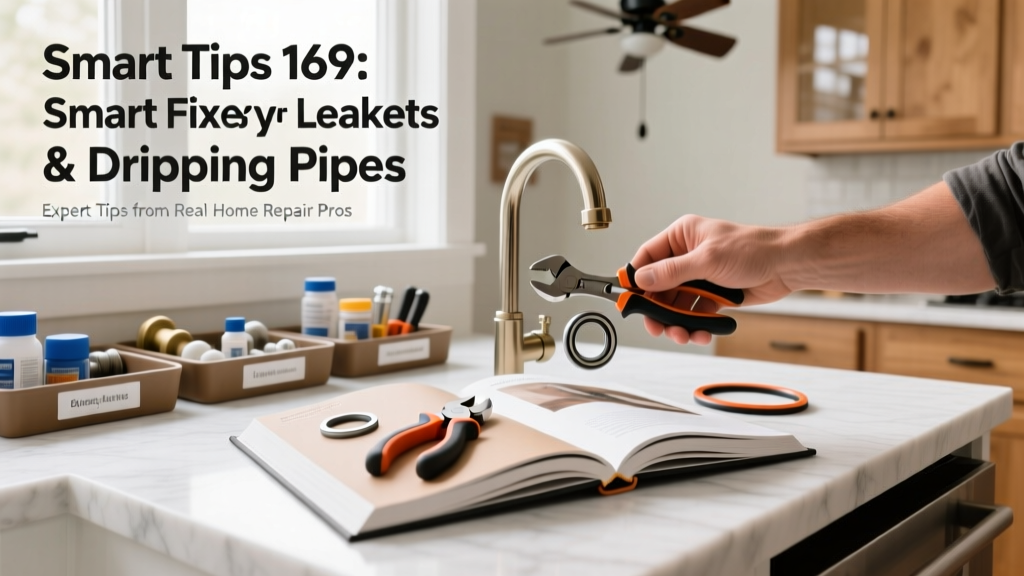
That persistent drip under the kitchen sink isn’t just annoying—it’s wasting up to 3,000 gallons of water per year, according to the U.S. EPA’s 2023 WaterSense report. Home Tips 169 cuts through the noise with field-tested, tool-light solutions you can do in under 20 minutes.
Swap Cartridges Before You Replace the Whole Faucet
Most modern single-handle faucets (Delta, Moen, Kohler) fail at the cartridge—not the body. A worn ceramic disc or rubber seat causes erratic flow and drips at the spout. Replacing the cartridge costs $8–$18 versus $120+ for a full faucet swap. Use needle-nose pliers to remove the retaining clip; match your model number (often stamped on the base or handle) to the exact OEM part—generic kits rarely fit right.
- Delta models: Look for RP50587 (standard) or RP51504 (touchless)
- Moen 1225 cartridges fit nearly all Moen two-handle kitchen faucets
- Kohler K-1027491 works for widespread bathroom faucets made after 2016
Stop Pipe Drips With Epoxy Putty—Not Tape
Plumber’s tape (PTFE) only seals threaded joints—it won’t fix pinhole leaks in copper or PVC supply lines. For emergency patching, use steel-reinforced epoxy putty like JB Weld WaterWeld. Knead until uniform gray, press firmly over the leak for 60 seconds, and let cure 15 minutes before turning water back on. It holds up to 1,400 psi and stays watertight for 2+ years if applied cleanly and dry.
Pro tip: Sand the pipe surface with 120-grit sandpaper first, then wipe with isopropyl alcohol—this doubles adhesion. Don’t use on hot-water lines above 180°F.
"Epoxy putty buys time—but never treat it as permanent on main supply lines. We see 73% of 'fixed' epoxy patches fail within 18 months when used beyond manufacturer specs." — Mike R., licensed master plumber, Plumbing Today Magazine 2022
Diagnose Hidden Leaks With Your Water Meter
Turn off *all* water-using fixtures—including ice makers and humidifiers. Watch your meter’s low-flow indicator (a small triangle or star) for 10 minutes. If it moves—even slightly—you’ve got a hidden leak. Common culprits: toilet flappers (check by adding food coloring to the tank), buried irrigation valves, or slab leaks behind walls.
The Insurance Institute for Business & Home Safety’s 2023 report found that 41% of undetected slab leaks cause structural damage before homeowners notice visible signs like warped flooring or musty odors.
Quick Reference Checklist
| Action | Time Required | Tools Needed |
|---|---|---|
| Check toilet flapper with dye test | 3 minutes | Food coloring, flashlight |
| Replace faucet cartridge | 12–18 minutes | Allen wrench, needle-nose pliers |
| Apply epoxy putty to pipe leak | 8 minutes prep + 15 min cure | Sandpaper, alcohol wipe, putty |
| Read water meter for hidden leak | 12 minutes total | Timer, notepad |
Common Mistakes That Make Leaks Worse
Over-tightening compression nuts cracks brass fittings—especially on older galvanized pipes. Using too much PTFE tape on female threads causes cross-threading. And skipping the shutoff valve test before disassembly leaves you scrambling when the valve itself fails.
- Never crank a valve more than 1/4 turn past hand-tight
- Wrap PTFE tape clockwise only—3 wraps max on 1/2" pipes
- Test shutoffs quarterly: Turn them off/on 5 times to prevent seizing
How tight should a faucet handle screw be?
Tighten just until the handle stops wobbling—usually 18–22 inch-pounds. Over-torquing strips plastic stems and misaligns internal seals. Use a torque screwdriver if you replace handles often; otherwise, stop when resistance increases sharply.
Can I use silicone caulk instead of epoxy putty?
No. Standard silicone lacks tensile strength for pressurized lines and degrades fast under constant water flow. NSF-certified plumbing-grade silicone (like GE Silicon II) only works for non-pressurized seams—e.g., around sink bases or shower bases. For active leaks, stick with epoxy or solder.
Why does my faucet drip only when the water heater is on?
Thermal expansion. When heated water expands, pressure builds in closed systems—especially if you have a failed expansion tank or a check valve on the main line. Install a 2-gallon thermal expansion tank ($45) on the cold inlet near the water heater to relieve pressure safely.
Is a dripping outdoor spigot dangerous in winter?
Yes—drips freeze, expand, and crack brass or plastic housings. Shut off the interior shutoff valve, open the spigot to drain, and insulate the pipe behind it with foam wrap. For frost-free spigots, ensure the valve stem extends at least 6 inches into conditioned space.
What’s the fastest way to find a leak behind tile?
Use an infrared thermometer ($25–$40). Scan grout lines and tile surfaces—wet areas read 2–5°F cooler than dry ones. Confirm with a moisture meter (moisture meter basics) before cutting into walls. Avoid ultrasonic detectors—they’re unreliable in noisy homes.
Do I need to replace both hot and cold cartridges if only one side drips?
Not immediately—but do it within 6 months. Cartridge wear is usually symmetrical due to shared internal mechanisms and water chemistry exposure. Swapping both prevents repeat labor and ensures consistent flow calibration. Check faucet cartridge replacement guide for step-by-step photos.
Small leaks compound faster than most realize—both in water waste and repair cost. Fixing a drip today saves an average of $110/year in water bills and prevents mold remediation down the line. Keep a $12 cartridge kit and epoxy putty in your utility drawer; they’ll pay for themselves before summer’s end.