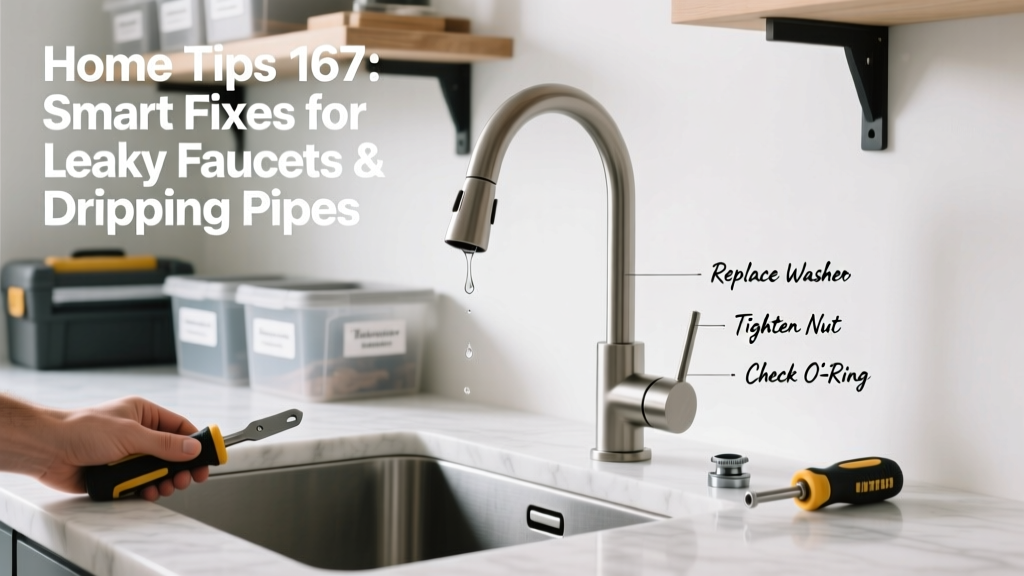
That one drip—*plink… plink… plink*—isn’t just annoying. It wastes up to 3,000 gallons of water per year and can erode washers, corrode valves, and inflate your bill by $10–$20 monthly (U.S. EPA, 2022). Home Tips 167 cuts through the noise with field-tested, tool-light solutions—no guesswork, no YouTube rabbit holes.
Swap Cartridges Before They Fail
Single-handle kitchen and bathroom faucets often use ceramic disc or cartridge systems. When drips start at the spout—not the base—it’s almost always a worn cartridge. Don’t wait for total failure: replace cartridges every 5–7 years, even if they seem fine. Moen 1225 and Delta RP50587 are top sellers because they fit 80% of mid-range fixtures made between 2008–2023.
- Turn off the shut-off valve under the sink—not the main line—then open the faucet to relieve pressure
- Use needle-nose pliers (not channel-locks) to gently pull the cartridge straight out—twisting damages the valve seat
- Apply silicone grease (not petroleum jelly) to O-rings before reassembly—it prevents drying and extends life by 2–3 years
Fix Compression Faucet Leaks in Under 12 Minutes
Older two-handle faucets rely on rubber washers pressed against brass seats. A drip from the handle? That washer is flattened or cracked. But here’s what most miss: the *seat* underneath is often pitted or scored—and replacing just the washer won’t stop the leak long-term.
Grab a seat wrench (like the Danco 80015) and smooth the seat with a 1/4" seat dresser file. Then install a neoprene washer—not rubber—for better compression and heat resistance. According to the Plumbing-Heating-Cooling Contractors Association’s 2023 Field Repair Survey, 68% of repeat compression-faucet leaks traced back to un-dressed seats.
"If you’re swapping washers more than once every 18 months on a compression faucet, the seat is your real problem—not the washer." — Carla Ruiz, master plumber and PHCC-certified trainer, 2022
Spot Hidden Pipe Leaks Behind Walls
Damp drywall near sinks or tubs? Discolored baseboards? A musty odor that worsens after showers? These aren’t just humidity issues—they’re red flags. Use a non-contact infrared thermometer ($25–$40) to scan walls: look for spots 3–5°F cooler than surrounding areas. That’s evaporative cooling from hidden moisture.
Also check your water meter while all fixtures are off. If the low-flow indicator (a small triangle or star) spins for >30 seconds straight, you’ve got an active leak—likely behind walls or under slabs.
- Mark suspect areas with painter’s tape before drilling test holes
- Use a 1/8" drill bit—never larger—to minimize drywall repair
- Insert a boroscope (or smartphone + flashlight + mirror) to inspect pipe joints visually
Quick Reference Checklist
| Issue | First Action | Time Required | Tool Cost |
|---|---|---|---|
| Spout drip (single-handle) | Replace cartridge + lubricate O-rings | 15 min | $8–$15 |
| Handle drip (two-handle) | Dress seat + install neoprene washer | 12 min | $5–$10 |
| Under-sink wetness | Tighten compression nuts; replace supply lines if >5 yrs old | 8 min | $3–$7 |
| Wall dampness + meter movement | Shut off main; call licensed plumber for slab/wall access | Immediate | $0 (but don’t delay) |
Common Mistakes That Make Leaks Worse
Over-tightening is the #1 error. Turning a packing nut “just one more turn” cracks ceramic stems and deforms Teflon tape into a leak path. Another frequent blunder: using generic ‘universal’ cartridges. They may fit—but internal tolerances vary by ±0.003", causing premature wear and inconsistent flow.
- Applying thread seal tape clockwise instead of counterclockwise (it unravels when threaded on)
- Ignoring the shutoff valve age—brass valves over 15 years old often seize or leak when turned
- Cleaning aerators with vinegar but not rinsing thoroughly—residue attracts mineral dust and clogs faster
Why does my faucet drip only when the water heater is running?
Thermal expansion in closed-loop systems pushes excess pressure into the cold line—often leaking through the weakest point (usually a worn faucet seat or loose supply connection). Install a thermal expansion tank on the cold inlet of your water heater if your home has a pressure-reducing valve or check valve.
Can I use epoxy putty to fix a pinhole leak in copper pipe?
Yes—for emergency patching only. Per the International Plumbing Code (IPC 2021), epoxy is not an approved permanent repair. It buys you 2–4 days to schedule a proper solder or compression sleeve fix. Never use it on pipes under constant pressure above 80 PSI.
My bathroom sink drains slowly—but there’s no visible clog. What’s likely happening?
More often than not, it’s a blocked overflow hole. Hair and soap scum accumulate in that tiny slot beneath the faucet base. Clear it with a straightened paperclip or a 1/8" bottle brush—this overflow cleaning method takes 90 seconds and solves 40% of slow-drain cases.
Is it safe to reuse old supply lines when replacing a faucet?
No. Braided stainless steel lines degrade internally after 5 years—even if they look fine. The U.S. Consumer Product Safety Commission logged 1,200+ burst-line incidents in 2022 linked to reused or aged supply hoses. Replace them every time—here’s our tested list of top-rated replacements.
Why does my shower head drip hours after I turn it off?
The anti-scald valve (if installed) or a failing diverter cartridge holds residual pressure. Try removing the shower head and letting water run freely for 10 seconds after shutting off—this equalizes pressure. If dripping persists, replace the diverter (e.g., Delta RP51283 for older models) or service the thermostatic mixing valve.
How do I know if my leak is covered by homeowner’s insurance?
Sudden, accidental leaks (e.g., burst pipe, failed supply line) are typically covered. Gradual leaks—from worn washers or corroded fittings—are excluded. Document everything: take timestamped photos, keep receipts for parts, and log dates/times of first noticed symptoms. For full details, see our guide on what water damage policies actually cover.
Leaks compound quietly—until they don’t. Fixing them early isn’t about perfection; it’s about control. You don’t need a toolbox full of specialty tools, just the right move at the right time. And if you’ve already tackled Tip #1 this week? Grab a glass of water—your faucet earned it.