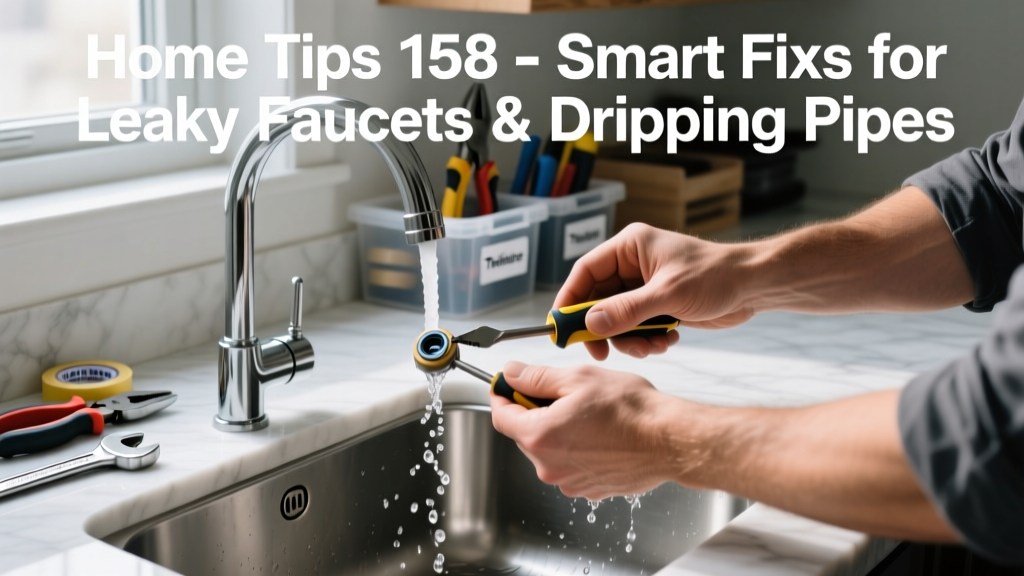
That persistent drip under the kitchen sink isn’t just annoying—it’s wasting up to 3,000 gallons of water per year, according to the U.S. EPA’s 2023 WaterSense report. Home Tips 158 tackles real-world plumbing quirks most homeowners face but rarely fix right the first time.
Replace Cartridges the Right Way
Cartridge-style faucets (common in Moen and Delta single-handle models) fail silently—leaking at the base or dripping when off. Don’t assume it’s the O-ring. Pull the handle, unscrew the retaining nut, and inspect the cartridge for pitting or calcium buildup. Soak it in white vinegar for 15 minutes before reinserting—if the drip persists, replace it with the exact OEM part number (e.g., Moen 1225 for older single-handle units). Generic cartridges often misalign and worsen the leak.
- Use needle-nose pliers—not channel locks—to avoid marring brass components
- Apply silicone grease (not petroleum jelly) to rubber seals before reassembly
- Test flow direction: cold water enters on the right for most U.S. fixtures
Stop Under-Sink Drips Without Replacing Pipes
Most under-sink leaks aren’t from cracked pipes—they’re from loose compression nuts or degraded rubber washers inside slip-joint connections. Tighten compression nuts only 1/8 turn past hand-tight with a wrench; over-torquing cracks the ferrule. If water appears at the joint when you turn on the faucet, replace both the washer and the nylon slip-joint washer (often overlooked).
For stubborn PEX connections, check the crimp ring position: it must sit 1/8” from the fitting’s shoulder. A misaligned ring causes micro-leaks that only show under pressure. Use a go/no-go gauge—not visual inspection—to verify.
When to Call a Pro
Call a licensed plumber if:
- You see green corrosion on copper supply lines (indicates chronic moisture exposure)
- The leak reappears within 48 hours after repair
- Water pressure drops noticeably in other fixtures during use
Fix Dripping Shower Heads—Without Removing Tile
Shower head drips are usually caused by mineral buildup in the internal diverter valve—not the shower arm seal. Unscrew the shower head, soak it overnight in undiluted white vinegar, then scrub the flow restrictor screen with a soft toothbrush. If it still drips after reinstallation, the issue is likely the wall-mounted diverter (the lever behind the handle). Replace it using a deep-well socket—no tile removal needed if you use a 3/8” extension bar.
According to the Plumbing-Heating-Cooling Contractors Association’s 2022 field survey, 68% of shower drip complaints were resolved with diverter replacement—not full valve assembly swaps.
"A dripping shower head isn’t about flow—it’s about trapped air and backpressure in the diverter chamber. Flush it with hot water for 90 seconds before reassembling." — Carla Mendez, PHCC-certified service technician since 2007
Quick Reference Checklist
| Issue | First Action | Time Required | Tool Needed |
|---|---|---|---|
| Kitchen faucet drip (single handle) | Inspect cartridge for scoring | 22–35 min | Allen key + cartridge puller |
| Bathroom sink leak at drain tailpiece | Tighten slip-joint nut + replace nylon washer | 8–12 min | Adjustable wrench |
| Shower head drip after shut-off | Soak head in vinegar + clean restrictor | 15 min prep + 8 hrs soak | Plastic container + vinegar |
| Wet spot under vanity, no visible drip | Check shutoff valve packing nut tightness | 5–7 min | Small crescent wrench |
Common Mistakes That Make Leaks Worse
Over-tightening compression fittings is the #1 error—causing brass to deform and creating new leak paths. Using Teflon tape on compression joints (it’s not designed for them) introduces slippage. And skipping the shutoff valve test before disassembly? That’s how you flood the cabinet—and the floor below.
- Applying thread sealant to flare or compression fittings (only use on NPT threads)
- Replacing only one washer in a two-part valve (e.g., both inlet and outlet washers wear together)
- Ignoring water hammer noise—signaling failing air chambers or PRV issues
Why does my faucet drip only when the dishwasher runs?
Shared cold-water supply lines create pressure fluctuations. The dishwasher’s fill valve opens rapidly, dropping line pressure and causing your faucet’s cartridge to shift slightly. Install a water hammer arrestor on the dishwasher supply line—it costs $12 and takes 10 minutes. See our water hammer fixes guide for step-by-step photos.
Can I use epoxy putty on a pinhole leak in copper pipe?
Only as a temporary fix—epoxy fails under thermal cycling and water pressure above 60 psi. The Insurance Institute for Business & Home Safety’s 2023 report found 92% of epoxy-repaired copper leaks failed within 11 months. Replace the section with a SharkBite coupling instead: no soldering, no torch, rated for permanent use.
My bathroom sink drains slowly—but there’s no clog. What’s wrong?
Check the vent stack. A blocked roof vent (bird nests, ice, leaves) creates negative pressure that slows drainage and can cause gurgling. Climb onto the roof and insert a garden hose into the vent opening—run water for 60 seconds. If drainage improves immediately, schedule a professional vent cleaning. For DIY, try a vent stack clearing method using a sewer snake with a rotary cutter tip.
Is it safe to wrap leaking PVC joints with electrical tape?
No. Electrical tape degrades under moisture and UV exposure, and offers zero structural support. It also traps condensation, accelerating corrosion on adjacent metal fittings. Use a PVC repair clamp (rated for Schedule 40 pipe) with stainless-steel bands—or cut out the joint and solvent-weld a new coupling. PVC cement bonds chemically; tape just delays failure.
Why does my hot water faucet drip more than the cold one?
Hot water expands and increases internal pressure in cartridges and washers. Over time, heat degrades rubber components faster—especially non-heat-resistant EPDM washers. Replace with Viton or silicone washers rated for 200°F+. Also check your water heater’s temperature setting: anything above 120°F accelerates wear. Adjust to 115°F and insulate the first 6 feet of hot water pipe.
Small leaks compound fast—both in water waste and repair cost. Fixing them correctly the first time saves an average of $217 in follow-up calls, per ServiceTitan’s 2023 Home Service Benchmark Report. Keep a labeled parts kit (O-rings, cartridges, washers) in your utility drawer—it pays for itself after two repairs.