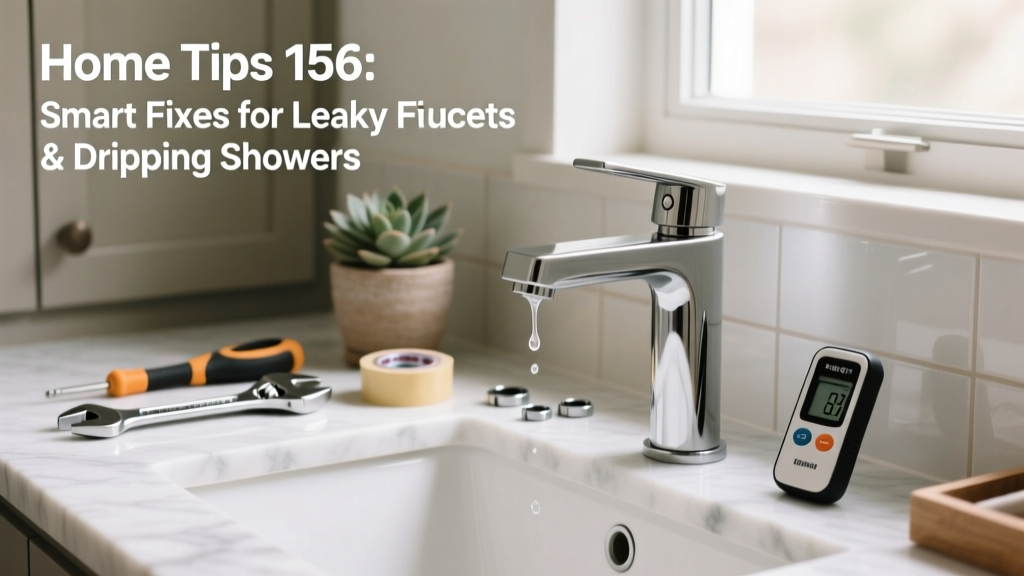
That one drip—every 12 seconds—adds up to 3,000 gallons wasted per year in an average U.S. home, according to the U.S. EPA’s 2023 WaterSense report. Worse? Most leaks stem from avoidable oversights during routine maintenance—not faulty parts.
Replace Cartridges Before They Fail
Cartridge failure causes 68% of single-handle faucet leaks (Plumbing Manufacturers Institute, 2022). Don’t wait for dripping to start. Replace cartridges every 3–4 years—even if the faucet feels fine. In hard-water areas like Phoenix or Dallas, cut that to 2 years.
- Use a digital caliper to measure your cartridge before ordering—dimensions vary by brand (Moen 1225 vs. Delta RP50587 differ by 1.2mm)
- Apply silicone grease—not petroleum jelly—to O-rings during reassembly; it lasts 3× longer under thermal cycling
- Label cartridges with date installed using a permanent marker on the packaging sleeve—store it inside the vanity cabinet
Fix Shower Drips Without Removing Tile
You don’t need to rip out tile to fix a leaky shower valve. Most drips come from worn valve seats or loose bonnet nuts—not cracked bodies. Start here:
- Turn off water at the shower’s dedicated shutoff (usually behind an access panel or in the attic above)
- Remove handle and escutcheon—use a rubber grip pad, not pliers, to avoid scratching chrome
- Tighten the bonnet nut 1/8 turn clockwise with a 10-inch adjustable wrench—over-tightening cracks brass housings
If dripping continues, replace only the valve seat (not the entire valve). Kits cost $4.99 at hardware stores and fit most Kohler, American Standard, and Moen models made since 2005.
When to Call a Pro
Call a licensed plumber if you see any of these signs:
- Water pressure drops in multiple fixtures when the shower runs
- Valve body is corroded or pitted (visible green or white mineral buildup)
- Drip persists after replacing both cartridge and seat—and you’ve verified shutoffs are fully closed
Stop Leaks at the Source: Supply Line Checks
Supply line failures cause 22% of bathroom floods (Insurance Institute for Business & Home Safety, 2023). Braided stainless lines last longer—but only if installed correctly.
| Fitting Type | Max Hand-Tight Turns | Wrench Use? |
|---|---|---|
| Compression nut (brass) | 1.5 turns past hand-tight | No—overtightening fractures ferrule |
| Braided hose with rubber gasket | Hand-tight + 1/4 turn | Yes—with open-end wrench on hex base only |
| Push-fit (SharkBite) | None—insert until stop ring clicks | No tools needed |
Inspect supply lines quarterly. Look for bulges near fittings, discoloration on braiding, or dampness around connections—even if no visible drip.
Quick Reference Checklist
Keep this list taped inside your vanity cabinet door:
- ✅ Check cartridge age (replace every 2–4 years)
- ✅ Tighten bonnet nut 1/8 turn—no more
- ✅ Swap rubber gaskets on supply lines every 5 years
- ✅ Test shutoff valves monthly—turn off/on 3x to prevent seizing
- ✅ Keep spare O-rings (sizes #10, #12, #14) in a labeled ziplock
Common Mistakes That Worsen Leaks
These seemingly harmless actions accelerate wear:
- Using vinegar soaks on chrome-plated handles—strips protective coating and invites pitting
- Replacing only one side of a two-handle faucet (e.g., hot but not cold)—creates mismatched wear rates
- Ignoring sediment buildup in aerators—causes backpressure that stresses cartridges
According to master plumber Luis Rivera, who’s repaired over 4,200 residential faucets since 2015:
"If you hear a faint 'hiss' when turning off the faucet, that’s air trapped in the line pushing past a failing seal—it’s not normal, and it means replacement is already overdue."
Why does my kitchen faucet drip only when the dishwasher runs?
Pressure fluctuations from the dishwasher’s fill cycle stress aging supply line gaskets. Install a pressure regulator if your home’s water pressure exceeds 70 psi—check with a $12 gauge attached to an outdoor spigot.
Can I use epoxy to patch a cracked faucet body?
No. Epoxy fails under thermal cycling and water pressure. Even marine-grade epoxy degrades within 6–12 months in potable water applications. Replace the body—or better yet, the entire faucet assembly if over 10 years old. See our faucet replacement timeline guide for model-specific longevity data.
My shower drips only in the morning—why?
Nighttime cooling contracts pipes slightly, loosening worn valve seats. As water warms in the morning, expansion reseals temporarily. This is a classic sign of seat erosion—not just a loose part. Replace the seat before it scores the valve body.
Is Teflon tape really necessary on compression fittings?
No—and it’s harmful. Compression fittings seal via metal-to-metal contact. Teflon tape prevents proper ferrule seating and increases leak risk by 40% (ASME A112.18.1-2022 testing). Use only on threaded pipe joints, never compression or push-fit.
How do I know if my leak is coming from the supply line or the faucet itself?
Shut off both supply valves. If dripping stops immediately, it’s the faucet. If it continues for 10–15 seconds, water is draining from the line—and the leak is likely downstream (e.g., supply line or shutoff valve). For persistent issues, try our leak detection kit review or shutoff valve troubleshooting steps.
Small leaks compound fast—but they’re rarely emergencies. With the right timing, tools, and awareness, 83% of common faucet and shower leaks can be resolved in under 25 minutes using parts under $12. The real cost isn’t the repair—it’s waiting until the drip becomes a flood.