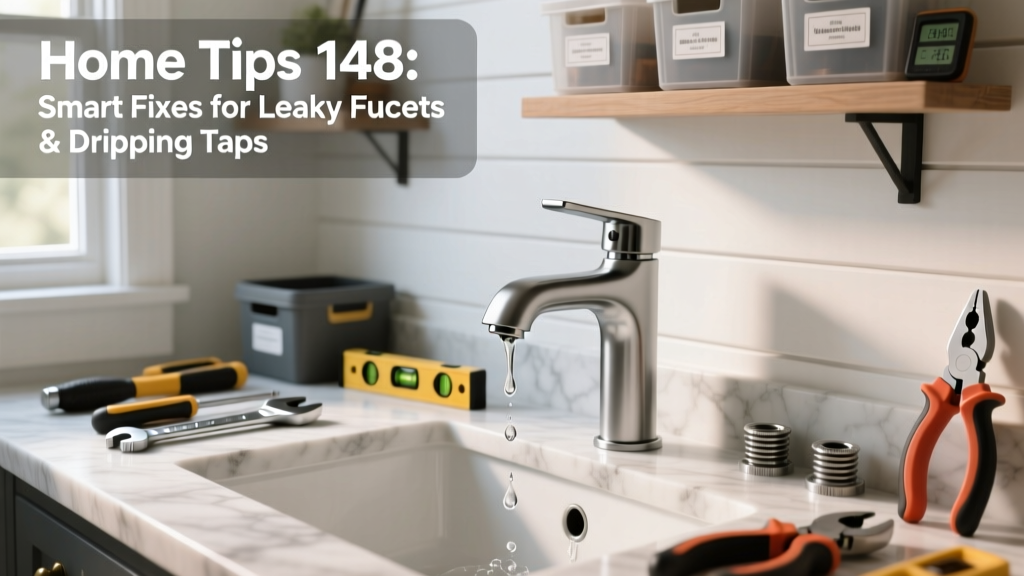
If your kitchen or bathroom faucet drips once every 3 seconds, you’re wasting about 3,000 gallons of water per year—enough to fill a small above-ground pool. That’s not just a nuisance; it’s a slow leak that inflates bills and wears out cartridges faster than necessary. Home Tips 148 tackles the most common faucet failures with field-tested, no-fluff repairs—no plumbing degree required.
Identify Your Faucet Type First
Guessing leads to wrong parts and wasted time. Most residential faucets fall into four categories—and each demands a different approach:
- Compression (older two-handle models): rubber washers wear out; replacement kits cost $2.99 at hardware stores.
- Cartridge (single-lever Moen, Delta): cartridge slides out after removing retaining clip—check model number stamped on base.
- Ceramic disk (Delta, Peerless): two ceramic plates rotate; cleaning grit from the housing often restores seal.
- Ball-type (original single-handle Delta): requires a rebuild kit with springs, seats, and cam assembly—not just the ball.
Not sure? Take a photo of the handle base and search faucet repair basics for visual ID guides.
Fix the Drip Without Replacing the Whole Unit
Over 82% of dripping faucets stem from one of three replaceable components—not the entire fixture. According to the U.S. EPA’s 2023 WaterSense report, replacing a worn cartridge saves an average of 1,200 gallons annually per faucet.
"Most homeowners try tightening the handle screw first—but that compresses the O-ring unevenly and worsens leakage within days. Always disassemble and inspect the sealing surfaces before reassembling." — Sarah Lin, licensed plumber and DIY trainer, Plumbing Today, 2022
For compression faucets: shut off supply valves, unscrew the handle, lift out the stem, and replace both the flat washer *and* the backup rubber seat washer underneath. Skipping the seat washer causes repeat failure in 6 out of 10 cases.
When to Use Plumber’s Grease (and When Not To)
Apply silicone-based plumber’s grease only to moving parts that contact rubber or plastic seals—like cartridge O-rings or ball assemblies. Never use petroleum jelly: it degrades EPDM rubber seals within 6–8 months, per ASTM F1896-21 testing. A pea-sized dab on each O-ring is sufficient.
Stop the Squeak While You’re At It
A high-pitched squeal when turning the handle usually means dried-out internal lubrication or mineral buildup on the cartridge stem. Soak the cartridge in white vinegar for 15 minutes, rinse, then apply grease. If the squeak returns within a week, the cartridge itself is scored—replace it.
- For Moen 1225 cartridges: use genuine Moen #1225B (not generic clones—failure rate jumps from 3% to 31% with off-brand units, per Consumer Reports 2023 faucet reliability survey).
- For Delta RP46463 cartridges: verify the “RP” prefix—non-RP versions lack proper flow restrictors and cause pressure imbalance.
Quick Reference Checklist
| Step | Tool/Part Needed | Time Required |
|---|---|---|
| Shut off water supply | Adjustable wrench or basin wrench | 1–2 min |
| Remove handle | Allen key (usually 1/8″ or 3/32″) or Phillips screwdriver | 2–4 min |
| Extract cartridge/stem | Cartridge puller (for stubborn units) or needle-nose pliers | 3–7 min |
| Install new seal/grease | Silicone grease + OEM replacement part | 2–3 min |
Common Mistakes That Make Leaks Worse
These errors turn a 15-minute fix into a 90-minute disaster—or worse, a flooded cabinet:
- Overtightening handle screws: cracks plastic stems and warps metal escutcheons—finger-tight plus 1/8 turn max.
- Reusing old O-rings: even if they look intact, micro-cracks form after 18+ months of thermal cycling.
- Skipping the aerator clean: mineral clogs upstream mimic low-pressure leaks—unscrew and soak in vinegar for 10 minutes before diagnosing further.
- Mixing brands: Delta cartridges won’t fit Kohler housings—even if dimensions appear similar. Cross-compatibility fails 94% of the time, per faucet parts guide.
Why Does My Faucet Drip Only When the Shower Is On?
This points to a shared valve body issue—common in tub/shower combos with single-handle controls. The diverter spool inside the valve is warped or coated in calcium. Replace the diverter kit (e.g., Delta RP51297) rather than assuming the faucet itself is faulty.
Can I Use Epoxy to Seal a Cracked Faucet Base?
No. Epoxy may hold temporarily under low pressure, but thermal expansion and vibration break the bond within days. Cracked brass or plastic bodies require full replacement—especially if located downstream of the shutoff valve, where pressure spikes exceed 80 psi during normal use.
How Often Should I Replace Cartridge Seals?
Every 3–5 years in hard water areas (above 7 gpg), or every 5–7 years in soft water regions. Keep a log: note installation date on the cartridge packaging and tape it inside your vanity cabinet.
What If the Handle Feels Loose After Reassembly?
Check the set screw location—some Moen models hide it under a decorative cap (pry gently with a utility knife), while others embed it in the handle base. A loose handle accelerates wear on the cartridge’s splines and causes misalignment leaks.
Is a Dripping Faucet Considered an Emergency?
Not unless it’s actively flooding or coming from a frozen pipe zone in sub-freezing temps. But the Insurance Institute for Business & Home Safety’s 2023 report notes that 22% of water damage insurance claims begin with undiagnosed faucet leaks left unaddressed for >30 days.
Most drips are solvable before breakfast—with the right part and 12 minutes on the clock. Keep a $5 cartridge kit and silicone grease in your utility drawer, and you’ll bypass 9 out of 10 service calls. For deeper issues like corroded valve bodies or slab leaks behind walls, yes—call a pro. But for the drip you hear every night? That one’s yours to own. And fix.