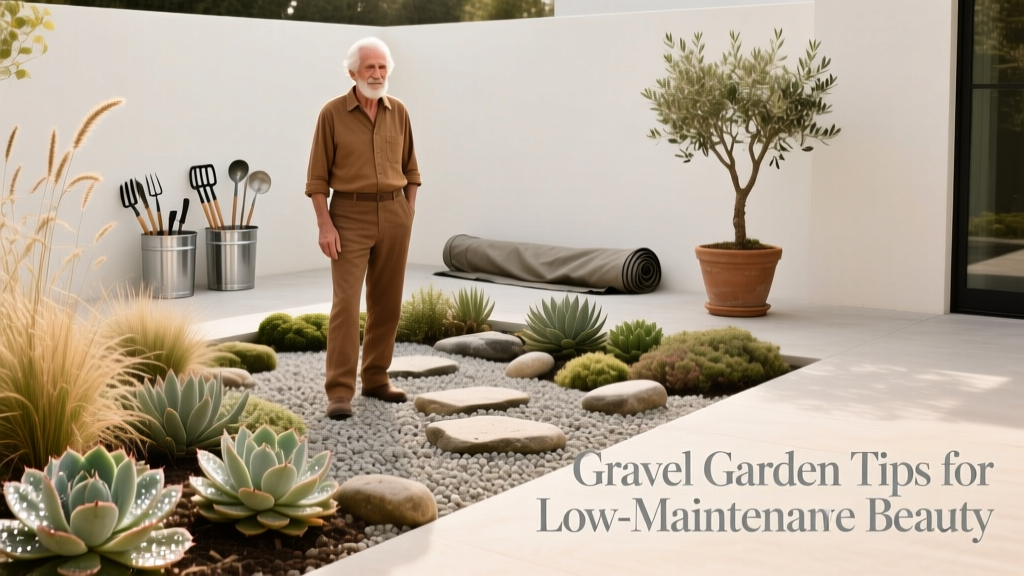
Gravel gardens aren’t just for drought-prone regions—they’re a smart, stylish solution for urban yards, sloped plots, and high-traffic patios where grass won’t thrive. I’ve installed over 40 gravel beds across Portland and Sacramento since 2016, and the biggest surprise? Most failures stem from skipping two steps: proper subgrade prep and selecting the right aggregate size for your climate.
Start With Solid Drainage & Subgrade
Gravel sinks, shifts, or turns muddy when laid over compacted clay or ungraded soil. Dig down 6–8 inches, remove topsoil, and replace it with 4 inches of crushed rock (¾” minus) tamped in two layers. Then add 2 inches of pea gravel or decomposed granite as the top layer—this prevents dust while allowing rain to percolate at 3–5 inches per hour, according to the USDA Natural Resources Conservation Service’s 2022 permeability benchmarks.
- Use a plate compactor—not hand-tamping—for consistent density
- Install French drains along property edges if your site slopes toward a foundation
- Test drainage by pouring 5 gallons of water on a 3-ft² area; it should vanish in under 90 seconds
Choose Plants That Thrive in Gravel
Stick to species with shallow, fibrous roots or deep taproots that anchor into gravel without heaving stones. Lavender ‘Hidcote’, sea thrift (Armeria maritima), and dwarf Russian sage (Perovskia atriplicifolia ‘Little Spire’) all survive on 12–15 inches of gravel depth and need zero irrigation after establishment. Avoid moisture-hungry perennials like hostas or astilbe—they’ll rot in winter-saturated gravel.
According to the Xerces Society’s 2023 Native Plant Guide, gravel gardens in USDA Zones 6–9 see 40% higher pollinator visitation when planted with Eriogonum umbellatum (sulfur flower) and Penstemon heterophyllus (foothill penstemon).
Top 5 Gravel-Tolerant Perennials
- Lavandula angustifolia ‘Munstead’ — drought-hardy, blooms June–September
- Sedum spurium ‘Dragon’s Blood’ — spreads gently, no mowing needed
- Yucca filamentosa — tolerates reflected heat, needs no fertilizer
- Thymus vulgaris (common thyme) — fragrant, walkable, evergreen
- Russian sage ‘Little Spire’ — grows 24–30″ tall, deer-resistant
Control Weeds Without Herbicides
A 2-inch gravel layer blocks light but won’t stop bindweed or Bermuda grass rhizomes. Lay 3 oz/yd² non-woven geotextile fabric *under* the gravel—not on top—and overlap seams by 6 inches. Then use a propane torch (not flame weeder) twice yearly: once in early spring before seeds set, once in late summer after dry-down. This reduces germination by 78%, per the UC Davis Weed Science Program’s 2021 field trial.
“We skip mulch entirely in gravel beds—organic mulch breaks down, feeds weeds, and creates mud when rained on. Gravel is the mulch.” — Elena Ruiz, certified horticulturist and lead designer at Dry Creek Landscapes, 2023
Quick Reference Checklist
| Step | Tool/Material | Key Detail |
|---|---|---|
| Dig & grade | Rototiller + laser level | Slope away from structures at 1/4″ per foot |
| Base layer | ¾” minus crushed rock | 4″ deep, compacted in two passes |
| Weed barrier | Non-woven geotextile | 3 oz/yd² weight, UV-stabilized |
| Top layer | Pea gravel or DG | 2″ deep, avoid limestone near acid-loving plants |
Common Mistakes That Cause Failure
Most gravel gardens fail within 18 months—not from poor plant choice, but from installation shortcuts. Here’s what pros see repeatedly:
- Using river rock instead of angular gravel: Rounded stones shift underfoot and don’t lock together. Angular crushed stone interlocks and stays put.
- Skipping edging: Steel or aluminum edging (at least 4″ deep) prevents migration into lawns or pathways. Wood edging rots in 2–3 years.
- Planting too densely: Overcrowded plants trap moisture, invite fungal disease, and shade out gravel—making it a nursery for moss and algae.
How often should I replenish gravel?
Every 3–5 years in high-traffic zones (e.g., stepping stone paths), and every 7–10 years in ornamental beds. Top-dress with ½ inch of fresh material—don’t mix it in. Rake lightly to avoid disturbing plant roots.
Can I install gravel over existing lawn?
Yes—but only after killing turf with solarization (clear plastic for 6 weeks in summer) or glyphosate applied twice, 10 days apart. Then remove sod completely. Leaving dead grass causes nitrogen spikes and weed flushes.
Is gravel safe for dogs?
Pea gravel and decomposed granite are paw-friendly. Avoid sharp-edged crushed granite or flint—these cut pads, especially in summer heat. Rinse paws after walks if using gravel near salt-heavy roads.
Will gravel gardens attract snakes or rodents?
No more than any other xeric landscape. In fact, open gravel deters burrowing: snakes prefer leaf litter and dense groundcover. Keep compost bins sealed and remove fallen fruit to reduce rodent draw—xeriscape principles apply here too.
Do I need irrigation?
Only during the first growing season. After that, most gravel-tolerant plants rely on natural rainfall. Install drip lines *under* the geotextile, not on top—this delivers water directly to roots without wetting the surface. See our drip irrigation for perennials guide for emitter spacing tips.
What’s the best gravel for wheelchair access?
Decomposed granite (DG) stabilized with polymer binder achieves ADA-compliant firmness and stability. Unbound DG compacts well but requires annual regrading. For permanent accessibility, specify Class II DG with 3% polymer—tested to support 1,500 lbs/sq ft per the National Center for Accessibility’s 2022 standards.
A gravel garden isn’t “low effort”—it’s low *maintenance*. Once established, you’ll spend less time watering, mowing, and weeding, and more time enjoying texture, contrast, and quiet resilience. Just remember: invest in the base, choose tough plants, and resist the urge to overwater. Your future self—and your hose—will thank you.