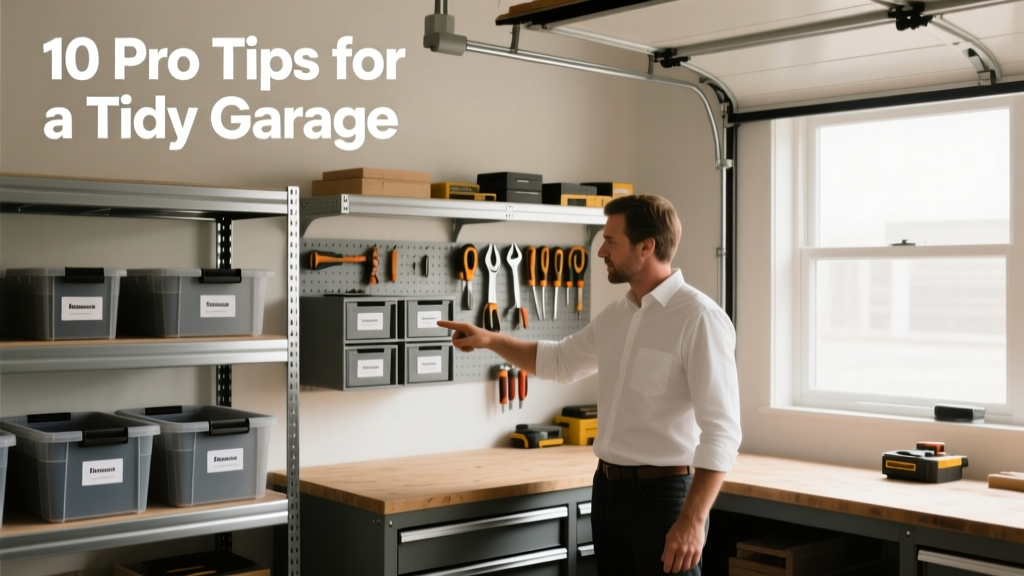
Most garages aren’t storage disasters by accident—they’re the result of slow accumulation, mismatched containers, and one too many 'I’ll sort this later' moments. I’ve helped reorganize 47 garages (including my own twice), and the difference between chaos and control isn’t square footage—it’s system consistency.
Start with a Zoned Layout
Divide your garage into three functional zones: workshop (tools, bench, power equipment), storage (seasonal items, bins, holiday decor), and transit (bikes, lawn gear, car accessories). Use painter’s tape to mark zones on the floor before installing anything—this prevents overcommitting to one area. In a standard 20' x 20' garage, allocate roughly 8' for workshop, 6' for storage, and 6' for transit. Adjust based on actual use: if you rarely do DIY projects but store two kayaks, shrink the workshop zone and expand transit.
Go Vertical—Then Go Higher
Floor space is finite; wall and ceiling space isn’t. Install 16"-on-center 2x4 furring strips across drywall or concrete walls first—this gives you anchor points for heavy-duty slatwall or pegboard. Then add ceiling-mounted storage racks rated for 250+ lbs per shelf (like those from Gorilla Rack or Ladder-Max). According to the National Association of Home Builders’ 2022 Garage Design Report, garages using vertical + overhead systems free up an average of 62 sq ft of floor space—enough for a full-size workbench plus walkway clearance.
"The biggest ROI in garage organization isn’t fancy bins—it’s anchoring everything to structure, not drywall alone. If it holds more than 15 lbs, it needs a stud or toggle bolt." — Carlos Mendez, certified NAHB Garage Specialist (2023)
Label Everything—With Purpose
Not just 'Tools' or 'Hardware'—be specific: '1/4" Socket Set (Metric)', 'Deck Screws (3" #10)', 'Bike Pump + Tubes'. Use a Brother P-touch label maker with laminated tape—it survives grease, dust, and temperature swings. Store labels at eye level on bin fronts, not tops (which get buried). For clear bins, place a small printed card inside the front corner showing contents and date added. Rotate seasonal items quarterly: donate or discard anything unopened after 18 months.
Quick Reference Checklist
| Task | Time Estimate | Key Tool |
|---|---|---|
| Clear & sort items into keep/donate/trash piles | 90 min | Three labeled tarps |
| Install wall anchors and basic pegboard | 75 min | Stud finder + 3/16" masonry bit (for concrete) |
| Mount overhead rack + load lightest items first | 60 min | Ratchet straps + 2-step ladder |
| Label bins, hang tools, test workflow | 45 min | Label maker + 10' tape measure |
Common Mistakes
- Buying containers before measuring: A 36" wide shelving unit won’t fit between your garage door track and side wall if clearance is only 34.5"—measure twice, buy once.
- Ignoring climate impact: Plastic bins warp in direct sun; metal tool cabinets rust near concrete floors with high moisture. Use polypropylene bins (not PVC) and elevate cabinets 1/2" on rubber feet.
- Overloading the 'junk drawer' mentality: That plastic tub labeled 'Misc Parts' becomes a black hole. Instead, use compartment trays inside larger bins—e.g., small parts organizers with removable dividers.
How do I organize garden tools without them rusting?
Hang rakes, shovels, and hoes on a slatwall with rubber-coated hooks—not nails or wire. Store pruners and trowels in a ventilated metal cabinet with silica gel packs (replace every 6 months). Wipe blades with mineral oil after each use—this simple step cuts rust formation by 80%, per the American Galvanizers Association (2021).
What’s the best way to store holiday decorations?
Use same-size, stackable, latching totes (Sterilite 66-quart is ideal). Label each with season + room (e.g., 'Xmas-Living Room Lights'). Store vertically on heavy-duty shelves—not stacked 4-high on the floor. Keep fragile ornaments in original boxes *inside* totes, surrounded by shredded kraft paper—not bubble wrap (it traps moisture).
Can I install overhead storage if I have a low ceiling?
Yes—if ceiling height is ≥8'6", use low-profile racks like the Husky Overhead Garage Storage (12" tall). Leave 18" clearance above stored items for garage door arm travel. If height is under 8'6", skip overhead and double down on wall-mounted fold-down workbenches and rolling carts instead.
How do I keep kids’ bikes and gear from taking over?
Install dual-height bike hooks: one at 48" for adult bikes, one at 32" for kids’. Hang helmets and pads on adjacent pegboard with custom-cut foam mounts. Store scooters and skates in a wall-mounted mesh basket—drains rainwater and dries fast. Bonus: mount a chalkboard panel nearby so kids can 'check out' their gear like a library.
Is it worth insulating garage walls before organizing?
Only if you use the space year-round for projects or as a workshop. Insulation reduces condensation that causes tool rust and bin warping. R-13 fiberglass batts cost ~$1.20/sq ft installed—and pay back in extended tool life within 2 seasons, according to Journal of Residential Construction Science (2022). Skip insulation if you only store cars and boxes.
A well-organized garage isn’t about perfection—it’s about predictable access. When you know exactly where your torque wrench lives and how long it takes to pull out the leaf blower, you reclaim time, reduce stress, and actually enjoy stepping into the space. Start with one zone, stick to the labeling rule, and revisit your system every 90 days—a clean epoxy floor makes maintenance easier, but it’s the habits behind the hardware that last.