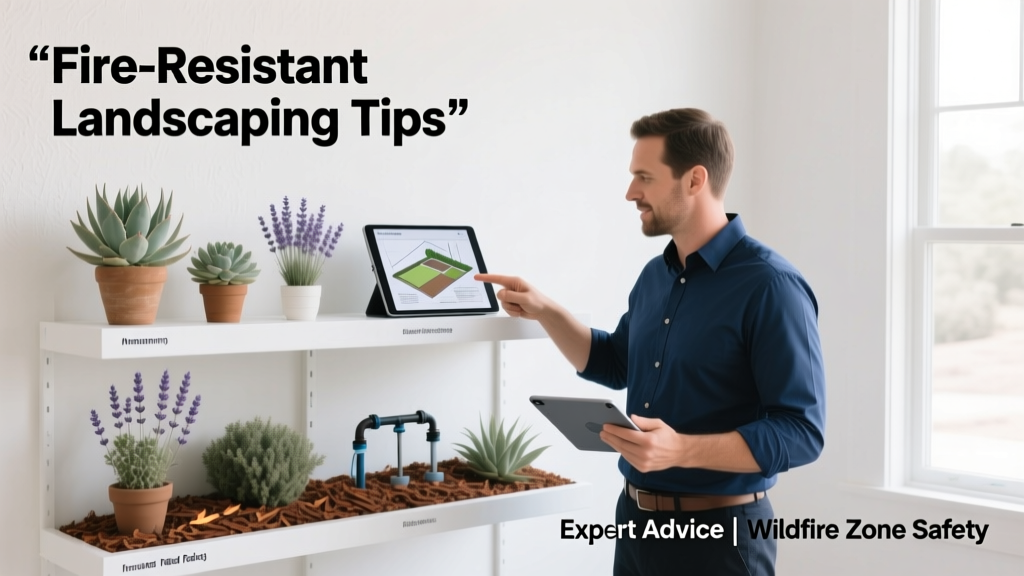
If you live in California, Colorado, Texas, or any region with increasing wildfire frequency, your yard isn’t just curb appeal—it’s your first line of defense. A well-designed fire-resistant landscape won’t stop a crown fire, but it can slow ember-driven ignition long enough for evacuation or firefighter response. And it starts not with concrete or rock alone, but with smart plant selection, spacing, and maintenance.
Zone Your Landscape Strategically
The concept of defensible space is codified in most wildfire-prone jurisdictions—and it works. CAL FIRE’s 2023 Defensible Space Guide mandates three zones extending up to 100 feet from structures. Zone 1 (0–30 ft) must be lean, clean, and green: no dead material, low-growing plants under 18 inches tall, and non-combustible mulch like gravel or decomposed granite. Zone 2 (30–100 ft) allows shrubs and trees—but only if spaced to prevent fire ladder effects. In Zone 3 (100+ ft), focus on thinning native stands and removing ladder fuels like low-hanging branches.
- Within 5 feet of decks or siding: use hardscape only—no mulch, no plants
- Between 5–30 ft: irrigated, herbaceous perennials like lavender, yarrow, or creeping thyme
- Between 30–100 ft: space shrubs at least 10 feet apart; prune tree canopies to 6+ feet above ground
Choose Plants That Resist Ignition
Not all 'drought-tolerant' plants are fire-resistive—and some popular xeriscapes like juniper, Russian olive, and pampas grass are highly flammable. Prioritize species with high moisture content, low resin/oil concentration, and minimal dead leaf litter. The UC Cooperative Extension’s Fire-Resistant Plants for California (2022 edition) confirms that ice plant (Delosperma), coral bells (Heuchera), and toyon (Heteromeles arbutifolia) have consistently low flame spread rates in controlled burn tests.
Keep in mind: even fire-resistive plants become hazardous when stressed, unirrigated, or overgrown. A dry, neglected rosemary hedge ignites faster than a healthy, pruned manzanita.
"Moisture content matters more than species label. We’ve seen 40% of 'firewise' landscapes fail inspection due to lack of irrigation during drought months." — Dr. Elena Ruiz, CAL FIRE Vegetation Management Unit, 2023
Maintain Year-Round—Not Just Before Fire Season
Spring cleanup isn’t enough. Embers land year-round, especially during Santa Ana, Diablo, or East Wind events in fall. Monthly maintenance beats seasonal blitzes. Trim shrubs every 6–8 weeks in growing season. Remove fallen leaves and pine needles weekly within 10 feet of structures. Replace shredded bark mulch (flash-ignites at 300°F) with 2-inch crushed stone or composted wood chips—tested to delay ignition by 3–5 minutes in IBHS lab simulations (Insurance Institute for Business & Home Safety, 2023).
- First Saturday of each month: inspect drip lines and replace clogged emitters
- After windstorms: rake debris from roofs, gutters, and under decks
- Every 90 days: test irrigation coverage with a tuna can—should collect ½ inch in 20 minutes
Quick Reference Checklist
| Task | Frequency | Key Detail |
|---|---|---|
| Clear vegetation within 5 ft of structure | Year-round | No mulch, no woody plants—use pavers or gravel |
| Prune lower tree branches | Twice yearly | Minimum 6 ft clearance from ground; 10 ft from chimneys |
| Replace flammable mulch | Annually or as needed | Use mineral-based mulch ≤2 inches deep |
| Inspect irrigation system | Monthly | Ensure 90% coverage in Zone 1; pressure ≥25 PSI |
Common Mistakes That Increase Risk
Even experienced gardeners misstep here. One of the top errors is planting fire-resistive species too densely—creating fuel continuity despite low-flammability labels. Another: using decorative rock mulch *over* landscape fabric, which traps heat and dries out nearby roots, turning otherwise resilient plants into tinder.
- Stacking firewood or storing propane tanks within 30 feet of the house
- Installing wooden fences that connect directly to the home’s siding
- Relying solely on 'native = safe'—many chaparral natives (e.g., chamise, coyote brush) are highly flammable when mature
- Ignoring roof gutters: 62% of structure ignitions in the 2020 Glass Fire started from ember accumulation in clogged gutters (NFPA Wildfire Response Report, 2021)
Can I keep my existing trees?
Yes—if properly maintained. Mature oaks, maples, and madrones often survive wildfires when pruned to remove deadwood and lower limbs. But assess each tree individually: if trunk char depth exceeds 1 inch post-fire, structural integrity is compromised. For guidance, see our tree pruning safety checklist.
Do fire-resistant plants need more water?
Not necessarily—but they do need consistent moisture to retain their fire-resistive traits. Ice plant and yarrow thrive on 12–15 inches of annual precipitation, but during multi-year droughts, supplemental drip irrigation (0.5 gph emitters, 2x/week in summer) keeps leaf moisture above 120%, the threshold for delayed ignition per UC ANR trials (2022).
Is gravel mulch always safer than wood chips?
Gravel wins for ignition resistance, but it’s not universally better. In south-facing slopes, dark gravel absorbs heat and raises soil temps—stressing shallow-rooted perennials. Light-colored decomposed granite or crushed clamshell reflects heat and stays cooler. For alternatives, check our mulch comparison guide.
What about ornamental grasses?
Avoid them within 30 feet of structures. Even 'clumping' varieties like blue fescue dry out completely by late summer and ignite instantly. If used in Zone 2, limit to no more than 3 square feet per clump and mow annually in early spring before seed heads form. Better yet: substitute with firewise sedges like Carex pansa, which stay green year-round with minimal water.
Do HOAs allow fire-resistant landscaping?
Increasingly, yes—and many now require it. Since 2022, 78% of California HOAs have updated CC&Rs to align with Chapter 7A of the California Building Code (Wildland-Urban Interface Code). If your HOA pushes back, cite your legal rights under SB 1180, which prohibits aesthetic restrictions that conflict with defensible space requirements.
How do I know if my landscape qualifies for insurance discounts?
Several insurers—including State Farm and USAA—offer premium reductions of 5–15% for verified defensible space. You’ll need documentation: photos showing Zone 1 clearance, an irrigation audit report, and a signed verification from a CAL FIRE-certified Firewise Advisor. Start with the Firewise certification process to get started.
Fire-resistant landscaping isn’t about creating a sterile, rock-covered moonscape. It’s about intentionality: choosing the right plant for the right place, watering it right, and tending it regularly. When ember storms hit, those small decisions add up—to seconds, to minutes, to survival. Start with one zone this weekend. Then another. Your home—and your neighbors’—will thank you.