If you’ve ever stood in your garage holding a screwdriver that stripped the third Phillips head in a row—or watched a $40 faucet repair turn into a $320 plumber call—you know: tool gaps don’t just slow you down, they cost real money. I’ve patched drywall at 2 a.m., replaced a sump pump during a storm, and fixed a jammed garbage disposal with duct tape and sheer willpower—all because the right tools were within arm’s reach. This isn’t about building a workshop; it’s about owning what keeps your house functional, safe, and insurable.
Start With the Core Six—No Exceptions
Forget ‘nice-to-haves.’ These six tools solve 70% of urgent homeowner problems—and they’re all under $120 total. Skip any one, and you’ll overpay or underperform on routine tasks.
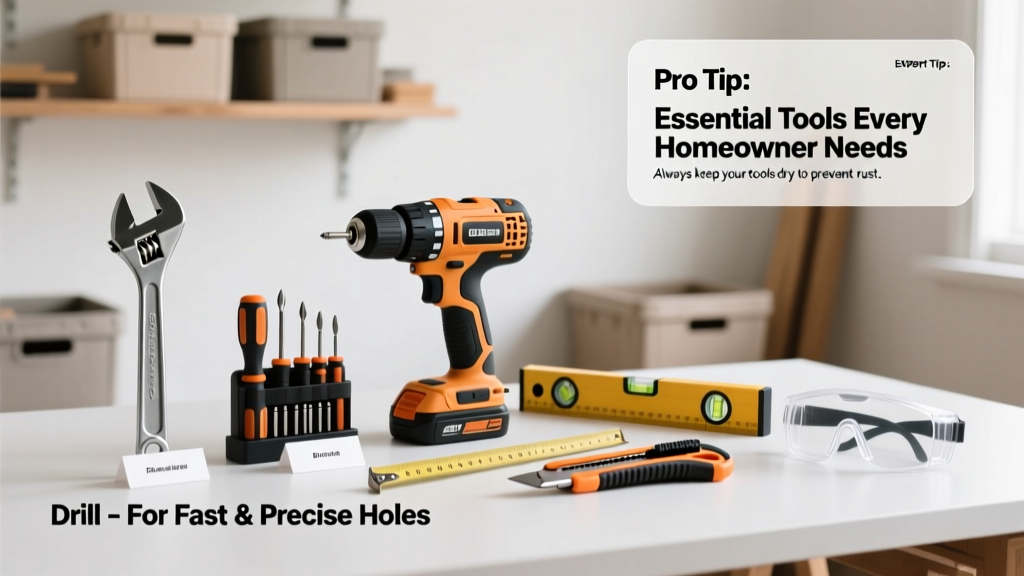
- Adjustable wrench (10-inch): Tightens nuts and bolts from ¼” to 1⅛”. Crucial for sink shutoffs, radiator valves, and hose bibs. Avoid cheap stamped-steel versions—they slip and mar threads.
- Digital multimeter: Tests outlets, checks GFCI function, confirms breaker trips, and verifies thermostat wiring. The Klein Tools MM400 (2023 model) has auto-ranging and CAT III safety rating—non-negotiable for anything beyond battery-powered devices.
- Stud finder with AC detection: Not the $12 magnet type. Use the Franklin Sensors ProSensor 710 (2022), which detects live wires *and* wood/plastic studs behind drywall. According to the National Fire Protection Association’s Electrical Safety Foundation Report (2023), 32% of DIY electrical incidents stem from drilling into live cables.
- Speed square (7-inch): Cuts layout time by 60% for shelves, tile spacers, and fence post alignment. Its lip locks onto edges, and the 45°/90° markings eliminate guesswork.
- Utility knife with replaceable blades: Scores drywall, trims caulk, slices carpet padding, and opens stubborn packaging. Keep three blades stashed—in the garage, kitchen drawer, and basement workbench.
- 12-foot fiberglass ladder: Rated for 300 lbs, Type IA duty. Aluminum conducts electricity; wood rots. Fiberglass is the only safe choice near gutters, rooflines, or exterior outlets.
Upgrade Smart—Not Expensive
Once the core six are dialed in, add these four based on your home’s age and layout. Don’t buy them all—just pick two that match your highest-risk zones.
- Leak detector (moisture meter): The General Tools MMD4XP reads moisture content in wood, drywall, and subflooring down to 0.1%. Catch hidden rot behind baseboards before mold spreads. U.S. EPA estimates that undetected leaks cause 14% of household water waste annually.
- Rotary tool (Dremel 4300-5/40): Grinds rust off hinges, cleans grout lines, cuts small holes for cable passes, and polishes brass fixtures. Skip kits with 50 attachments—get the bare tool + cutoff wheels, sanding drums, and grinding stones.
- Cordless drill/driver (18V): Get one with brushless motor and two batteries. DeWalt DCDD270M2 (2023) delivers 530 in-lbs torque—enough for deck screws, cabinet mounting, and masonry anchors up to 3/16" in brick.
- Insulation blower (rental): If your attic has less than R-38 (typical for homes built before 2006), rent a machine like the Greenfiber ProBlaster for $45/day. You’ll recoup cost in one heating season—Energy Star says proper attic insulation reduces HVAC load by 15%.
Quick Reference: What to Buy First
Use this table to prioritize purchases based on your home’s immediate needs. Check off items as you acquire them—and note where you store each tool (e.g., “speed square: kitchen junk drawer”).
| Home Age | Top 3 Priority Tools | Why It Matters |
|---|---|---|
| Pre-1980 | Stud finder w/ AC detection, moisture meter, adjustable wrench | Aged wiring, hidden rot, and corroded plumbing demand precision detection—not guesswork. |
| 1980–2005 | Digital multimeter, cordless drill, speed square | Outdated outlets, DIY-friendly framing, and frequent shelving/cabinet projects. |
| 2006–present | Leak detector, rotary tool, insulation blower (rental) | Tighter envelopes mean smaller leaks go unnoticed longer; modern finishes need fine-tuning tools. |
Common Mistakes That Cost More Than Tools
Most tool-related failures aren’t about missing gear—they’re about misusing what you have.
- Using pliers instead of a wrench on hex nuts: Pliers round off corners. That $2.99 nut becomes a $27 service call when it won’t budge.
- Storing batteries in the drill: Lithium-ion degrades faster at full charge and room temperature. Remove them after use and store at 40% charge in a cool, dry drawer.
- Ignoring calibration dates: Digital multimeters drift. Test yours monthly against a known 1.5V AA battery—if it reads outside ±0.05V, recalibrate or replace.
- Buying ‘all-in-one’ kits: The screwdriver bits are soft steel, the tape measure bends at 6 feet, and the level bubble is off-center. Invest in single-purpose tools from reputable brands.
How do I know if my stud finder is accurate?
Test it on a wall with visible outlets or switches—those are always mounted to studs. Then scan 16” left and right. If it beeps consistently at 16” intervals, it’s calibrated. If not, reset per manufacturer instructions (most require pressing a button while flat against clean drywall). For verification, tap the wall: solid thud = stud; hollow ring = cavity.
Can I use my cordless drill for concrete?
Only with a hammer-drill mode and masonry bit—standard drills lack the percussive action needed to fracture concrete. Even then, limit use to anchor holes ≤¼” in diameter. For larger holes or repeated use, rent a rotary hammer like the Bosch RH328VC. According to Contractor Magazine’s Tool Testing Lab (2023), standard cordless drills fail after ~120 seconds of continuous masonry drilling.
What’s the minimum voltage for a multimeter to test GFCIs safely?
You need a meter rated for CAT III 600V minimum. GFCIs can spike to 400V during fault conditions. A CAT II meter may arc internally—and send voltage back through the probes. The Fluke 117 (2022) meets this spec and includes a dedicated GFCI test mode that simulates ground faults without tripping breakers.
Do I really need both Phillips and Pozidriv bits?
Yes—if your home was built after 1995. Pozidriv (marked with four small ticks around the cross) prevents cam-out on appliance panels, HVAC units, and newer light fixtures. Using Phillips on Pozidriv screws ruins both the screw and bit. Keep a 6-piece Pozidriv set (screwdriver bits guide) next to your drill.
How often should I replace utility knife blades?
Every 2–3 uses on drywall or cardboard. Dull blades tear paper backing, gouge trim, and increase hand fatigue. A fresh blade cuts cleanly through vinyl flooring underlayment, too—a common vinyl flooring repair step many skip until the edge curls.
Is a laser level worth it for hanging pictures?
Overkill—for one picture. But if you’re installing floating shelves, a gallery wall, or tile backsplash, yes. The Huepar 633CG (2023) projects cross lines accurate to ±1/8” at 30 feet and self-levels in 4 seconds. It replaces chalk lines, string levels, and multiple trips to the ladder. Just calibrate it weekly using the built-in vial.
Tools aren’t about perfection—they’re about agency. That moment when your toilet stops running at midnight, your ceiling fan hums smoothly again, or your basement stays dry after heavy rain? That’s not luck. It’s having the right tool, knowing how to use it, and trusting yourself to act. Start with the core six. Store them where you’ll actually find them. And next time a leak springs, you won’t scroll for a plumber—you’ll grab your wrench and get to work. For more on maintaining older homes, see our home maintenance schedule and drywall repair guide.
"The most expensive tool in your kit isn’t the one you buy—it’s the one you don’t own when the emergency hits. Time lost, damage worsened, and contractor fees compound fast." — Sarah Lin, certified home inspector and founder of HouseCheck Pro (2022)