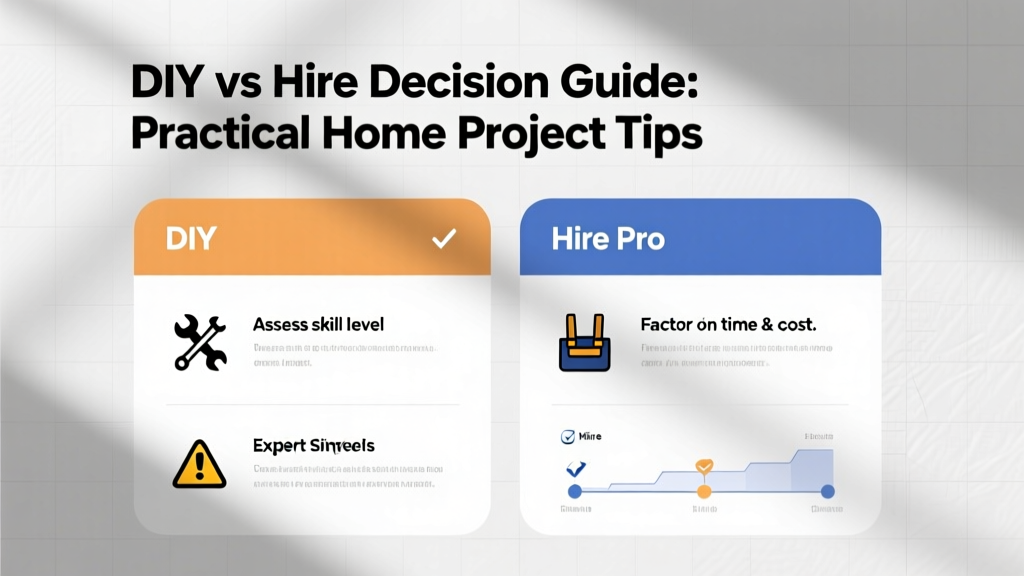
That leaky faucet? The wobbly deck railing? The bathroom tile that’s been loose for six months? Every homeowner faces the same split-second calculation: 'Can I do this—or should I pay someone?' It’s not just about skill; it’s about risk, hidden costs, and whether your 'quick fix' becomes next week’s emergency call.
Know Your Skill Threshold
Start with honesty—not optimism. If you’ve never wired a GFCI outlet, installing one in a damp bathroom isn’t a learning opportunity—it’s a liability. The National Fire Protection Association reports that 51% of home electrical fires between 2018–2022 involved DIY wiring errors (NFPA Electrical Fire Report, 2023). That’s not discouragement—it’s data.
- Safe DIY zone: Caulking windows, replacing faucet cartridges, patching drywall under 12 inches
- Red-flag tasks: Anything involving gas lines, load-bearing walls, or breaker panel work
- Gray-area test: Can you source and interpret local code amendments? If not, assume it’s pro territory.
Calculate the True Cost of DIY
That $40 faucet kit looks cheap—until you factor in three trips to the hardware store, $18 in mismatched fittings, two hours of YouTube tutorials, and the $90 plumber you call when the shutoff valve seizes. According to HomeAdvisor’s 2024 Cost vs. Time Analysis, homeowners spend an average of 2.7x longer on DIY plumbing than pros—and 38% end up hiring help mid-project.
"Time is amortized labor cost. If your hourly wage is $35 and the job takes 6 hours, you’re already at $210—before materials or mistakes." — Sarah Lin, contractor and founder of BuildWise Consulting, 2023
Assess the Consequence of Failure
A botched paint job is inconvenient. A misaligned HVAC refrigerant line can void your warranty, trigger a $1,200 compressor replacement, and release ozone-depleting gases. Ask: What’s the worst-case outcome—and who absorbs that cost?
- Low-consequence: Replacing cabinet knobs, repainting trim, installing shelf brackets
- High-consequence: Roof flashing repairs, sump pump installation, sewer line camera inspection
- Insurance red flag: Most homeowner policies exclude damage caused by unpermitted DIY work on structural, electrical, or plumbing systems.
Quick Reference Checklist
| Factor | Lean DIY | Lean Hire |
|---|---|---|
| Time available | ≥8 hours, no deadline pressure | Urgent (e.g., active leak, safety hazard) |
| Permit required? | No permit needed | Permit required (electrical, plumbing, structural) |
| Tools owned | All tools on hand (e.g., multimeter, torque wrench, pipe threader) | Specialty tools needed ($150+ rental or purchase) |
| Code knowledge | Familiar with IRC Chapter 27 (plumbing) or NEC Article 404 (switches) | Unsure of local amendments or inspection requirements |
Common Mistakes
People don’t fail because they lack ambition—they fail because they misread signals. Here’s what trips up even experienced DIYers:
- Underestimating prep time: Sanding, priming, and drying add 60–75% more time than the core task (PaintCare Industry Survey, 2023).
- Ignoring insurance clauses: Filing a claim after DIY-installed smoke detector fails during a fire? Many insurers deny coverage per policy exclusions Section 4.2b.
- Using 'good enough' parts: Non-UL-listed electrical components may pass visual inspection but overheat under load—causing slow degradation and fire risk.
Is my project covered by warranty?
Yes—if it’s factory-installed or performed by an authorized technician. DIY voids most appliance, HVAC, and roofing warranties. Check your warranty’s ‘Labor & Workmanship’ clause: if it says “performed by a licensed professional,” self-installation invalidates it—even if done perfectly.
What if I start DIY and hit a wall?
Stop immediately. Document everything: photos before/after each step, receipts, notes on what failed. Then contact a pro with that context. Many contractors offer ‘rescue rates’ (15–20% below standard) for partial-DIY jobs—especially if you’ve sourced correct materials and prepped cleanly. See our how to hire a contractor guide for vetting rescue-friendly pros.
Can I DIY part of a larger job?
Absolutely—and it’s often smart. Demolition, hauling debris, painting finished surfaces, or installing trim are common DIY segments. Just confirm with your contractor which phases they’ll inspect or sign off on. One client saved $1,100 by demoing their kitchen themselves—then hired a licensed electrician and plumber for all rough-ins (kitchen remodel timeline example).
Does DIY affect home resale value?
Yes—but unevenly. Clean, code-compliant DIY (with permits where required) adds neutral value. Unpermitted electrical work or amateur drywall seams? Appraisers and inspectors flag them. Per the National Association of Realtors’ 2023 Remodeling Impact Report, 62% of buyers walk away from homes with visible, unpermitted renovations—even if functionally sound.
How do I find a trustworthy pro for small jobs?
Start with trade-specific platforms like best handyperson apps, not generic review sites. Look for: state license number in bio, ≥3 project photos showing before/during/after, and responses to negative reviews that cite code sections or material specs. Avoid anyone who says, “I can do anything”—specialists beat generalists on complex tasks every time.
There’s no universal answer—but there is a repeatable process. Pause before buying supplies or booking a pro. Run your project through the consequence, cost, and code filters. When in doubt, get a 15-minute consult (many pros offer free pre-assessments). You’ll gain clarity—and possibly save hundreds. Because the best DIY decision isn’t always doing it yourself—it’s knowing exactly when not to.