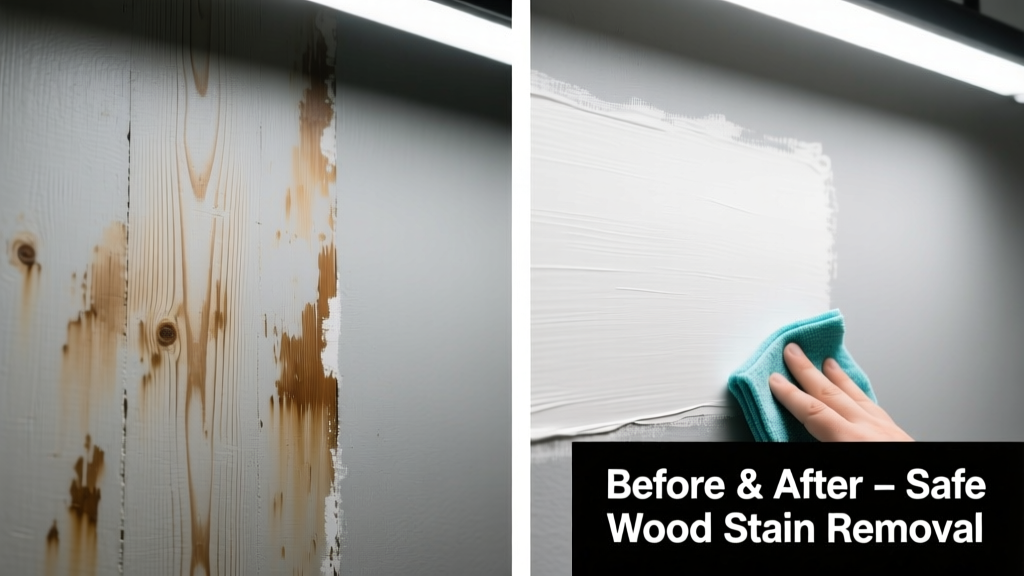
Spilled wood stain on a freshly painted wall is one of those heart-sinking moments—especially when you realize it’s not just surface-level. Unlike water-based spills, oil- or solvent-based wood stains penetrate fast and bond aggressively with latex and acrylic paints. The good news? With the right approach, most fresh-to-moderate stains (under 72 hours old) can be lifted without sanding or full repainting—but speed, material awareness, and restraint are non-negotiable.
What You Need
| Item | Purpose | Cost Range |
|---|---|---|
| Mineral spirits (low-odor) | Solvent for oil-based stains | $6–$12/qt |
| Isopropyl alcohol (91% or higher) | Effective on newer water-based stains | $4–$8/pt |
| Soft white cotton cloths (lint-free) | Avoids scratching or pigment transfer | $5–$10/pkg (12) |
| Plastic putty knife (non-metal) | Gentle scraping without gouging paint | $3–$7 |
| Touch-up paint + matching brush | For minor scuffing or halo effects | $12–$25 (varies by brand) |
Step-by-Step Removal Process
- Blot immediately—never rub. Use a dry, clean cloth to absorb excess stain. Work from the outer edge inward to prevent spreading.
- Identify the stain type: Oil-based (almond or petroleum scent, slow-drying) vs. water-based (acrid or vinegary smell, dries in under 2 hours). This dictates your solvent choice.
- Test first on an inconspicuous area (e.g., behind a switch plate). Apply solvent with a cotton swab for 10 seconds, then blot. Wait 15 minutes—check for paint lifting, dulling, or color bleed.
- Apply solvent sparingly: Dampen—not soak—a cloth with mineral spirits (oil-based) or 91% isopropyl alcohol (water-based). Press gently onto the stain for 20 seconds, then blot. Repeat up to 4 times, waiting 2 minutes between attempts.
- Neutralize and rinse: Wipe the area with a cloth dampened with distilled water (not tap—minerals can leave residue), then dry immediately with a clean towel.
- Assess and touch up: If a faint shadow remains, apply a thin coat of primer-sealer (e.g., Zinsser Bulls Eye 1-2-3) before spot-painting. Let cure 24 hours before recoating.
Surface-Specific Tips
Drywall with flat or eggshell paint behaves very differently than semi-gloss or plaster walls. Here’s how to adapt:
- Flat or matte latex paint: Most vulnerable to solvent damage. Use only 70% isopropyl alcohol (diluted with distilled water) and limit dwell time to 10 seconds max per pass.
- Eggshell or satin finishes: Tolerate mineral spirits better—but never use steel wool or abrasive pads. A microfiber cloth is mandatory.
- Plaster walls (pre-1950s): Often coated with calcimine or casein paint, which dissolves on contact with solvents. Test with distilled water first—if the surface clouds or lifts, stop and consult a conservator.
- Textured walls (orange peel, knockdown): Avoid aggressive blotting. Use a soft-bristle artist’s brush dipped lightly in solvent to work into crevices, then blot vertically with folded gauze.
What NOT to Do
- Don’t use acetone, lacquer thinner, or paint stripper—these will dissolve latex paint in seconds, exposing drywall paper or plaster.
- Don’t scrub with baking soda paste or vinegar: abrasives etch sheen; acids react unpredictably with pigments and binders.
- Don’t apply heat (hair dryer, steam cleaner)—it sets oil-based stains deeper and risks blistering paint film.
- Don’t wait more than 48 hours to act. According to the Paint Quality Institute’s 2023 Stain Response Study, removal success drops from 86% at 12 hours to 31% after 72 hours.
Prevention
Wood staining near finished walls is high-risk—but avoidable with smart prep:
- Cover walls with 3-mil plastic sheeting taped *above* baseboards—not just draped. Secure top edge with painter’s tape, bottom with blue tape to avoid pulling paint.
- Use a stain tray with a built-in lip and keep rags within arm’s reach—no reaching across wet surfaces.
- Stain vertical wood (like banisters or trim) before painting adjacent walls, not after.
- Keep a 2-oz spray bottle of 91% isopropyl alcohol nearby during staining—it’s the fastest first-response tool for accidental splatters.
Can I use WD-40 to remove wood stain?
No. WD-40 contains petroleum distillates that may temporarily lift surface residue but leave an oily film that repels paint and attracts dust. It also degrades acrylic binders over time. Skip it—use mineral spirits or alcohol instead.
Will bleach remove wood stain from painted walls?
Bleach (sodium hypochlorite) does not break down wood stain pigments or resins. It may lighten tannin-based stains on raw wood—but on painted surfaces, it causes yellowing, binder breakdown, and irreversible chalkiness. The U.S. EPA explicitly warns against using chlorine bleach on interior painted surfaces (EPA Safer Choice Guidelines, 2022).
What if the stain has been there for over a week?
If it’s visibly dark and hasn’t faded after gentle solvent attempts, the stain has likely migrated through the paint film into the drywall paper. At this point, light sanding (220-grit only) followed by priming damaged drywall is safer than aggressive chemical treatment. Never sand glossy paint—it creates hazardous dust and uneven sheen.
Can I paint over the stained area without removing it?
You can—but only after sealing with a stain-blocking primer like Kilz Original or BIN shellac. Latex paint alone won’t hide it. Shellac dries fast and blocks tannins and dye bleed. Apply two thin coats, sand lightly between, then topcoat. For best results, extend primer 2 inches beyond the visible stain to avoid haloing.
Why did my stain spread when I wiped it?
Rubbing creates capillary action—pushing liquid deeper into pores and along paint edges. Always blot vertically or in one direction, and replace cloths after each pass. As restoration specialist Maria Chen notes in Interior Surface Care Handbook (Routledge, 2021): “Stain migration is 80% technique, 20% chemistry. Blotting isn’t passive—it’s controlled extraction.”
“Stain migration is 80% technique, 20% chemistry. Blotting isn’t passive—it’s controlled extraction.” — Maria Chen, Interior Surface Care Handbook, Routledge, 2021
Do I need professional help for large stains?
If the affected area exceeds 12 inches wide or crosses multiple wall sections (e.g., around a window casing), yes—especially if the wall has historic plaster or decorative glaze. Professionals carry low-VOC solvent blends and infrared moisture meters to verify subsurface penetration. DIY attempts on large zones often create texture mismatches and overspray halos that require full-wall repainting.
Removing wood stain from painted walls isn’t about brute force—it’s precision timing, material literacy, and resisting the urge to ‘fix it faster.’ When done right, you’ll preserve both your wall’s integrity and your peace of mind. For related challenges, see our guides on removing paint splatter from walls and treating water-damaged painted walls.