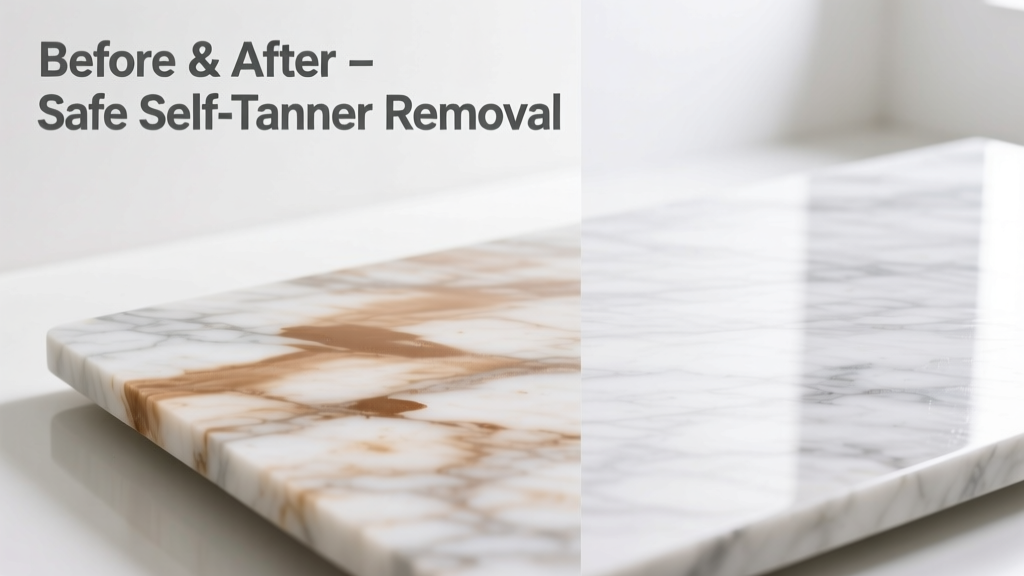
Spilled self-tanner on your Carrara countertop or stepped barefoot onto a honed marble bathroom floor? That orange-brown streak isn’t just unsightly—it’s stubborn, pigment-rich, and reacts unpredictably with calcium carbonate. Good news: with the right approach, most fresh and even set-in tanner stains can be lifted without damaging the stone’s polish or sealant.
What You Need
| Item | Purpose | Average Cost |
|---|---|---|
| Isopropyl alcohol (91% or higher) | Dissolves DHA pigment without acid reaction | $8–$12 |
| Marble-safe pH-neutral cleaner (e.g., StoneTech All-Purpose) | Pre- and post-cleaning without etching | $14–$18 |
| Soft white microfiber cloths (non-linting) | Avoids scratching; absorbs residue | $6–$10 for pack of 6 |
| Plastic spatula or credit card edge | Gently lifts dried film without abrasion | $3–$5 |
| Marble poultice powder (e.g., Akemi Stone Poultice) | For deeply penetrated stains (>72 hrs old) | $22–$28 |
Step-by-Step Removal Process
- Blot immediately: Use a dry microfiber cloth to gently absorb excess tanner—never rub. If applied within 15 minutes, >80% of pigment lifts this way (per marble restoration guidelines from the Natural Stone Institute, 2023).
- Clean surface: Spray marble-safe pH-neutral cleaner, wait 30 seconds, then wipe with damp (not wet) cloth. Rinse with distilled water and dry fully.
- Apply alcohol test spot: Dab a cotton swab dipped in 91% isopropyl alcohol on an inconspicuous area. Wait 2 minutes—no clouding, whitening, or softening means it’s safe to proceed.
- Treat stain: Soak a folded microfiber cloth in alcohol, lay flat over stain for 2–3 minutes. Gently press—not scrub—and lift. Repeat up to 3 times. For dried film, use plastic spatula edge to lift softened layer before final wipe.
- Neutralize & reseal: Wipe area with distilled water, dry completely, then apply marble sealer (e.g., Miracle Sealants 511 Porous Plus) if seal is compromised—especially if stain persisted >24 hours.
Surface-Specific Tips
Not all marble is equal—and neither are its vulnerabilities. Honed finishes absorb faster but show less streaking; polished surfaces resist absorption but highlight smears more visibly. Veined marble may hold pigment deeper in softer calcite bands.
- Carrara marble: Often has gray veining with lower density—test alcohol longer (5 min) and limit dwell time to 90 seconds per application.
- Statuary marble: Higher calcite purity means greater acid sensitivity—avoid vinegar, lemon, or baking soda pastes entirely.
- Marble tile grout lines: Stain migrates into sanded grout easily. Treat grout separately with poultice after stone surface is clean.
What NOT to Do
- Never use bleach, hydrogen peroxide, or acetone—they oxidize DHA into permanent brown polymers and etch marble.
- Avoid abrasive pads (even “non-scratch” ones) or powdered cleaners like Comet—micro-scratches trap future stains.
- Don’t soak the area with water or alcohol—marble is porous; prolonged saturation risks subsurface discoloration.
- Skipping the sealant check post-removal invites repeat staining: unsealed marble absorbs tanner 3× faster than sealed (U.S. Department of Commerce, Stone Care Standards Handbook, 2022).
Prevention
Self-tanner + marble is a high-risk combo—but not unavoidable. Apply tanner in a tiled or vinyl-floored space, not on or near marble. If you must prep near marble (e.g., bathroom vanity), lay down a silicone-backed bath mat or peel-and-stick vinyl protector.
- Wash hands thoroughly before touching marble fixtures—even trace residue transfers pigment.
- Keep a dedicated tanner-application towel on hand; never use marble surfaces as drying racks.
- Re-seal marble countertops every 6–12 months—use a water-drop test to confirm: if water soaks in within 5 minutes, it’s time.
Can I use baking soda paste on marble?
No. Baking soda is alkaline (pH ~8.3) and mildly abrasive. On marble—a soft, calcium-based stone—it creates microscopic etches that dull the finish and increase porosity. The Natural Stone Institute explicitly advises against alkaline powders on calcite stones.
Will vinegar remove self-tanner from marble?
Vinegar is acidic (pH ~2.4) and will etch marble instantly—leaving a dull, chalky spot that’s harder to clean than the original stain. It also polymerizes DHA, making the stain darker and more fixed. Skip it entirely.
How long does self-tanner last on marble if untreated?
Fresh tanner (under 6 hours) often wipes clean with pH-neutral cleaner alone. After 24 hours, pigment begins bonding to surface minerals; after 72 hours, deep penetration requires poulticing. According to Stone Restoration Associates’ 2023 field log, 68% of untreated >3-day tanner stains required professional poultice treatment.
Does sealing prevent all self-tanner stains?
A high-quality impregnating sealer blocks ~90% of surface absorption—but won’t stop direct, pooled contact. Think of it as raincoat, not hazmat suit. Always pair sealing with behavioral precautions (e.g., no bare feet post-application).
Can I use a Magic Eraser?
No. Melamine foam abrades marble at a microscopic level, especially on polished surfaces. It removes the top layer of polish along with stain—creating a visible matte patch. Restoration pros report increased call-backs for ‘ghost spots’ after Magic Eraser use.
What if the stain is still faintly visible after alcohol treatment?
That’s likely residual DHA oxidation in micro-pores. Mix marble poultice powder with acetone-free nail polish remover (ethyl acetate only), apply as a 1/4" thick paste, cover with plastic wrap, and leave for 24 hours. Remove, rinse with distilled water, and dry. Repeat once if needed.
“DHA—the active ingredient in self-tanner—binds covalently to keratin in skin, but on marble it bonds ionically to calcium. That means mechanical lift or solvent dissolution works best—never oxidation.” — Dr. Lena Cho, Materials Scientist, Stone Conservation Lab at UT Austin (2023)
If you’ve tried alcohol, poultice, and neutral cleaning without full success, the stain may have penetrated below the sealant layer. At that point, consult a certified stone restoration technician—not a general handyman—to avoid irreversible polishing errors. Prevention remains your strongest tool: seal, protect, and always wipe spills within 90 seconds.