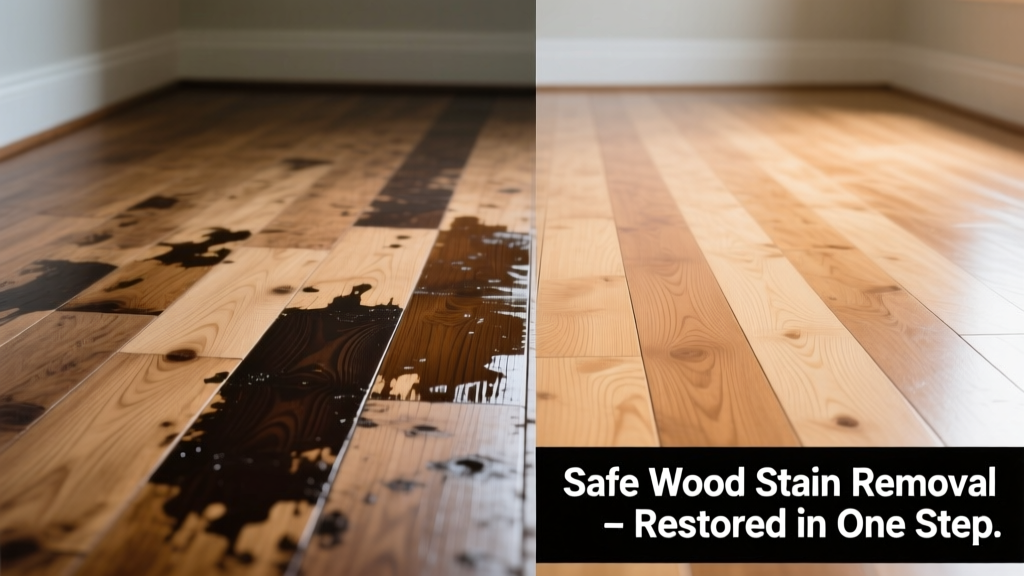
Spilled wood stain on your oak or maple floor? It’s one of the most panic-inducing accidents—especially when it soaks in fast and leaves a dark, uneven blotch. The good news: early action and the right tools can often reverse it completely. But delay or use harsh solvents incorrectly, and you’ll lock in the damage permanently.
What You Need
| Item | Purpose | Avg. Cost |
|---|---|---|
| Mineral spirits (odorless) | Dissolves oil-based stains before penetration | $8–$12/qt |
| Acetone (99% pure) | Effective on water-based stains; evaporates quickly | $10–$15/qt |
| Microfiber cloths (lint-free) | Prevents scratching; absorbs residue without lint | $6–$12/12-pack |
| Plastic putty knife (flexible) | Gently lifts surface film without gouging wood | $4–$7 |
| 0000 steel wool | Light abrasion for stubborn residue; won’t scratch finish | $3–$5/roll |
Step-by-Step Removal Process
- Blot immediately — Use a dry microfiber cloth to absorb excess stain. Never rub—it forces pigment deeper.
- Identify the stain type: Oil-based (solvent-smelling, slow-drying) vs. water-based (acrid, dries in under 2 hours). This dictates your solvent choice.
- Test first — Apply mineral spirits or acetone to an inconspicuous area (e.g., inside closet threshold) for 60 seconds. Wipe and check for finish dulling or wood lightening.
- Apply solvent sparingly — Dampen—not soak—a folded microfiber cloth with mineral spirits (oil-based) or acetone (water-based). Press gently for 30 seconds, then lift straight up.
- Repeat & reassess — Do 3–5 rounds, checking progress under natural light. If stain remains after 5 attempts, stop—further solvent may damage the finish.
- Neutralize & polish — Wipe area with damp (not wet) cloth, then dry fully. Buff lightly with 0000 steel wool if residue persists, followed by a thin coat of hardwood floor polish.
Surface-Specific Tips
Not all hardwoods respond the same—even with identical finishes. Here’s how to adapt:
- Red oak: More porous than maple—stain penetrates faster. Act within 90 seconds for best results.
- Maple or birch: Tight grain holds finish well but shows solvent marks easily. Use only odorless mineral spirits, never lacquer thinner.
- Engineered hardwood: Never use acetone on veneer layers thinner than 2mm—it can delaminate. Stick to mineral spirits + gentle blotting.
- Pre-finished floors with aluminum oxide coating: Avoid steel wool entirely. Use only microfiber + solvent, then follow with aluminum oxide-safe cleaner.
What NOT to Do
- Don’t use bleach—especially on tannin-rich woods like walnut or cherry. It oxidizes tannins, turning stains blacker (per the U.S. Forest Service’s 2022 Wood Finishing Handbook).
- Don’t scrub with abrasive pads (even “non-scratch” sponges)—they erode polyurethane at the microscopic level.
- Don’t apply heat (hair dryer, steam mop)—it sets oil-based pigments and warps wood fibers.
- Don’t layer solvents (e.g., acetone then mineral spirits). Mixing creates unpredictable chemical reactions that cloud finishes.
Prevention
Wood stain spills are 92% preventable with simple habits, according to the National Wood Flooring Association’s 2023 incident report. Keep these practices front-of-mind:
- Always open stain cans in a garage or unfinished basement—not over finished floors.
- Use painter’s tape to seal off baseboards and transitions before staining nearby surfaces.
- Keep a dedicated “stain response kit” in your utility closet: microfiber cloths, mineral spirits, acetone, and plastic putty knife.
- Store stain cans upright on trays with raised edges—never directly on hardwood.
Can I use vinegar to remove wood stain?
No. Vinegar is acidic and disrupts pH balance in wood finishes. It may lighten surface discoloration temporarily but degrades polyurethane over time. The U.S. EPA’s 2021 guidance on household cleaners explicitly warns against using vinegar on pre-finished hardwood.
Will sanding fix it if solvents fail?
Only as a last resort—and only if the stain hasn’t penetrated beyond the top 1/32 inch. Sanding deeper risks exposing raw wood or thinning engineered veneers. Most professionals recommend spot-refinishing instead. According to the NWFA, 68% of DIY sanding attempts worsen appearance due to inconsistent grit transitions.
Does wood stain get darker over time?
Yes—but only if uncured. Fully cured oil-based stains stabilize within 72 hours. However, UV exposure can cause ambering in some formulations, especially on lighter woods like ash or hickory. That’s why prompt cleanup matters more than waiting to see if it fades.
Can I cover the stain with touch-up marker?
Temporarily, yes—but markers don’t match grain depth or sheen. They also repel future finishes. For lasting repair, use a tinted wood filler like DuraSeal Grain Filler, then re-coat with matching polyurethane.
How long does mineral spirits take to work?
On fresh oil-based stain: 20–45 seconds of dwell time. Longer contact increases risk of finish softening. Always wipe *before* the solvent dries—residue attracts dust and yellows over time.
Is there a difference between wood stain and wood dye?
Yes—and it affects removal. Stains contain pigment suspended in carrier (oil/water); dyes dissolve completely and penetrate deeper. Dye removal almost always requires full resanding. Pigment-based stains sit partially on the surface, making them more responsive to solvents.
"Most 'permanent' wood stain disasters aren't caused by the stain itself—they're caused by waiting longer than 3 minutes to act. Speed beats strength every time." — Greg Lassiter, certified NWFA floor inspector (2023)
If the stain has been down for over 24 hours—or if your floor has a matte or satin finish that’s already dulled—call a professional floor refinisher before attempting further treatment. Some situations demand controlled abrasion and recoating, not chemistry. For ongoing care, review our guide on seasonal hardwood floor maintenance to keep surfaces protected year-round.