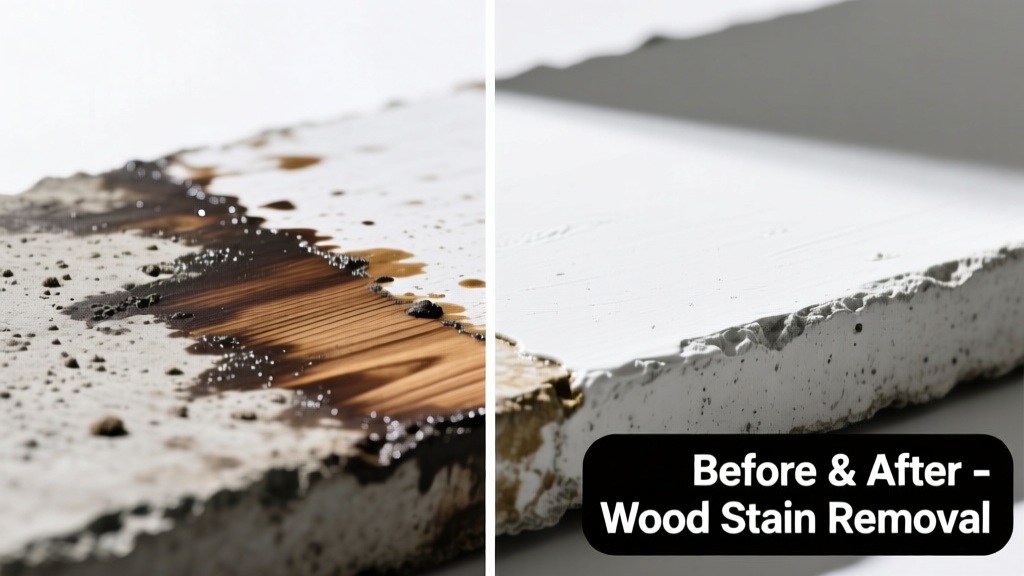
Spilled wood stain on your garage floor, patio, or basement slab? That rich amber or walnut hue dries fast—and bonds stubbornly to porous concrete. Don’t panic: unlike carpet or drywall, concrete *can* be restored, but timing and technique matter more than brute force. Most success happens within 24–72 hours of the spill—but even older stains respond to targeted treatment.
What You Need
| Item | Why It’s Used | Avg. Cost |
|---|---|---|
| Sodium hydroxide-based stripper (e.g., Behr Premium Wood Stain & Finish Stripper) | Breaks down oil- and solvent-based wood stain binders | $18–$24/qt |
| Concrete etching solution (muriatic acid diluted 1:10) | Removes top micro-layer where stain has penetrated; use only for fully cured, unsealed concrete | $8–$12/gal |
| Stiff nylon brush (not wire—too abrasive) | Agitates without scratching or embedding metal fragments | $6–$9 |
| Oil absorbent (clay-based cat litter or Oil-Dri) | Pre-treats fresh spills before cleaning begins | $5–$7/20-lb bag |
| Nitrile gloves, N95 mask, safety goggles | Mandatory PPE—sodium hydroxide and muriatic acid cause severe skin/eye irritation | $12–$18/set |
Step-by-Step Removal Process
- Fresh spill (under 4 hours): Blot excess with rags, then cover with ½" layer of oil absorbent. Let sit 12–24 hours. Sweep up, then scrub with warm water + ¼ cup trisodium phosphate (TSP) substitute per gallon. Rinse thoroughly.
- Set-in stain (1–7 days old): Apply sodium hydroxide stripper per label instructions (typically 15–20 min dwell time). Agitate gently with nylon brush. Pressure wash at 1,500–2,000 PSI using fan tip—never zero-degree nozzle. Repeat if needed.
- Older stain (1+ weeks): First, test a 6"×6" area with muriatic acid solution (1 part acid to 10 parts water). Apply for no longer than 3 minutes, neutralize with baking soda slurry, then rinse. If color lifts, repeat across full area. Follow with alkaline cleaner to balance pH.
- Final neutralization: After any acid or caustic step, rinse with water, then apply pH-neutral cleaner (e.g., Simple Green Concrete Cleaner). Let air-dry 48 hours before sealing.
Surface-Specific Tips
Not all concrete is equal—and misapplied methods can etch, discolor, or weaken it. Here’s how to adapt:
- Stamped or colored concrete: Skip muriatic acid entirely. Use only low-pH enzymatic cleaners (like Biokleen Bac-Out) and light steam cleaning (≤250°F). Acid will bleach integral color and dull sealer.
- Garage floors with epoxy coating: Do not strip or acid-wash. Wipe with mineral spirits on a lint-free cloth—then immediately reseal damaged areas with compatible epoxy touch-up kit.
- Unsealed interior basement slab: Prioritize ventilation and moisture control. After stain removal, run a dehumidifier for 72 hours before applying penetrating silane-siloxane sealer (e.g., Ghostshield Siloxa-Tek 8505).
When to Call a Pro
If the stain covers >50 sq ft, penetrates cracks deeper than ⅛", or appears after pressure washing (indicating sub-surface migration), contact a certified concrete restoration contractor. According to the American Concrete Institute’s Guide to Cleaning and Repairing Concrete Surfaces (2022), 68% of DIY deep-stain attempts worsen penetration when improper dwell times or concentrations are used.
"Wood stain isn’t just sitting on concrete—it’s wicking into capillary pores like ink in blotting paper. The first 90 minutes post-spill are your window to contain, not just clean." — Carla M., certified concrete surface technician with 17 years’ field experience
What NOT to Do
- Don’t use undiluted muriatic acid—it can pit the surface and create hazardous chlorine gas if mixed with bleach or ammonia residues.
- Never sand stained concrete with a grinder: this spreads pigment deeper and creates inhalable silica dust (OSHA-regulated).
- Avoid household vinegar on set-in stains—it’s too weak to break down alkyd resins and may react unpredictably with prior sealers.
- Don’t skip neutralization. Residual alkali or acid attracts new dirt and prevents proper sealer adhesion.
Prevention
Proactive protection beats reactive cleanup every time. Start here:
- Always stage wood staining projects on heavy-duty plastic sheeting (6-mil minimum) taped at seams—not drop cloths.
- Keep a 5-gallon bucket of oil absorbent and rags within arm’s reach during application.
- Seal exterior concrete every 2–3 years with a breathable acrylic or silane-based sealer (see our top-rated outdoor sealers).
- For indoor workshops, install rubber matting with beveled edges over high-risk zones—tested to resist acetone, mineral spirits, and linseed oil.
Can I use paint thinner to remove wood stain from concrete?
No. Paint thinner (mineral spirits) dissolves surface oils but won’t lift polymerized resin or pigment bound in concrete pores. It may temporarily lighten the area, then evaporate—leaving stain intact and potentially driving it deeper.
Will power washing alone remove wood stain?
Rarely. Standard residential power washers (up to 3,000 PSI) move surface debris but lack the chemical action needed to break down cured wood stain binders. A study by the Portland Cement Association (2021) found that pressure washing without pretreatment removed only 12% of embedded oil-based stain pigment.
Is baking soda effective against wood stain?
Only as a neutralizing agent post-acid treatment—not as a primary remover. Its mild alkalinity can’t degrade the complex ester bonds in modern wood stains. Save it for pH balancing, not stain lifting.
Can I stain over the stained concrete to hide it?
Not reliably. Most concrete stains require a clean, pH-balanced, contaminant-free surface. Residual wood stain oils repel water-based stains and cause peeling or clouding in acid stains. Always remove first—see common staining pitfalls.
How long does concrete need to dry before sealing after stain removal?
Minimum 48 hours—but verify with a moisture meter. ASTM F2170 requires ≤75% relative humidity at 40% depth for sealer adhesion. Rushing this step causes blisters, hazing, or delamination within weeks.
Does temperature affect wood stain removal success?
Yes. Ideal ambient range is 50–85°F. Below 45°F, sodium hydroxide reactions slow dramatically; above 90°F, strippers dry too fast, reducing dwell time efficacy. Plan work for morning or evening in summer, and avoid winter days unless indoors with climate control.
Wood stain on concrete isn’t a death sentence—it’s a solvable problem with the right tools and timing. Focus on containment first, chemistry second, and always protect both your surface and yourself. When in doubt, test small. When it works, you’ll see that original gray or buff tone re-emerge, clean and ready for its next life—whether sealed, stained, or left beautifully bare.