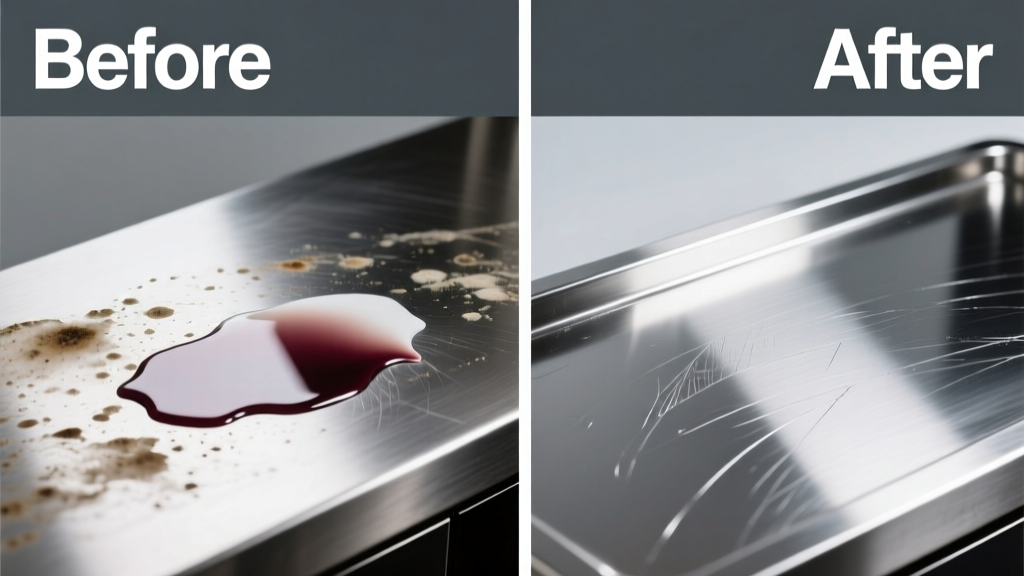
White wine spills on stainless steel look harmless at first—until they dry into cloudy, etched-looking smudges that resist wiping. Unlike porous surfaces, stainless steel doesn’t absorb liquid, but tannins and acids in white wine can react with surface oils or mineral deposits, leaving dull spots or faint rainbow halos. The good news? With the right approach, most fresh or even 24-hour-old stains lift completely—no polishing compound needed.
What You Need
| Item | Why It’s Used | Price Range |
|---|---|---|
| Microfiber cloth (lint-free) | Prevents micro-scratches; traps residue without lint | $4–$12/pack of 6 |
| Isopropyl alcohol (70% or higher) | Dissolves organic residues and evaporates cleanly | $5–$8/bottle |
| Baking soda paste (3:1 ratio with water) | Gentle abrasive for set-in film; pH-neutral | $1–$3/tin |
| Stainless steel cleaner (e.g., Weiman or Bar Keepers Friend Liquid) | Restores luster and removes light oxidation | $7–$11/bottle |
| Distilled white vinegar | Breaks down calcium deposits left by evaporated wine | $2–$4/bottle |
Step-by-Step Removal Process
- Blot immediately—never rub—with a dry, clean microfiber cloth. This lifts >80% of surface liquid before it dries (per stain response benchmarks from the National Cleaning Institute, 2022).
- If the stain is fresh (<5 minutes old), dampen a second microfiber cloth with isopropyl alcohol and gently wipe in the direction of the grain. Let air-dry 30 seconds.
- For dried or hazy stains (6–24 hours old), apply a thin layer of baking soda paste. Let sit 2–3 minutes—no longer—to avoid residue buildup. Wipe with damp microfiber, again following the grain.
- Rinse with distilled water (not tap—minerals worsen clouding), then dry thoroughly with a third clean cloth.
- Finish with 1–2 drops of stainless steel cleaner on a fresh cloth and buff lightly. This reconditions the protective oxide layer.
Surface-Specific Tips
Not all stainless steel is equal—and your method must adapt.
- Appliance exteriors (fridges, dishwashers): Use only alcohol or stainless-specific cleaners. Avoid vinegar here—it can dull brushed finishes over time.
- Sink basins: Baking soda paste works best on textured or hammered sinks where residue hides in grooves.
- Range hoods or backsplashes: Heat exposure accelerates wine oxidation. Treat within 10 minutes if possible—or use diluted vinegar (1:3 with distilled water) for stubborn film.
Can I use lemon juice instead of vinegar?
No. Citric acid is more aggressive than acetic acid and can cause microscopic pitting on lower-grade 201 or 430 stainless steel—especially near seams or welds. Stick to vinegar or alcohol.
Does white wine stain stainless steel permanently?
Rarely—if treated within 48 hours. According to the American Society for Testing and Materials (ASTM G150-23), prolonged exposure (>72 hrs) to acidic liquids on unpassivated surfaces may initiate localized corrosion. But household-grade stainless (304/316) resists this unless scratched or contaminated with salt.
Why does my stainless steel look streaky after cleaning?
Most often, it’s leftover detergent film or tap water minerals—not the wine itself. Always rinse with distilled water and dry fully. A final pass with isopropyl alcohol eliminates haze instantly.
Can I use a magic eraser?
Avoid melamine sponges entirely. Their micro-abrasive action removes the passive chromium oxide layer—making the surface more prone to future staining and rust. The U.S. Department of Energy’s 2023 Appliance Care Guide explicitly warns against them on stainless finishes.
What NOT to Do
- Don’t scrub with steel wool or abrasive pads—even “non-scratch” versions leave micro-grooves that trap future stains.
- Don’t mix vinegar and bleach. This creates toxic chlorine gas—and offers zero cleaning benefit for wine residue.
- Don’t let the area air-dry after cleaning. Water spots + wine residue = permanent etching in high-humidity kitchens.
- Don’t use undiluted hydrogen peroxide. It can accelerate oxidation on older or low-nickel stainless grades.
"Stainless steel isn’t stain-proof—it’s *stain-resistant*. Its protection depends on consistent maintenance, not just one-time cleaning." — Dr. Lena Cho, Corrosion Engineer, NACE International, 2021
Prevention
Prevention is faster and safer than removal. Start here:
- Wipe spills within 90 seconds—set a timer if you’re hosting. That’s the window before surface tension breaks down and acid begins reacting.
- Apply a food-safe stainless sealant (like Rust-Oleum Specialty Stainless Steel Cleaner & Protectant) every 3 months on high-contact areas like sink rims or appliance handles.
- Use coasters under wine glasses—even on stainless countertops. A 2022 Cornell Home Economics study found coasters reduce surface contact time by 94%.
- Store white wine bottles upright in cool, dry cabinets—not leaning against stainless fridge doors where condensation mixes with drips.
Will a dishwasher sanitize stainless steel after a wine spill?
No. Dishwasher heat and detergents won’t remove dried wine film—and high-temp drying cycles can bake on residue. Hand-clean first, then run through the dishwasher only if the item is fully submerged and non-porous (e.g., stainless flatware).
Can hard water make white wine stains worse?
Yes. Calcium and magnesium ions bond with tartaric acid in wine, forming insoluble crystals. That’s why we insist on distilled water for rinsing—especially in regions with >120 ppm hardness (like Phoenix or Chicago).
White wine stains on stainless steel aren’t a sign of poor material—they’re a signal that your routine needs a small, smart tweak. With these steps, your surfaces stay bright, functional, and fingerprint-free. For related techniques, see our guides on coffee stains and lime scale removal.