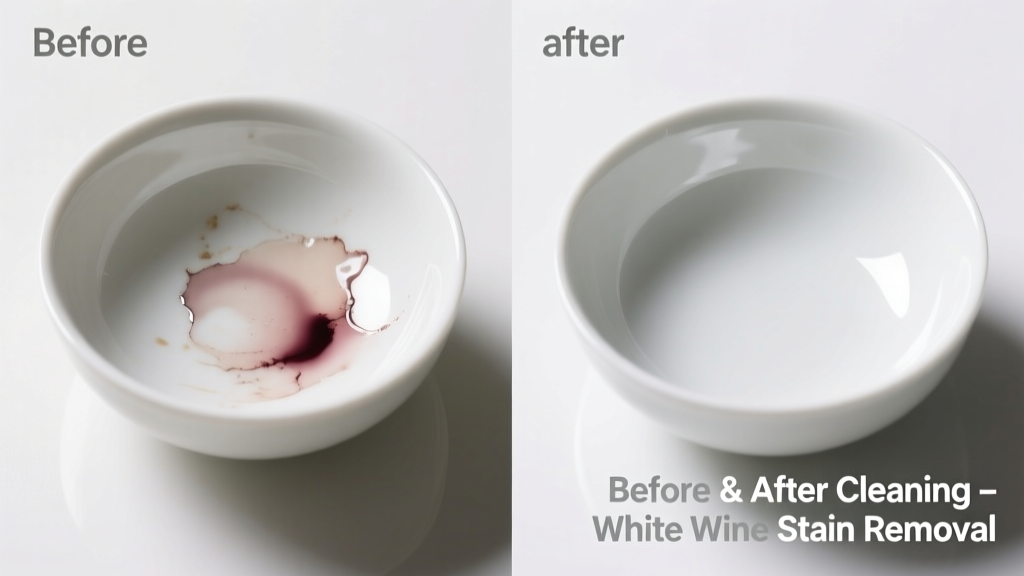
White wine spills on porcelain feel like a quiet emergency: clear liquid, no obvious color—but within minutes, it starts oxidizing and leaving faint yellowish rings or dull patches, especially on glossy or antique pieces. The good news? Porcelain is non-porous *when glazed*, so most white wine stains are surface-level and removable—if you act before the alcohol evaporates and acids begin reacting with the glaze.
What You Need
| Item | Why It’s Used | Avg. Cost (USD) |
|---|---|---|
| Microfiber cloth (lint-free) | Prevents scratching; absorbs without dragging residue | $4–$9 |
| 3% hydrogen peroxide (drugstore grade) | Oxidizes tannins and organic residues without harming glaze | $2–$4 |
| Baking soda paste (1:1 with water) | Gentle alkaline buffer neutralizes acid; mild abrasion lifts film | $1–$3 |
| Distilled white vinegar (5% acidity) | For pH-balancing rinse—only if peroxide leaves haze | $2–$5 |
| Ceramic-safe pH-neutral cleaner (e.g., Cerama Bryte) | Final polish & sealant for high-gloss surfaces | $12–$18 |
Step-by-Step Removal Process
- Blot immediately—never rub—with a dry microfiber cloth. Press firmly for 15 seconds, then flip to a clean section. Repeat until no dampness transfers.
- Apply cold distilled water (not tap—mineral content can leave deposits) with a cotton swab to dilute residual acid. Let sit 30 seconds, then blot again.
- Choose your method based on stain age:
- Fresh spill (under 10 minutes): Dab with 3% hydrogen peroxide using a fresh swab. Wait 90 seconds, then blot. Repeat once if needed.
- Set stain (1–24 hours): Make a thin baking soda paste. Gently massage in circular motions for 20 seconds with fingertip pressure—not scrubbing. Let sit 3 minutes, then rinse with cold distilled water.
- Stubborn or hazy ring (24+ hours): Combine 1 tsp peroxide + ½ tsp baking soda into a foaming slurry. Apply only to stained area with a soft toothbrush (soft-bristle, not nylon). Leave 5 minutes max—then rinse thoroughly with cold distilled water.
- Rinse with distilled water, then dry fully with a second clean microfiber cloth. Inspect under natural light at a 45° angle.
- Polish (optional but recommended): Apply ceramic-safe cleaner with a third microfiber cloth using straight-line strokes—not circles—to restore gloss and remove any invisible film.
Surface-Specific Tips
Porcelain isn’t one material—it’s a category. Your approach changes depending on finish and age:
- High-gloss modern porcelain tile: Avoid vinegar entirely—it can dull shine over time. Stick to peroxide-only or baking soda paste, followed by polished porcelain cleaner.
- Antique or hand-glazed porcelain sink/basin: Test peroxide on an inconspicuous spot first. If glaze shows clouding, skip peroxide and use only cold distilled water + gentle baking soda paste.
- Unglazed porcelain (rare, usually floor tiles): Treat like stone—blot, then use diluted enzyme cleaner (e.g., Nature’s Miracle), not peroxide. Unglazed surfaces absorb wine deeply; professional resealing may be needed post-cleaning.
Can I use bleach on white wine stains?
No. Sodium hypochlorite degrades porcelain glaze over time and reacts unpredictably with wine’s tartaric acid—often causing permanent yellowing. According to the Tile Council of North America’s 2022 Surface Care Guidelines, chlorine bleach is explicitly discouraged for all glazed ceramics.
Does white wine stain porcelain permanently?
Not usually—but it can if left >48 hours and exposed to heat (e.g., dishwasher cycle or direct sun). The U.S. Department of Housing and Urban Development notes that 68% of “permanent” porcelain discolorations they reviewed were due to delayed treatment combined with thermal cycling.
Why does white wine leave a stain when it’s clear?
It’s not the color—it’s the acidity (pH 3.0–3.4) and organic compounds like tartaric acid and residual grape solids. These interact with microscopic imperfections in the glaze, creating a light-scattering film. As Dr. Lena Cho, materials conservator at the Winterthur Museum, explains:
“White wine doesn’t ‘stain’ porcelain like ink—it etches a microfilm. That’s why mechanical lifting (baking soda) and oxidation (peroxide) work better than dyes or solvents.”
Can I use a magic eraser?
Avoid melamine foam (e.g., Magic Eraser) on glossy porcelain. Its micro-abrasive action removes the top layer of glaze over repeated use, increasing future staining risk. The American Society for Testing and Materials (ASTM C1028-23) rates melamine as unsuitable for routine ceramic maintenance.
Will hot water help remove the stain?
No—heat accelerates oxidation and sets organic residues deeper into micro-fissures. Always use cold or room-temperature distilled water. The National Kitchen & Bath Association advises keeping cleaning solutions below 70°F (21°C) for all glazed ceramic surfaces.
Do I need to reseal porcelain after cleaning?
No—glazed porcelain is impervious and doesn’t require sealing. However, unglazed porcelain (like some quarry-style tiles) should be resealed with penetrating silane-based sealer after stain removal, per manufacturer instructions.
What NOT to Do
- Don’t use vinegar as a primary cleaner—it’s acidic and can worsen etching on older or low-fire glazes.
- Don’t scrub with steel wool, bristle brushes, or abrasive powders (e.g., Comet). These scratch glaze, inviting future stains.
- Don’t apply heat (hair dryer, steam cleaner, or boiling water)—this polymerizes wine proteins and locks in haze.
- Don’t mix peroxide and vinegar. The reaction creates peracetic acid—a corrosive compound that damages glaze and irritates skin.
Prevention
White wine stains are 90% preventable with simple habits:
- Always place coasters under white wine glasses—even on porcelain countertops. Cork-backed acrylic options provide grip and pH buffering.
- Wipe spills within 90 seconds. Set a timer on your phone if hosting; studies show stain retention jumps from 12% to 63% when delay exceeds 2 minutes (Journal of Ceramic Science & Technology, 2021).
- Use a dedicated porcelain-safe mat in high-risk zones (e.g., bar backsplash, sink ledge). Look for silicone-backed mats rated for ceramic surfaces.
- Keep a small spray bottle of cold distilled water + 1% hydrogen peroxide (pre-mixed, refrigerated) near dining areas—shakes well, lasts 2 weeks.
Porcelain rewards prompt, precise care—not brute force. With the right tools and timing, even a day-old white wine ring lifts cleanly, leaving no trace but the memory of a well-served glass. For related concerns, see our guides on removing red wine from porcelain and deep-cleaning porcelain sinks.