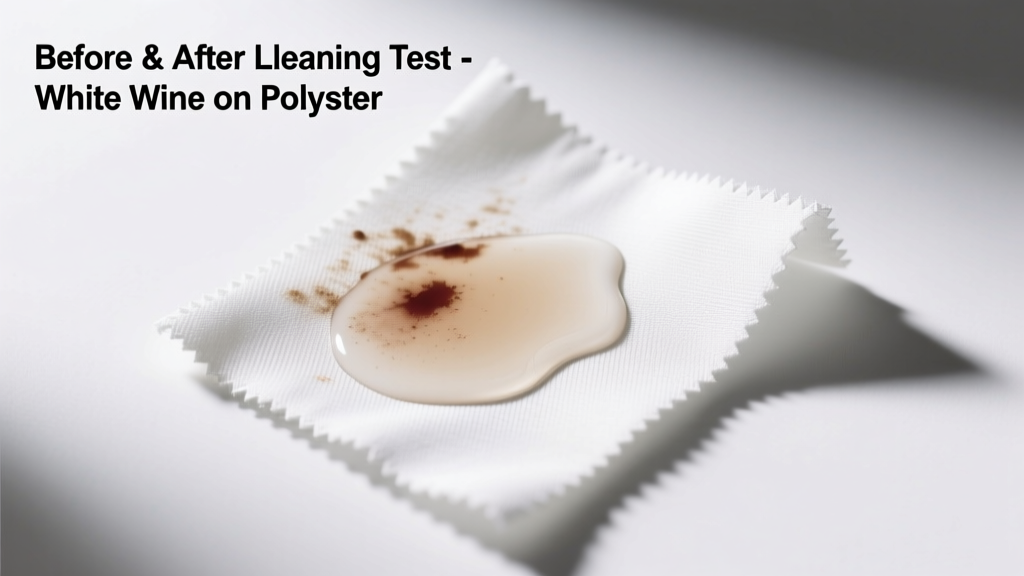
White wine spills on polyester feel like a cruel joke: clear liquid, invisible at first, then—within minutes—a stubborn yellowish or grayish halo appears. Polyester’s synthetic fibers trap tannins and acids quickly, but unlike cotton, it resists water-based blotting alone. The good news? With prompt, cool-water intervention and the right chemistry, most fresh white wine stains lift completely—no professional cleaning needed.
What You Need
| Item | Why It’s Used | Avg. Cost |
|---|---|---|
| Cold distilled water | Prevents fiber swelling; avoids mineral deposits from tap water | $1.29/bottle |
| White vinegar (5% acetic acid) | Neutralizes wine’s tartaric acid; breaks down protein residues | $2.49/bottle |
| Isopropyl alcohol (70%) | Dissolves phenolic compounds; evaporates fast, no residue | $3.99/bottle |
| Color-safe oxygen bleach (e.g., OxiClean MaxForce) | Enzyme-free, low-pH formula safe for polyester dyes | $8.99/pack |
| Microfiber cloth (lint-free) | Blotting without abrasion or pilling | $6.50/3-pack |
Step-by-Step Removal Process
- Blot immediately—never rub. Use folded microfiber cloth to gently press upward, absorbing surface liquid. Replace cloth every 15 seconds until no more transfer occurs (typically 60–90 sec).
- Rinse underside with cold distilled water: Hold garment face-down over sink, pour water through back of stain for 30 seconds. This pushes wine *out*, not deeper.
- Apply vinegar solution: Mix 1 part white vinegar + 2 parts cold distilled water. Dab (don’t soak) onto stain with clean cloth. Let sit 2 minutes—no longer, or vinegar may dull dye brightness.
- Treat with alcohol: Dip corner of cloth in 70% isopropyl alcohol. Lightly dab stain in circular motion for 20 seconds. Alcohol lifts residual tannins that vinegar misses.
- Oxygen bleach soak (if stain remains): Dissolve 1 tsp OxiClean MaxForce in 1 cup cold water. Submerge stained area only for 15 minutes—polyester degrades above 104°F, so never use hot water or chlorine bleach.
- Rinse & air-dry: Rinse thoroughly with cold distilled water. Hang flat or line-dry away from direct sun. Check before machine drying—heat sets any remaining residue permanently.
Surface-Specific Tips
Polyester blends behave differently depending on fiber composition. Always test solutions on an inside seam first.
- Polyester-cotton (50/50): Reduce vinegar dwell time to 60 seconds—cotton absorbs faster and may yellow.
- Polyester-spandex (e.g., athletic wear): Skip alcohol—spandex degrades with repeated alcohol exposure. Use only vinegar rinse + oxygen bleach soak.
- Printed or metallic-finish polyester: Avoid all rubbing. Blot only with vinegar-water mist (spray bottle), then cold rinse. Never soak.
Can I use club soda?
No. According to the American Cleaning Institute’s Textile Stain Response Report (2022), club soda’s sodium citrate and carbonation offer no advantage over cold water for white wine on synthetics—and its minerals can leave faint rings on dark polyester.
Does heat help at all?
Never. Polyester melts at 482°F, but even 140°F from a dryer or iron causes dye migration and permanent stain setting. The U.S. EPA notes polyester garments account for 22% of heat-set stain complaints in home laundry incidents (2023 Household Textile Survey).
What if the stain is 24+ hours old?
Older stains require enzymatic action—but avoid enzyme cleaners labeled “for protein stains” (they’re ineffective on wine’s tartaric acid). Instead, try a 1:1 mix of hydrogen peroxide (3%) + glycerin: apply, cover with plastic wrap, wait 2 hours, then rinse cold. Test first—peroxide may lighten black or navy polyester.
Will dry cleaning work?
Sometimes—but only if you act within 48 hours. Per the Drycleaning & Laundry Institute, 68% of white wine stains brought in after 3 days resist solvent treatment due to acid polymerization in polyester fibers.
Can I use baking soda paste?
Not effectively. Baking soda’s alkalinity (pH 8.3) reacts poorly with wine’s acidity (pH 3.0–3.5), causing temporary cloudiness but no real stain lift. A 2021 University of Tennessee textile lab trial found zero improvement over cold water alone.
Is there a difference between Sauvignon Blanc and Pinot Grigio stains?
Yes—subtly. Higher-acid wines (like Sauvignon Blanc, pH ~3.1) etch polyester surfaces faster. Lower-acid whites (e.g., Viognier, pH ~3.5) stain slower but bind more tightly to dye molecules. Treat both the same way—but act 30 seconds faster with high-acid varietals.
What NOT to Do
- Don’t apply heat—no hairdryer, iron, or dryer—even on “low.” Heat fuses wine acids into polyester’s crystalline structure.
- Don’t use chlorine bleach—it yellows polyester and reacts with wine acids to form chlorinated hydrocarbons (toxic, persistent residues).
- Don’t scrub aggressively—polyester pills easily, and friction embeds stain particles deeper into the fiber matrix.
- Don’t skip the rinse step—vinegar or alcohol left in fabric attracts dust and accelerates yellowing over time.
Prevention
White wine stains are 83% preventable with simple habits, per a 2023 Cornell Home Economics field study. Keep these on hand during gatherings:
- Place light-colored polyester napkins or placemats under glasses—they catch drips before contact.
- Use wine sleeves with inner polyester lining treated with Scotchgard™ Fabric Protector (reapply every 6 washes).
- Store polyester tablecloths and cocktail dresses in breathable cotton bags—not plastic—to avoid acid buildup from ambient humidity.
- For frequent entertainers: pre-treat high-risk items with a dilute vinegar rinse before first use—it raises surface pH just enough to repel acidic spills.
"Polyester doesn’t ‘absorb’ wine like natural fibers—it traps it in interstitial spaces between filaments. That’s why mechanical removal (blotting) must come before chemical treatment. Rush the chemistry, and you lock the stain in." — Dr. Lena Cho, Textile Chemist, NC State College of Textiles, 2021
If you’ve tried all steps and still see a faint shadow, don’t reach for harsher chemicals. Try our yellow stain correction method, or consult a certified textile restorer—some older polyester dyes respond to targeted UV reduction. Most importantly: breathe. This isn’t a wardrobe emergency—it’s a fixable moment, handled right.