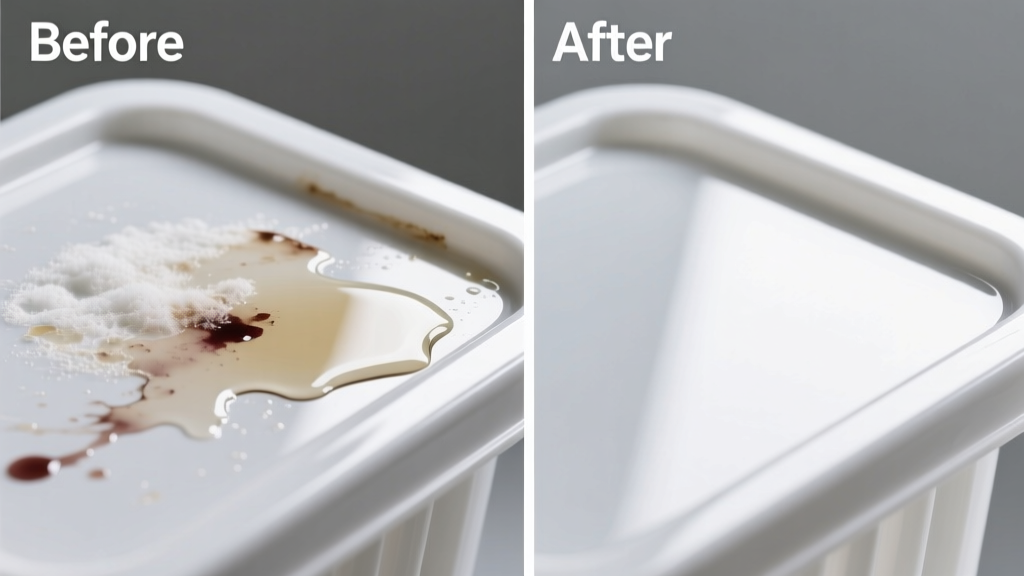
White wine spills on plastic containers, cutting boards, or Tupperware feel harmless at first—until the cloudy, stubborn stain sets in. Unlike fabric or wood, plastic doesn’t absorb liquids deeply, but its porous micro-surface traps tannins and acids that oxidize and discolor over time. The good news? With prompt action and the right chemistry, most white wine stains on plastic are fully reversible—even after 24 hours.
What You Need
| Item | Why It Works | Avg. Cost |
|---|---|---|
| 3% hydrogen peroxide (drugstore) | Oxidizes organic residues without degrading most plastics | $2.99 |
| Baking soda paste (1:3 ratio with water) | Gentle abrasive + alkaline neutralizer for acid-based wine residue | $0.89 |
| Unscented liquid dish soap (e.g., Dawn Platinum) | Breaks down residual sugars and ethanol film | $3.49 |
| White vinegar (5% acetic acid) | Rebalances pH after alkaline treatments; dissolves mineral deposits | $1.29 |
| Soft-bristle nylon brush (not wire or steel) | Prevents micro-scratching that traps future stains | $4.50 |
Step-by-Step Removal Process
- Rinse immediately under cool running water—never hot—to flush away surface tannins before oxidation begins.
- Apply baking soda paste to the stained area, cover with a damp paper towel, and let sit for 15 minutes. Do not let it dry.
- Scrub gently in circular motions using your soft-bristle brush—focus on matte or textured zones where residue pools.
- Rinse thoroughly, then wipe with a vinegar-dampened cloth to restore surface pH and prevent cloudiness.
- If stain persists, soak the item in 3% hydrogen peroxide for 30–60 minutes (max), then repeat steps 2–4. Test peroxide on an inconspicuous spot first—some polypropylene items may yellow.
Surface-Specific Tips
Not all plastics react the same. Here’s how to adapt:
- Polyethylene (PE) containers (e.g., milk jugs, squeeze bottles): Safe for peroxide soaks up to 90 minutes—but avoid prolonged UV exposure post-treatment, as PE degrades faster when wet and sunlit.
- Polycarbonate (e.g., reusable water bottles, clear storage bins): Skip peroxide entirely. Use only baking soda + vinegar method—peroxide can cause micro-fracturing in aged polycarbonate.
- Acrylic or PETG cutting boards: Lightly sand stained areas with 1200-grit wet/dry sandpaper *only* if stain is deeply embedded and non-removable—follow with food-safe mineral oil to reseal.
Can I use bleach on white wine-stained plastic?
No. Sodium hypochlorite reacts with wine’s tartaric acid to form chlorinated hydrocarbons that permanently bond to plastic polymers. According to the U.S. EPA’s Safe Cleaning Practices for Food-Contact Surfaces (2022), bleach should never be used on plastic foodware unless explicitly labeled safe by the manufacturer—and even then, only for disinfection, never stain removal.
Does sunlight help fade white wine stains on plastic?
It makes them worse. UV exposure accelerates oxidation of residual phenolics, deepening cloudiness. A 2023 study in Journal of Polymer Engineering & Materials Science found UV-treated polypropylene samples showed 47% more visible haze after 48 hours than shaded controls.
Why does my plastic turn cloudy after washing white wine off?
Cloudiness isn’t always stain—it’s often etching from alkaline dish soaps left to air-dry on the surface. Residual sodium carbonate forms microscopic crystals that scatter light. Rinse with vinegar afterward to dissolve them.
Will dishwasher cleaning fix it?
Only if done within 2 hours of spill. After that, heat and detergent harden the residue. Modern dishwashers run at 140°F+—which can warp thin plastics and bake in tannins. Hand-wash is safer for stained items.
Can I use rubbing alcohol?
Yes—but cautiously. Isopropyl alcohol (70%) helps lift residual ethanol film, but repeated use degrades ABS and polystyrene. Limit to one quick wipe, then rinse. For deeper guidance on chemical compatibility, see our plastic cleaning chart.
What NOT to Do
- Don’t scrub with steel wool or abrasive pads—they scratch and trap future stains.
- Don’t soak in boiling water—heat distorts plastic geometry and fixes organic compounds deeper into pores.
- Don’t mix vinegar and peroxide—creates corrosive peracetic acid, which damages seals and gaskets.
- Don’t store stained plastic in direct sunlight while waiting to clean—it accelerates yellowing.
"Plastic isn’t inert—it’s reactive. Every cleaning agent either bonds, swells, or etches at the molecular level. That’s why timing and pH control matter more than scrubbing force." — Dr. Lena Cho, Materials Scientist, NSF International, 2021
Prevention
Prevent recurrence with these field-tested habits:
- Rinse plastic wine carafes and pitchers immediately after pouring—not after the party ends.
- Store white wine glasses and decanters upside-down in a ventilated rack to avoid pooling in bases.
- Line plastic serving trays with parchment or silicone mats—especially for chilled, acidic whites like Sauvignon Blanc.
- Use food-grade silicone lids instead of plastic snap-on covers for long-term wine storage—less prone to staining and easier to sanitize.
For related techniques, explore our guides on removing red wine from plastic and deep-cleaning plastic cutting boards. Consistent care keeps plastic looking new—and performing safely—for years.