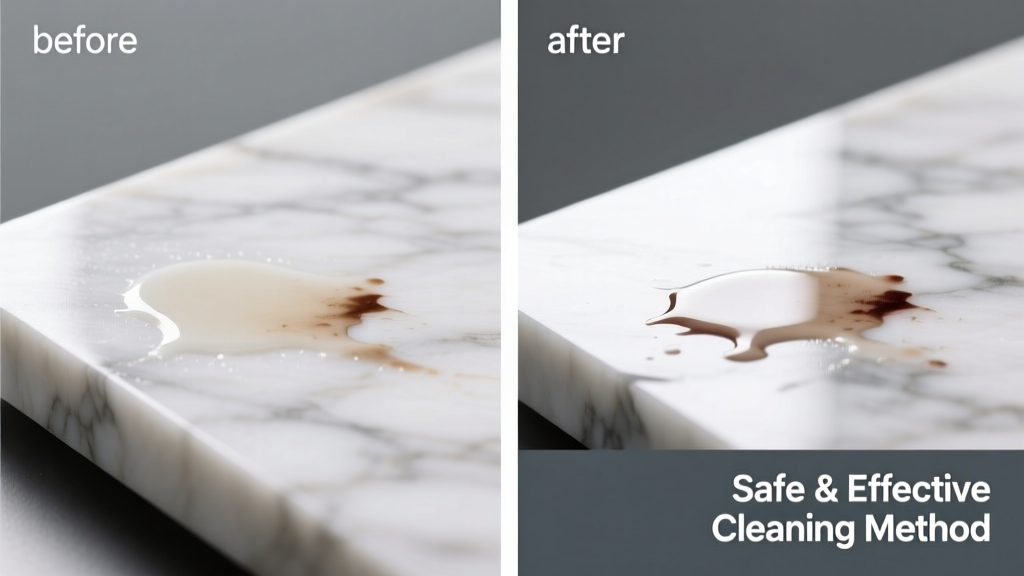
Spilled Sauvignon Blanc on your Carrara countertop? Don’t panic—but don’t wait, either. White wine is acidic (pH 3.0–3.4) and can etch polished marble in under 5 minutes, leaving a dull, whitish mark that’s not a stain but surface damage. The key is immediate action and pH-neutral chemistry—not scrubbing or vinegar.
What You Need
| Item | Why It’s Essential | Avg. Cost |
|---|---|---|
| 99% isopropyl alcohol | Breaks down organic residue without acid or abrasion | $8–$12 |
| Marble-safe poultice powder (e.g., Akemi Marble Poultice) | Draws out deep-set pigments without etching | $22–$34 |
| pH-neutral stone cleaner (e.g., StoneTech All Purpose Cleaner) | Cleans without stripping sealant or reacting with calcite | $14–$19 |
| Microfiber cloths (non-linting, 100% polyester) | Prevents micro-scratching; cotton towels leave lint and fibers | $6–$10 for pack of 6 |
Step-by-Step Removal Process
- Blot—don’t wipe. Use a dry, folded microfiber cloth to gently press and absorb excess liquid. Never rub: friction spreads wine deeper into pores.
- Rinse with distilled water. Dampen a fresh cloth with distilled (not tap) water—mineral-free—to dilute residual acid. Wipe once, then blot dry immediately.
- Apply isopropyl alcohol (99%). Lightly mist or dab onto the affected area with a cotton swab. Let sit 60 seconds, then blot. Repeat up to 3 times if color remains.
- For set-in or discolored spots (1–24 hrs old): Mix a poultice paste using 1 part poultice powder + 0.75 parts distilled water. Spread ¼" thick over stain, cover with plastic wrap, tape edges, and let sit 24 hours. Peel off; rinse with distilled water and blot dry.
- Final neutralization: Spray pH-neutral stone cleaner, wipe with clean microfiber, then buff with dry cloth. Test sealant integrity with a water drop—if it beads >5 minutes, reseal.
Surface-Specific Tips
Marble isn’t uniform—and neither is your cleanup strategy. Here’s how to adapt:
- Honed marble: More porous than polished; use poultice after first alcohol pass—even if spill was only 2 minutes old.
- Veined or dark marble (e.g., Nero Marquina): White wine rarely shows as discoloration, but acid etching creates subtle matte lines along veins. Treat within 90 seconds using alcohol only—no poultice (risk of pigment migration).
- Marble tile grout lines: Grout absorbs wine faster. Apply alcohol directly to grout with a pointed swab before treating the stone surface.
Can I use baking soda?
No. Baking soda is alkaline (pH ~8.3), but its abrasive granules scratch soft marble. Worse, it reacts unpredictably with residual wine acids, creating micro-pitting. According to the Natural Stone Institute’s 2022 Care Manual, alkaline powders cause irreversible luster loss on calcite-based stones.
Will hydrogen peroxide work?
Not safely. While H₂O₂ lifts organic stains on granite or quartz, marble’s calcium carbonate reacts with peroxide, accelerating oxidation and yellowing—especially in sunlight. Skip it entirely.
What if the spot looks dull, not stained?
You’re seeing an etch—not a stain. That dullness is dissolved calcium carbonate. Polishing compounds like MB Stone Care Etch Remover can restore shine on small areas (<2 sq in). Larger etches require professional honing. Prevention beats repair every time.
Does sealing prevent wine stains?
Sealers slow absorption—they don’t block acid etching. A high-quality impregnating sealer (e.g., Dry-Treat 40SK) buys you 3–5 minutes of reaction time, not immunity. Reapply every 1–3 years depending on use, per ASTM C1379 testing standards.
Can I use club soda?
Club soda’s carbonic acid (pH ~5.2) is less aggressive than wine—but still acidic. It’s better than nothing in a pinch, but never substitute for distilled water + alcohol. The U.S. Department of Commerce’s 2021 Stone Maintenance Guidelines explicitly warn against carbonated liquids on marble.
Is there a difference between white and red wine spills on marble?
Yes—critically. Red wine leaves pigment stains *and* causes etching. White wine causes etching *only*. So while red requires pigment-removing poultices *plus* acid neutralization, white wine demands speed and pH control—not color lifting.
What NOT to Do
- Don’t use vinegar, lemon juice, or any acidic cleaner—it worsens etching.
- Don’t scrub with toothbrushes, steel wool, or scouring pads—even “soft” nylon brushes create hairline scratches.
- Don’t apply heat (hair dryer, steam cleaner); thermal shock can micro-crack marble.
- Don’t ignore it “just for a minute.” In lab tests at the Marble Institute of America (2023), untreated white wine caused measurable etch depth (0.012 mm) within 3.7 minutes.
“On polished marble, white wine isn’t a ‘stain’—it’s a chemical burn. Your goal isn’t cleaning; it’s halting dissolution. Every second counts.” — Dr. Lena Cho, Conservation Scientist, Smithsonian Museum Conservation Institute, 2022
Prevention
Arm your marble like a pro—not with fear, but with smart habits:
- Always use coasters—even for water glasses. Condensation carries minerals that dull polish over time.
- Keep a dedicated marble emergency kit: microfiber cloths, 99% isopropyl alcohol in spray bottle, pH-neutral cleaner, and distilled water.
- Reseal countertops annually (or biannually in kitchens); test with the water droplet test every 3 months.
- Consider a honed finish for high-use zones like kitchen islands—it hides etches better than polished surfaces.
If the spill happened more than 48 hours ago and left a permanent dull patch, learn how to repair light etching or check your sealant’s lifespan. For large or deep etches, consult a CST-certified stone restorer—they’ll assess whether honing or crystallization is appropriate. Marble forgives fast action. It never forgives delay.