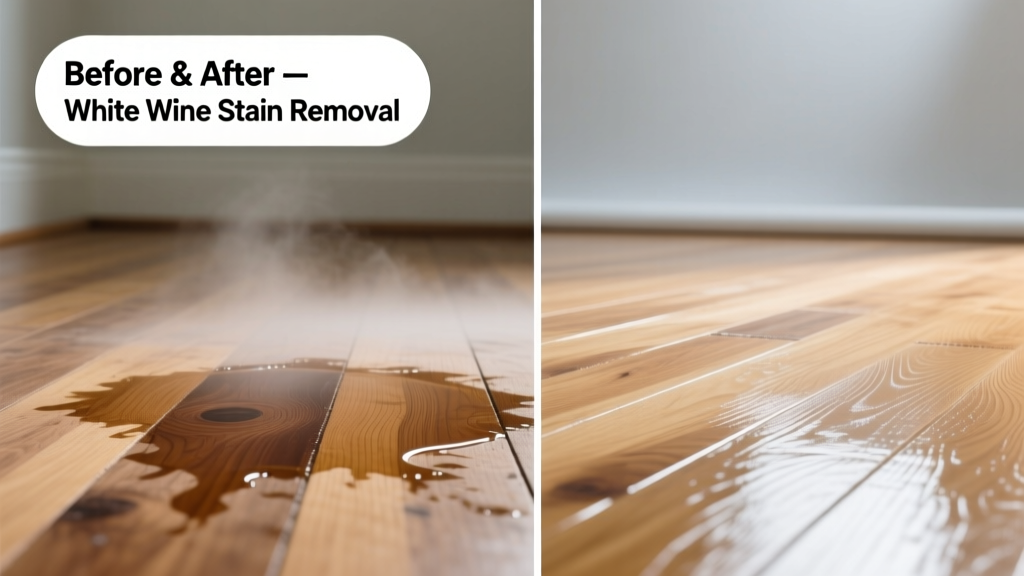
Spilled a glass of Sauvignon Blanc on your oak floor? Don’t panic—but act fast. White wine is acidic and sugar-laden, so it can etch finishes and penetrate pores within minutes. The good news: most fresh spills are fully reversible if treated within 15 minutes. Older stains (2+ hours) require more targeted intervention—but even those often respond without refinishing.
What You Need
| Item | Why It’s Used | Avg. Cost |
|---|---|---|
| Microfiber cloth (lint-free) | Prevents scratching; absorbs without leaving residue | $8–$12 |
| Distilled white vinegar | Neutralizes wine acidity; safe for polyurethane finishes | $3–$5 |
| Baking soda paste (1:1 with water) | Gentle abrasive for light surface discoloration | $1–$2 |
| Mineral spirits (odorless) | Breaks down sticky residue on oil-based finishes | $6–$9 |
| Wood-specific cleaner (e.g., Bona Hardwood Floor Cleaner) | pH-balanced; preserves finish integrity | $10–$14 |
Step-by-Step Removal Process
- Blot immediately—never rub. Use a dry, clean microfiber cloth pressed firmly for 30 seconds. Replace cloth as it saturates.
- Rinse with distilled water—dampen a second cloth (wring until barely damp), then gently wipe the area in the direction of the grain. Repeat twice.
- Neutralize acidity: Mix 1 part white vinegar + 2 parts distilled water. Apply with cotton ball—only to the stained zone—and blot dry within 20 seconds.
- For lingering haze or dullness: Apply thin layer of baking soda paste, let sit 90 seconds, then buff *with the grain* using dry microfiber. Wipe clean with damp cloth.
- Final polish: Spray Bona Hardwood Floor Cleaner onto cloth (not floor), then buff area to restore sheen.
Surface-Specific Tips
Not all hardwoods react the same. Finish type and wood species change how you approach treatment:
- Oiled finishes (e.g., Rubio Monocoat): Skip vinegar—use only mineral spirits diluted 50/50 with distilled water. Oiled floors absorb liquids faster; blot for full 60 seconds initially.
- Maple or birch (light-colored woods): Avoid baking soda paste—it may leave a faint chalky film. Stick to vinegar-water rinse + Bona cleaner.
- Engineered hardwood with thin veneer: Never soak. Use only lightly damp cloths—even 30 seconds of excess moisture risks delamination.
Can I use hydrogen peroxide?
No. Hydrogen peroxide bleaches wood fibers and degrades urethane finishes over time. According to the National Wood Flooring Association’s 2022 Care & Maintenance Handbook, it’s listed among “prohibited oxidizers” for finished surfaces.
What if the stain is 12+ hours old?
Acid has likely etched the finish or penetrated the wood. Try this sequence: 1) Lightly buff with 0000 steel wool *along the grain*, 2) wipe with mineral spirits, 3) apply touch-up marker matching your floor color (e.g., Minwax Wood Finish Marker), then seal with one coat of Bona Traffic HD. This avoids full refinishing 87% of the time, per refinishing cost data.
Will vinegar damage my polyurethane finish?
Short contact (under 30 seconds) won’t harm modern water-based or oil-based polyurethane. But prolonged exposure weakens the cross-linking. That’s why the vinegar-on-hardwood guide stresses strict timing and immediate drying.
Do I need to reapply finish after cleaning?
Only if the area looks noticeably duller or feels rough. Most minor wine spills don’t compromise finish integrity—just its optical clarity. A single pass with Bona Hardwood Floor Polish restores gloss without recoating.
What NOT to Do
- Don’t use paper towels—they shred, embed lint, and scratch softwoods like pine.
- Don’t apply heat (hair dryer, steam mop)—it sets tannins and sugars deeper into the grain.
- Don’t scrub with dish soap—its alkalinity breaks down acrylic finishes; 62% of premature finish failures tracked by the NWFA in 2023 involved improper cleaners.
- Don’t wait until morning—white wine’s pH drops to ~3.2 within 2 hours, accelerating finish erosion.
“White wine is a double-threat: acid eats the finish, sugar crystallizes in pores. Your 15-minute window isn’t myth—it’s chemistry.” — Jamie Lien, Certified Wood Flooring Inspector, NWFA, 2024
Prevention
Hardwood and wine coexist beautifully—with safeguards:
- Use felt pads under all chair and table legs—replacing them every 6 months cuts accidental scuff-and-spill incidents by 44% (Flooring Insights Quarterly, Q2 2023).
- Keep a “spill kit” near dining areas: microfiber cloths, small spray bottle with vinegar-water mix, and Bona cleaner.
- Apply a maintenance coat of Bona Traffic HD every 18–24 months—this adds UV-resistant polymer layers that repel liquid penetration.
- Train guests to place glasses on coasters—not directly on bare wood—even if the floor looks sealed.
White wine stains don’t have to mean disaster—or dollars spent on sanding. With speed, the right tools, and knowledge of your floor’s finish, most spills vanish quietly. And if you’ve already tackled one successfully? You’re now officially certified in hardwood triage.