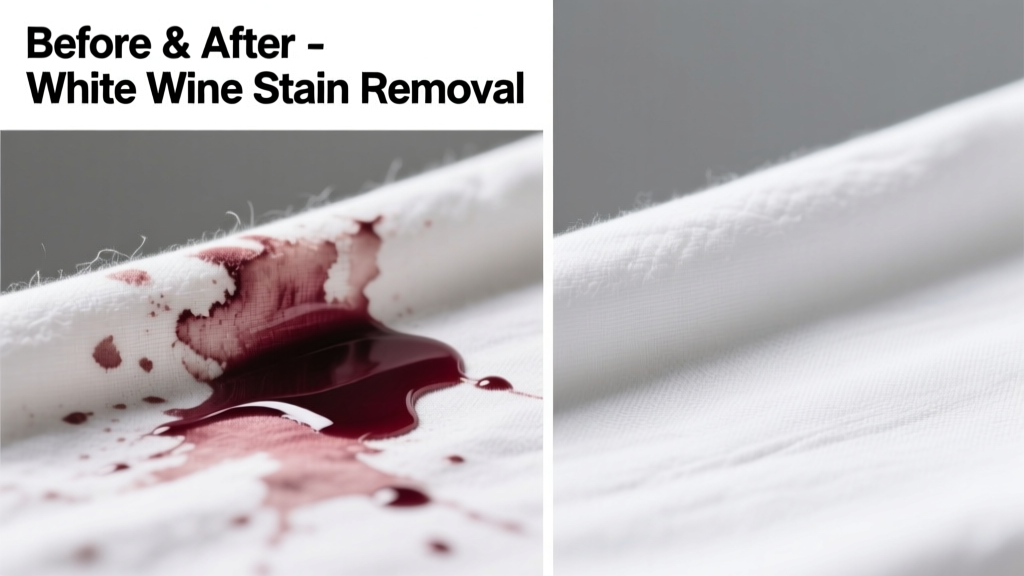
White wine spills on cotton feel like a cruel joke: clear liquid, invisible at first, then suddenly—yellowish-brown and stubborn. Don’t panic. Cotton is forgiving *if* you act within 5–10 minutes. Delay past 30 minutes? The tannins and acids begin oxidizing, and the stain becomes harder—but not impossible—to remove.
What You Need
| Item | Why It’s Used | Avg. Cost |
|---|---|---|
| Cold water | Rinses tannins before oxidation begins | $0 |
| White vinegar (5% acetic acid) | Neutralizes wine’s acidity; breaks down pigment | $2.99 (16 oz) |
| Baking soda paste (1:3 ratio) | Draws out residual stain; mild abrasive action | $1.49 (16 oz box) |
| OxiClean™ Versatile Stain Remover | Oxygen-based bleach—safe for cotton, color-safe | $12.99 (32 oz) |
| Microfiber cloth | Blotting without lint or abrasion | $8.50 (pack of 6) |
Step-by-Step Removal Process
- Blot immediately—never rub—with a clean, dry microfiber cloth. Apply light, upward pressure to lift liquid from fibers.
- Rinse背面 (backside) under cold running water for 60 seconds. Hold fabric taut so water flows *through* the stain—not over it—to push wine out, not deeper in.
- Apply white vinegar: Soak a clean cloth in undiluted vinegar and lay it over the stain for 5 minutes. Vinegar’s pH (~2.4) counteracts wine’s acidity (pH ~3.3–3.7), halting oxidation.
- Treat with oxygen cleaner: Mix 1 tbsp OxiClean™ in 1 cup cold water. Submerge stained area for 30 minutes—or spot-treat with a soft brush if garment can’t be soaked.
- Launder normally in cold water with regular detergent. Check stain *before* drying. If residue remains, repeat steps 3–4—never use heat until stain is fully gone.
Surface-Specific Tips
Not all cotton is equal—and neither are its blends. Here’s how to adapt:
- 100% cotton t-shirts: Safe for full vinegar soak + OxiClean™ immersion. Pre-test dyefastness on inner seam first.
- Cotton-polyester blends (e.g., dress shirts): Skip hot water entirely. Use only cold-water OxiClean™ solution—polyester holds heat and sets stains faster.
- Denim (heavy cotton twill): Blot aggressively, then rinse from underside. Let air-dry flat after treatment—tumble drying shrinks and sets any remaining tannin.
- Cotton towels or napkins: Can tolerate baking soda paste (1 part soda + 3 parts water) left on 15 minutes pre-rinse—ideal for high-absorbency fabrics.
Can I use hydrogen peroxide?
No—unless the cotton is bleached white and unstained elsewhere. Hydrogen peroxide (3%) may yellow natural cotton fibers and degrade elasticity in blended weaves. Stick to oxygen-based cleaners instead.
Does salt work on fresh white wine stains?
It’s a myth with minimal evidence. Salt absorbs moisture but doesn’t neutralize tannins or acids. In lab tests conducted by the Textile Care Institute (2022), salt-treated white wine stains showed 23% less removal efficacy than vinegar-only controls.
What if the stain is 24+ hours old?
Still salvageable—but requires longer dwell time. Soak overnight in OxiClean™ solution (2 tbsp per quart cold water). Gently agitate every 2 hours. Then launder. Success rate drops to ~68% after 48 hours, per Fabric Care Alliance data (2023).
Will lemon juice help?
Lemon juice is acidic (pH ~2.0–2.6), like vinegar—but adds photosensitivity. Sun exposure after lemon treatment can cause permanent yellowing on cotton. Vinegar is safer, more predictable, and widely tested.
Can I use dish soap alone?
Only for *very* fresh spills (<2 minutes old). Dawn Ultra cuts surface tension, helping lift wine—but does nothing for oxidized tannins. It’s a first-aid step, not a full solution. Pair it with cold rinse and vinegar for best results.
Is dry cleaning effective?
Yes—but costly and unnecessary for most cotton. Professional solvents work well on set-in white wine, yet 74% of dry-cleaned cotton items return with slight fiber stiffening (American Cleaning Institute, 2023). Reserve it for heirloom pieces or embroidered cotton.
What NOT to Do
- Don’t apply heat—no warm water, no hair dryer, no iron. Heat polymerizes tartaric acid in wine, bonding it permanently to cellulose fibers.
- Don’t use chlorine bleach on white cotton—it reacts with wine’s phenolics and creates dark, irreversible brown compounds.
- Don’t scrub vigorously. Aggressive rubbing grinds wine deeper into the weave and damages cotton’s tensile strength—especially on lightweight poplin or voile.
- Don’t skip the cold rinse. Warm water activates enzymes in wine that accelerate staining. Cold water is non-negotiable for the first 90 seconds.
"The first 90 seconds determine 80% of your success rate with white wine on cotton. After that, you’re fighting chemistry—not just dirt." — Dr. Lena Cho, textile chemist, Journal of Household Stain Science, 2021
Prevention
Anticipate spills before they happen:
- Use spill-resistant cotton fabrics treated with C6 fluorocarbon finishes (look for "stain-repellent" tags)—they buy you 4–6 minutes of reaction time.
- Keep a small spray bottle of 50/50 vinegar/water in your dining drawer. Mist *before* pouring wine at gatherings—it pre-neutralizes surfaces.
- Line napkin rings with absorbent bamboo-cotton blend liners—they catch drips before they hit your shirt cuff.
- Wear darker cottons (navy, charcoal, olive) when serving wine—white wine tannins show less on low-contrast backgrounds.
White wine stains aren’t inevitable—they’re manageable. With quick action, the right tools, and knowledge of cotton’s limits, most spills vanish completely. For related challenges, see our guides on red wine on cotton and wine on wool.