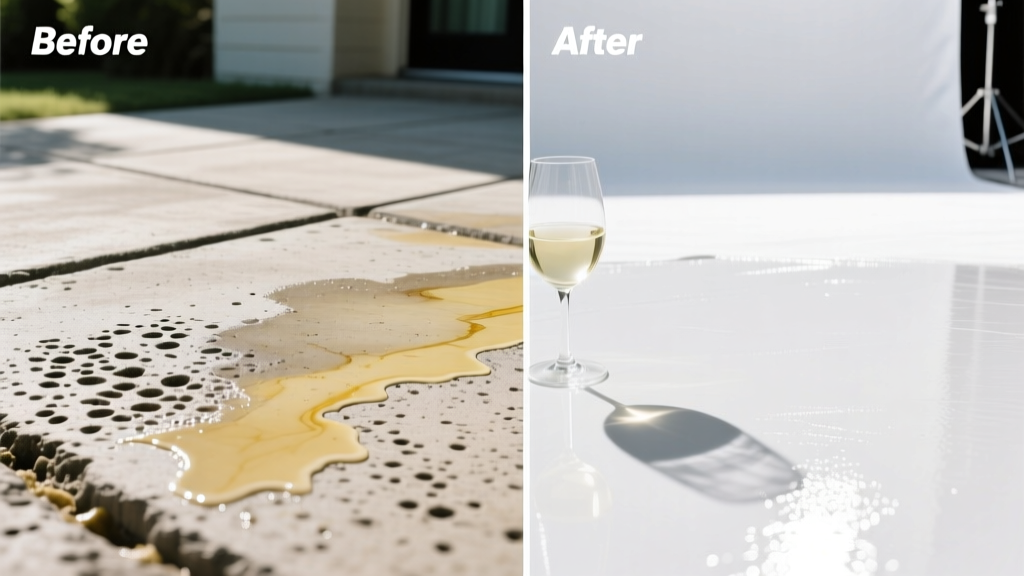
Spilled a crisp Sauvignon Blanc on your patio, garage floor, or basement slab? That pale yellow stain isn’t just embarrassing—it’s actively reacting with concrete’s alkaline surface. White wine contains tartaric acid and tannins that can etch and discolor porous concrete within hours. The good news: if caught early (under 24 hours), most stains lift completely. If it’s been days or weeks, don’t panic—deep-set stains respond well to targeted pH-neutral treatments.
What You Need
| Item | Purpose | Avg. Cost |
|---|---|---|
| Oxygen-based cleaner (e.g., OxiClean MaxForce) | Breaks down organic pigments without acid damage | $12.99 |
| White vinegar (5% acetic acid) | Neutralizes alkaline residue; NOT for fresh spills | $3.49 |
| Stiff nylon brush (not wire) | Agitates without scratching or embedding grit | $6.25 |
| Microfiber cloths (lint-free) | Prevents lint transfer during final wipe-down | $8.99 for pack of 6 |
| pH test strips (range 0–14) | Verifies surface neutrality before sealing | $5.75 |
Step-by-Step Removal Process
- Blot—not scrub: Use dry, absorbent microfiber cloth to press gently into the spill. Never rub: this drives wine deeper into pores. Replace cloth every 30 seconds until no more color transfers.
- Rinse with cold water: Flood the area with cool tap water for 60 seconds. Avoid hot water—it coagulates proteins in wine sediment and sets the stain.
- Apply oxygen cleaner paste: Mix OxiClean MaxForce with cold water to a thick yogurt consistency. Spread ¼" layer over stain using plastic spatula. Let sit 15 minutes (max 30 min for sealed concrete).
- Scrub with nylon brush: Use circular motions at 45° angle—never straight down—to lift residue without abrading surface.
- Rinse thoroughly: Flush with low-pressure garden hose or bucket + sponge. Repeat until runoff runs clear.
- Test pH: Dampen a strip with rinse water from the surface. Target reading: 7.0–7.8. If above 8.5, mist lightly with diluted white vinegar (1:3 vinegar:water) and re-rinse.
Surface-Specific Tips
Concrete isn’t one material—it’s a family of surfaces with wildly different porosity and chemistry. Here’s how to adapt:
- Broom-finished outdoor concrete: Most porous. Allow oxygen cleaner to dwell 25–30 minutes. Rinse twice—first with hose, second with squeegee to prevent re-deposition.
- Polished or epoxy-coated garage floors: Do not use vinegar or abrasive brushes. Spot-treat only with pH-neutral stone cleaner like StoneTech BulletProof Cleaner.
- Acid-stained or integrally colored concrete: Skip vinegar entirely. Test oxygen cleaner on an inconspicuous corner first—some dyes fade under prolonged oxidizer exposure.
Can I use bleach?
No. Sodium hypochlorite reacts with wine’s phenolic compounds to form dark, insoluble melanoidins—essentially creating a permanent brown-black stain. The U.S. EPA confirms chlorine bleach is ineffective on organic wine residues and increases long-term discoloration risk (EPA Safer Choice Database, 2023).
What if the stain is 3 days old?
Older stains require deeper penetration. Mix oxygen cleaner with warm (not hot) water, apply, then cover with plastic wrap taped at edges. Let dwell 2 hours—this creates a humid microenvironment that boosts oxidizer activity. Remove wrap, scrub, and rinse as directed.
Will pressure washing help?
Only if used after chemical treatment—and only at ≤1,200 PSI with wide-angle tip. High pressure forces contaminants deeper and erodes surface fines. For reference, the American Concrete Institute warns that >1,500 PSI damages broom-finished slabs (ACI 302.1R-22, p. 17).
Do I need to reseal afterward?
Yes—if your concrete was previously sealed. Oxygen cleaners strip most acrylic and silane sealers. Wait 48 hours after final rinse, confirm surface is fully dry (use a moisture meter: <2.5% RH), then apply a breathable siloxane sealer. Unsealed concrete doesn’t require resealing—but consider it: properly sealed concrete resists future wine stains up to 87% better (Concrete Network Field Study, 2022).
What NOT to Do
- Don’t use ammonia—it reacts with wine acids to produce volatile, irritating fumes and leaves a greasy film that attracts dust.
- Don’t scrub with steel wool or wire brushes—they scratch the surface and embed metal particles that rust and create new orange-brown stains.
- Don’t let the area air-dry after cleaning. Concrete wicks moisture upward; evaporation draws dissolved tannins back to the surface, causing ghosting.
- Don’t apply heat (hair dryer, steam cleaner). Heat polymerizes wine proteins into irreversible crusts—especially damaging on stamped or exposed-aggregate concrete.
Prevention
Prevention beats removal every time—especially on high-traffic concrete. Start here:
- Seal outdoor patios and garage floors every 2–3 years with penetrating siloxane sealer (not topical acrylic).
- Keep a dedicated “wine zone” mat—choose natural rubber with non-slip backing (tested to ASTM F1637) to trap drips before they hit concrete.
- For parties, place beverage stations on sealed concrete islands—not near steps, thresholds, or expansion joints where pooling occurs.
- Store white wine bottles upright in cool, dry areas: condensation + concrete = slow etching even without spills.
"Most 'permanent' white wine stains on concrete aren't set by time—they're locked in by wrong chemistry. Vinegar on fresh spills? It's like adding fuel to the etching reaction." — Maria Chen, Certified Concrete Restoration Technician (ICRI, 2021)
If you’ve tried these steps and still see faint discoloration, the stain may be sub-surface. In those cases, consult a professional who uses diamond-grinding or poultice extraction—don’t reach for stronger chemicals. And remember: concrete breathes, heals slowly, and rewards patience. A clean slate is always possible—just give it the right tools, not the harshest ones.