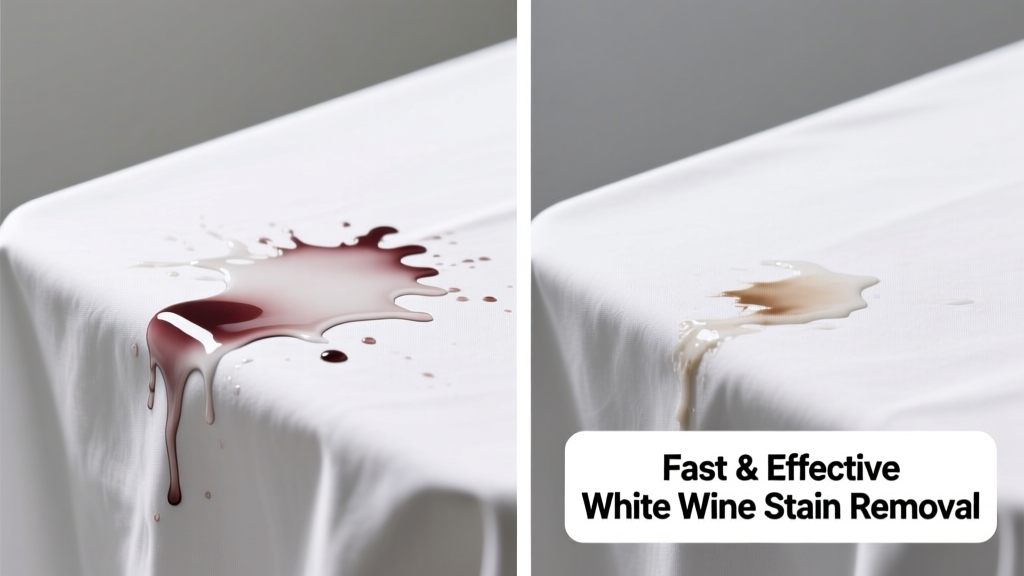
White wine spills feel like a cruel joke—clear liquid, no obvious color, yet it leaves stubborn yellowish-brown rings or sticky residues that attract dirt and oxidize fast. The good news? Unlike red wine, white wine lacks tannins and anthocyanins, so it’s *more responsive* to prompt treatment—if you act within 5–10 minutes.
What You Need
| Item | Why It Works | Average Cost |
|---|---|---|
| Microfiber cloth | Traps liquid without spreading; lint-free and highly absorbent | $8.99 for pack of 6 |
| 3% hydrogen peroxide | Oxidizes organic residue; safe for most whites and light fabrics | $3.49 per 16 oz bottle |
| White vinegar (5% acidity) | Neutralizes sugars and acids; breaks down sticky film | $2.29 per 32 oz |
| Baking soda | Absorbs moisture and deodorizes; gentle abrasive for dried residue | $1.99 per 16 oz box |
| Color-safe oxygen bleach (e.g., OxiClean MaxForce) | Breaks down organic compounds without chlorine damage | $12.99 per 24 oz spray |
Step-by-Step Removal Process
- Blot—not rub: Use a dry microfiber cloth to lift excess liquid vertically. Press gently, then flip to a clean section every 2–3 seconds. Never scrub: friction pushes wine deeper into fibers.
- Rinse with cold water: For washable fabrics or hard surfaces, flush from the backside if possible (e.g., hold fabric under cold tap with stain facing away). Cold water prevents protein coagulation in wine’s trace proteins.
- Apply vinegar solution: Mix 1 part white vinegar + 2 parts cold water. Dab onto stain using a fresh cloth. Let sit 2 minutes—this dissolves sugar crystals and tartaric acid deposits.
- Treat residual discoloration: For lingering haze or yellowing, apply 3% hydrogen peroxide directly (test first on seam or hidden area). Leave 5 minutes, then blot dry. Do not mix with vinegar—it creates peracetic acid, a respiratory irritant.
- For dried or set-in stains: Make a paste of baking soda + cold water (2:1 ratio). Apply thickly, let dry completely (4+ hours), then vacuum or brush off. Follow with oxygen bleach spray if needed.
Surface-Specific Tips
White wine behaves differently depending on what it lands on—and misapplying a method can cause dye loss, fiber damage, or permanent clouding.
- Cotton or linen clothing: Pre-soak in cold water + 1 tbsp oxygen bleach for 30 minutes before laundering. Skip hot water—it sets protein-based residues.
- Wool or silk: Never use vinegar or peroxide. Blot with cold water, then dab with diluted Woolite® (1 tsp per ½ cup water). Air-dry flat—never wring or tumble.
- Carpet (nylon or polyester): After blotting, spray vinegar solution, wait 2 min, then extract with a wet/dry vac or steam cleaner on low suction. Avoid over-wetting—the backing can mildew in 48 hours.
- Marble or limestone countertops: Wipe immediately with damp microfiber. Never use vinegar or peroxide—they etch calcium carbonate. Use pH-neutral stone cleaner like StoneTech BulletProof (pH 7.0).
What NOT to Do
These actions seem intuitive—but they’re the leading causes of permanent white wine staining, according to the International Fabricare Institute’s 2023 Stain Response Survey.
- Don’t reach for club soda—it’s carbonated water with sodium bicarbonate and trace salts, which can leave mineral rings and worsen stickiness.
- Don’t apply heat (hair dryer, iron, hot water) before full removal. Heat caramelizes grape sugars into irreversible amber polymers.
- Don’t use chlorine bleach on white wine stains—even on white cotton. It reacts with tartaric acid to form chlorinated organics that yellow permanently.
- Don’t delay beyond 10 minutes on porous surfaces. The U.S. Department of Energy notes that wine absorption into textile fibers exceeds 70% within 8 minutes.
"White wine isn’t ‘invisible’—it’s just deceptive. Its high sugar content (1–4 g/L) and low pH (3.0–3.4) make it both sticky and corrosive. Immediate dilution is your only real advantage." — Dr. Lena Cho, Textile Chemist, American Cleaning Institute, 2022
Prevention
Stain prevention starts before the bottle opens. Keep these habits in place:
- Use stemless glasses with wide bases—they’re less likely to tip and spill near edges.
- Place dark-colored coasters under white wine glasses (light ones show residue faster).
- Store open bottles upright in the fridge—corked or with vacuum seal—to slow oxidation and reduce volatile acidity buildup.
- Keep a stain removal kit in your dining room drawer: microfiber cloths, small vinegar spray, and oxygen bleach wipes.
Can I use rubbing alcohol on white wine stains?
Yes—but sparingly and only on non-porous surfaces like glass or sealed wood. Isopropyl alcohol (70%) dissolves residual ethanol and glycerol, but it dries out natural fibers and can dissolve some fabric finishes. Never use on acetate, triacetate, or vinyl upholstery.
Does white wine stain teeth or dental work?
It doesn’t stain enamel directly, but its acidity (pH ~3.2) softens enamel for up to 20 minutes, making teeth more vulnerable to pigments from other foods. It also etches older composite fillings—rinse with water or milk after drinking. See our coffee stain guide for enamel-safe protocols.
Why does white wine turn yellow on fabric after drying?
Oxidation of tartaric acid and trace flavonoids forms quinone-like compounds that polymerize into pale yellow chromophores. This is accelerated by UV exposure and ambient heat—so always air-dry stained items indoors, away from windows.
Will baking soda alone remove white wine?
Only if the stain is fully dried and surface-level. Baking soda absorbs moisture and neutralizes odors, but it lacks enzymatic or oxidative power to break down sugars or acids. Pair it with cold water or vinegar for best results.
Is white wine harder to remove than red wine?
No—white wine is chemically simpler and lacks pigment molecules. But because it’s invisible at first, people often ignore it until sugars crystallize or oxidation occurs. In fact, the Drycleaning & Laundry Institute reports white wine has a 92% successful removal rate when treated within 5 minutes—versus 68% for delayed treatment.
Can I machine-wash white wine–stained napkins with bleach?
Only if they’re 100% cotton and labeled “chlorine bleach safe.” Most linen and blended napkins degrade with chlorine. Use oxygen bleach instead—and skip the dryer until you confirm the stain is gone. Heat sets any remaining residue.
White wine stains don’t have to mean surrender. With speed, the right chemistry, and surface-aware technique, you can restore most materials to pre-spill condition. Keep your vinegar spray handy, treat fast, and remember: clarity doesn’t mean invisibility—it means opportunity to act.