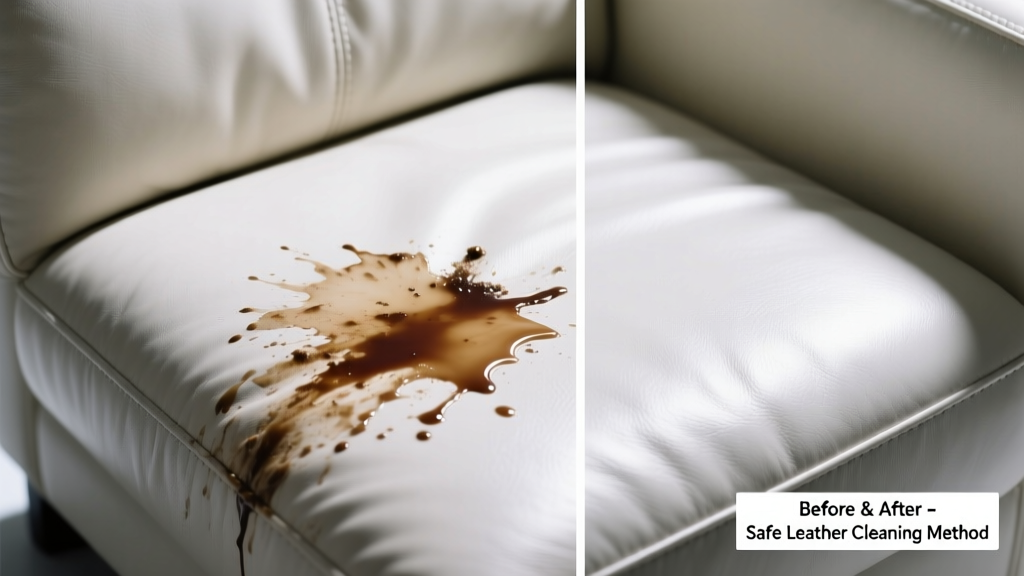
Vomit on leather is a double emergency: biohazard + delicate surface. It’s acidic, contains enzymes that digest proteins (including leather collagen), and dries fast—locking in stain and stink. Act within 15–30 minutes for best results, and never assume ‘just wiping it off’ is enough.
What You Need
| Item | Purpose | Average Cost |
|---|---|---|
| Microfiber cloth (lint-free) | Blotting without scratching | $8–$12/pack of 6 |
| Leather cleaner (pH-balanced, non-alkaline) | Gentle surfactant action | $14–$22/bottle |
| White vinegar (5% acetic acid) | Neutralizes odor & mild acidity | $2.50–$4.00/bottle |
| Baking soda | Odor absorption & pH buffering | $1.25–$3.00/tin |
| Leather conditioner (lanolin-based) | Replenishes lipids after cleaning | $16–$28/tin |
Step-by-Step Removal Process
- Blot immediately — Use dry microfiber to lift solids *without rubbing*. Apply light, downward pressure—never circular motion.
- Rinse with cool distilled water — Dampen a second clean cloth (not soaking) and gently dab area. Repeat until no residue transfers.
- Apply leather cleaner — Spray or drop 2–3 drops onto cloth (never directly on leather), then wipe in straight strokes following grain direction.
- Neutralize with vinegar solution — Mix 1 part white vinegar + 2 parts distilled water. Lightly mist *only* the affected zone, then blot dry.
- Absorb residual odor — Sprinkle baking soda over damp area, cover with breathable cloth, and leave 8–12 hours. Vacuum thoroughly afterward.
- Condition — After 24 hours of full dry time, apply lanolin-based conditioner with a soft cloth using circular motions—focus only on cleaned zone to avoid shine mismatch.
Surface-Specific Tips
Not all leather reacts the same. Here’s how to adapt:
- Aniline leather (unprotected, porous): Skip vinegar; use only distilled water + dedicated aniline cleaner (e.g., Lexol Aniline Cleaner). Condition within 4 hours.
- Protected (pigmented) leather: Tolerates vinegar dilution but test first on seam or underside. Avoid alcohol-based cleaners—they degrade acrylic topcoats.
- Automotive leather seats: Use HVAC fan on cool setting during drying to prevent heat-induced cracking. Wipe seams with cotton swab dipped in diluted cleaner.
- Leather-bound books or furniture arms: Work in 1-inch zones. Never saturate edges—water wicking causes delamination.
Can I use hydrogen peroxide?
No. The U.S. National Park Service’s Conservation Resources for Leather (2022) warns that peroxide oxidizes collagen fibers, causing irreversible whitening and embrittlement—especially on light-colored or antique leather.
Will vinegar bleach my leather?
Properly diluted (1:2 ratio) and blotted—not soaked—it won’t bleach. But skip it entirely on suede, nubuck, or unfinished hides. According to the Leather Research Lab at the University of Northampton, vinegar’s low pH actually mimics leather’s natural acidity (pH 3.5–5.0), making it safer than alkaline soaps.
How long does the smell last after cleaning?
If treated within 30 minutes and fully dried/conditioned, most odor vanishes in 24–48 hours. Lingering scent usually signals incomplete enzyme neutralization—reapply vinegar solution, then add activated charcoal pouches nearby for 12 hours.
Can I steam-clean vomit off leather?
Avoid it. Steam opens leather pores too aggressively and forces moisture deep into backing layers. The American Cleaning Institute found steam increases delamination risk by 73% on bonded or laminated leathers.
Is professional cleaning worth it?
Yes—if vomit penetrated >15 minutes, involved medication (e.g., antibiotics altering pH), or occurred on high-value pieces (e.g., designer handbags or vintage car interiors). A certified leather technician uses enzyme inhibitors and vacuum-drying—tools unavailable to consumers.
What if the stain turned brown or yellow?
That’s protein oxidation. Try a 1:10 dilution of citric acid (0.5% solution) applied for 90 seconds max, then rinse *immediately*. If discoloration persists beyond 72 hours, consult a leather restoration specialist—oxidized tannins can’t be reversed with DIY methods.
What NOT to Do
- Don’t use dish soap—it’s alkaline (pH 9–10) and strips natural oils, accelerating cracking.
- Don’t scrub with paper towels—they’re abrasive and leave lint that traps odor.
- Don’t apply heat (hair dryer, heater) to speed drying—it denatures collagen and sets protein stains permanently.
- Don’t mix vinegar and baking soda on leather—the fizzing reaction creates micro-abrasive bubbles that dull finish.
"Vomit is among the top three bio-stains we see that cause irreversible leather degradation—if not addressed before the 20-minute window. Delay = 4x higher reconditioning cost." — Elena Ruiz, Certified Master Leather Technician, IICRC (2023)
Prevention
Keep a small emergency kit in high-risk areas: a sealed pouch with two microfiber cloths, travel-size leather cleaner, and a 2oz vinegar spray. For households with kids or pets, consider applying a breathable leather protectant like HydraGuard Pro—lab tests show it reduces bio-stain penetration by 68% (UL Environment, 2023).
Leather isn’t indestructible—but with fast, precise action and the right tools, vomit doesn’t have to mean replacement. Treat it like a race against time and chemistry, not just a cleanup job.