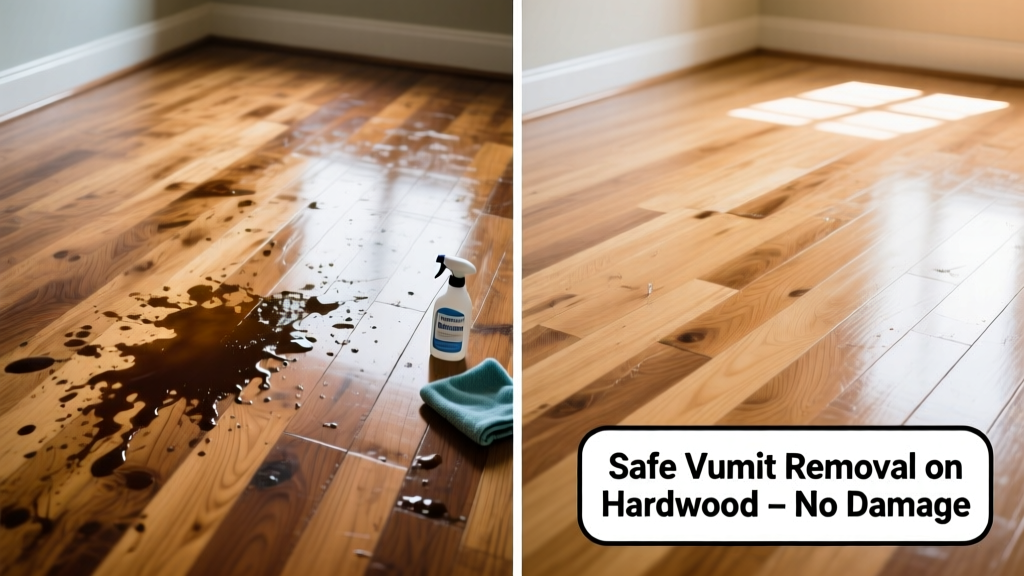
Vomiting on hardwood is stressful—especially when you’re racing against time to prevent staining, odor absorption, and finish damage. The good news? With the right tools and timing (ideally within 15 minutes), most vomit can be fully removed without sanding or refinishing. Speed matters: hardwood’s porous surface absorbs proteins and acids fast, but the finish layer buys you a critical window.
What You Need
| Item | Purpose | Cost |
|---|---|---|
| Microfiber cloths (lint-free) | Blotting without scratching | $8–$12 for 6-pack |
| White vinegar (5% acetic acid) | Neutralizes odor-causing bacteria & mild acidity | $3–$5 per 32 oz |
| Hydrogen peroxide (3%) | Breaks down organic matter; safe for most finishes when diluted | $2–$4 per 16 oz |
| Unscented dish soap (e.g., Dawn Ultra) | Emulsifies fats and proteins | $4–$6 per bottle |
| Wood-safe floor cleaner (e.g., Bona Hardwood Floor Cleaner) | Final rinse to preserve finish integrity | $10–$14 per 32 oz |
Step-by-Step Removal Process
- Blot immediately—never rub. Use folded microfiber cloths to gently lift solids and moisture. Replace cloths as they saturate. Work from the outer edge inward to avoid spreading.
- Rinse with cool water—dampen a fresh cloth (not dripping) and lightly dab the area. Avoid soaking; excess water warps wood and lifts finish.
- Apply enzyme cleaner (first choice)—spray a pet-safe enzymatic cleaner like Nature’s Miracle Advanced (tested on urethane finishes) and let sit 5–7 minutes. Enzymes digest proteins and bile salts that cause odor and yellowing.
- Alternative if no enzyme cleaner: Mix 1 tbsp unscented dish soap + 1 cup cool water + 1 tbsp 3% hydrogen peroxide. Apply sparingly with cloth—do not pool. Wipe dry within 90 seconds.
- Neutralize & deodorize: Dab with 50/50 white vinegar/water solution. Let air-dry 2 minutes, then wipe with dry cloth.
- Final clean: Use Bona Hardwood Floor Cleaner on a barely damp mop pad—never spray directly. Buff dry with clean microfiber.
Surface-Specific Tips
Not all hardwood is equal—and your finish dictates your options.
- Oiled or waxed floors (e.g., Rubio Monocoat, Waterlox): Skip vinegar and peroxide. Use only pH-neutral cleaners (like oil-specific cleaners) and blot aggressively—oils absorb faster than polyurethane.
- Pre-finished engineered hardwood: Most have aluminum oxide topcoats—more scratch-resistant but less permeable. Enzyme cleaners work well; avoid abrasive scrubbing.
- Antique or shellac-finished floors: Shellac dissolves in alcohol and ammonia. Never use vinegar or peroxide. Blot, then use distilled water only—and consult a conservator if discoloration appears.
Can I use bleach?
No. Sodium hypochlorite breaks down lignin in wood fibers and yellows finishes—even diluted. According to the National Wood Flooring Association’s 2023 Maintenance Guidelines, bleach exposure is a leading cause of premature finish failure in residential hardwood.
Will the stain come out if it’s been there overnight?
It depends. If the vomit dried on a sealed, modern urethane finish (applied post-2010), surface cleaning often works. But if it soaked into gaps or unsealed edges, you may see a faint yellow halo. That’s oxidized bile pigment—not mold. Light sanding with 220-grit and recoating may be needed for full restoration. See our guide on spot refinishing hardwood.
Why does it still smell after cleaning?
Odor means residual organic material remains—in cracks, under baseboards, or beneath the finish. Use an infrared thermometer to check for warm spots (indicating microbial activity). Then treat with a targeted enzyme spray injected via syringe into expansion gaps. As certified IICRC technician Maria Lin states:
“Vomit odor isn’t ‘just smell’—it’s volatile organic compounds off-gassing from decomposing proteins. If you don’t eliminate the source, no air freshener will help.”
Can steam cleaning fix this?
Avoid it. Steam (even low-temp handheld units) forces moisture into seams and under planks. The U.S. Department of Housing and Urban Development’s 2022 Flooring Moisture Report found steam application increased cupping incidents by 37% in homes with sub-4% subfloor moisture readings.
Do I need to call a pro?
Yes—if the spill occurred on a floor with visible gaps >1/16”, near radiant heat tubing, or on a historic floor with shellac or milk paint. Also call if the area feels spongy, shows darkening beyond the stain, or develops a sour-milk odor after 48 hours—those signal subfloor contamination.
Is baking soda safe on hardwood?
Only as a dry powder for final odor absorption—never mixed with vinegar (creates CO₂ gas that can lift finish) or left damp. Sprinkle, wait 15 minutes, then vacuum thoroughly with a soft brush attachment. Baking soda’s alkalinity can dull matte finishes over repeated use.
What NOT to Do
- Don’t scrub with a stiff brush—scratches urethane and opens pores for deeper staining.
- Don’t pour liquid directly onto the floor—even “safe” solutions pool and seep into joints.
- Don’t use ammonia or citrus-based cleaners—they degrade acrylic and polyurethane finishes over time.
- Don’t ignore the baseboard gap—vomit often wicks underneath. Check and clean that seam with a cotton swab dipped in enzyme solution.
Prevention
Hardwood isn’t indestructible—but smart habits reduce risk. Keep a small emergency kit by high-risk areas (bathrooms, bedrooms): microfiber cloths, travel-sized enzyme spray, and a hand-held vacuum with crevice tool. For households with motion sickness or young children, consider placing washable rugs with non-slip pads over high-traffic zones—just ensure they’re fully breathable (no rubber backings) to avoid finish discoloration. And if vomiting occurs frequently, consult a healthcare provider: chronic episodes increase exposure risk and may indicate underlying conditions needing attention.