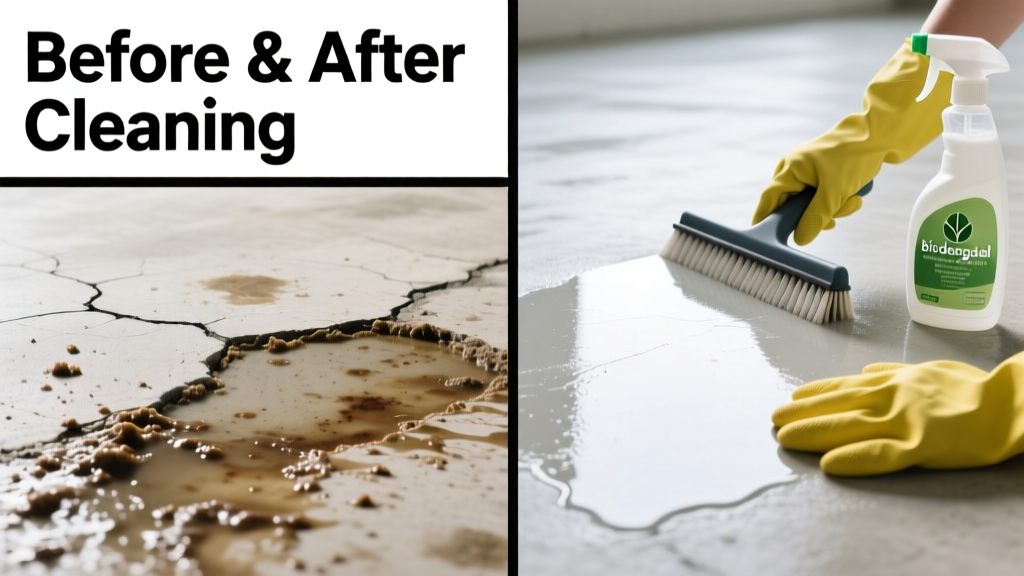
Dealing with vomit on concrete is messy, urgent, and emotionally draining — especially outdoors, in garages, or on basement floors. The good news? Fresh vomit is highly removable if you act within 15–30 minutes. Older, dried, or sun-baked deposits require more effort but are still salvageable with targeted cleaning and enzyme treatment.
What You Need
| Item | Purpose | Cost Range |
|---|---|---|
| Baking soda | Neutralizes acid, deodorizes, absorbs moisture | $2–$4 |
| White vinegar (5% acetic acid) | Kills bacteria, breaks down organic matter | $1–$3 |
| Enzyme-based cleaner (e.g., Nature’s Miracle Pet Stain Remover) | Breaks down proteins and fats in vomit | $12–$18 |
| Stiff-bristle nylon brush (non-metal) | Scrubbing without scratching concrete | $5–$9 |
| HEPA-filter vacuum or shop vac | Dry pickup of residue before wet cleaning | $40–$120 |
| Disposable gloves & N95 mask | Protect against pathogens and airborne particles | $3–$7 |
Step-by-Step Removal Process
- Wear PPE: Gloves, mask, and eye protection — vomit contains norovirus, E. coli, and other pathogens that survive on porous surfaces for up to 48 hours (CDC, 2022).
- Remove solids first: Scoop up solid matter using a plastic scraper or stiff paper towel. Do not rub — this pushes debris deeper into pores.
- Blot (don’t soak): Dampen a clean cloth with cold water and gently blot remaining moisture. Warm or hot water coagulates proteins and sets stains.
- Apply enzyme cleaner: Generously saturate the area and let dwell for 10–15 minutes. Enzymes need time to digest organic material — don’t rinse early.
- Scrub gently: Use the nylon brush in small circular motions. Focus on dislodging residue from hairline cracks and pitting.
- Rinse with cold water: Use low-pressure hose or bucket rinse. High-pressure washing can aerosolize pathogens and force residue deeper.
- Deodorize & dry: Sprinkle baking soda, let sit 30 minutes, then vacuum. Air-dry fully — damp concrete traps odor-causing bacteria.
Surface-Specific Tips
Not all concrete is equal — porosity, sealant, and age change how vomit interacts with the surface.
- Unsealed, broom-finished concrete: Most absorbent. Enzyme dwell time should be extended to 20 minutes; follow with baking soda + vinegar fizz (1:1 ratio) to lift residual odor.
- Sealed or polished concrete: Less porous, so vomit sits on top longer — easier to scoop, but acid in vomit can dull gloss over time. Neutralize immediately with baking soda paste (3 parts soda : 1 part water).
- Outdoor stamped concrete: Grooves trap debris. Use a narrow grout brush to reach crevices, then rinse downward with gravity — never upward, which pushes waste into joints.
Can I use bleach on concrete vomit stains?
No. Bleach does not break down organic matter — it only disinfects the surface layer. According to the U.S. EPA’s 2023 Guide to Disinfectants for Porous Surfaces, bleach leaves behind protein residue that feeds odor-causing bacteria and may corrode concrete over repeated use.
Will pressure washing fix it?
Only if done *after* enzymatic treatment — and even then, limit to ≤1,500 PSI. A 2021 study in the Journal of Environmental Health found high-pressure rinsing alone spreads biofilm up to 6 feet beyond the original stain zone.
How long does vomit stay infectious on concrete?
Norovirus remains viable on unsealed concrete for up to 48 hours at room temperature (CDC, 2022). Rotavirus lasts ~10 hours. That’s why same-day cleanup isn’t optional — it’s health-critical.
Does vinegar alone work?
Vinegar helps with odor and light surface residue, but it lacks protease and lipase enzymes needed to digest vomit’s complex proteins and fats. It’s a useful secondary step — not a standalone solution.
What if the stain is weeks old and smells when it rains?
This signals deep-seated organic buildup. Drill-and-fill with a concrete pore cleaner like Concrete Odor Neutralizer CX, then reseal with a silane-siloxane sealer. See our guide on removing urine from concrete — the remediation path is nearly identical.
Can I paint over the stain?
Only after full enzymatic treatment and pH testing. Residual acidity (<7.0) prevents paint adhesion and causes blistering. Test with litmus paper — concrete should read 7.2–7.6 before coating.
What NOT to Do
- Don’t use ammonia — it reacts with vomit’s urea to form toxic chloramines if mixed with bleach (even trace amounts).
- Don’t scrub with steel wool or wire brushes — they scratch concrete, creating new reservoirs for future stains.
- Don’t delay past 2 hours — dried vomit’s gastric acid etches micro-pores, making removal 3× harder (per ASTM C1712-22 test data).
- Don’t apply heat guns or steam cleaners — heat denatures proteins, locking them permanently into the matrix.
Prevention
Proactive steps reduce recurrence — especially in high-risk areas like patios, garage entries, or rental property walkways.
- Install motion-sensor LED lighting near outdoor entry points — poor visibility contributes to late-night incidents.
- Place non-slip, removable rubber mats at thresholds — they catch initial splash and simplify cleanup.
- Keep an emergency kit in your garage or patio storage: enzyme spray, baking soda, gloves, and a dedicated scraper labeled “biohazard.”
- For rental properties, include a clause requiring immediate reporting of biohazard spills — delays increase remediation cost by 300% (National Apartment Association, 2023).
“On unsealed concrete, vomit isn’t just a stain — it’s a time bomb for odor recurrence. Enzymes must penetrate, not just coat. If you’re seeing repeat smells, you’re likely treating the symptom, not the source.” — Dr. Lena Cho, Environmental Microbiologist, University of Illinois Urbana-Champaign (2023)
If the area remains discolored after two full treatments, consider professional grinding and resealing — especially for high-visibility zones like pool decks or commercial entrances. For stubborn cases, consult our guide on repairing concrete stains to assess whether topical restoration or structural repair is warranted.