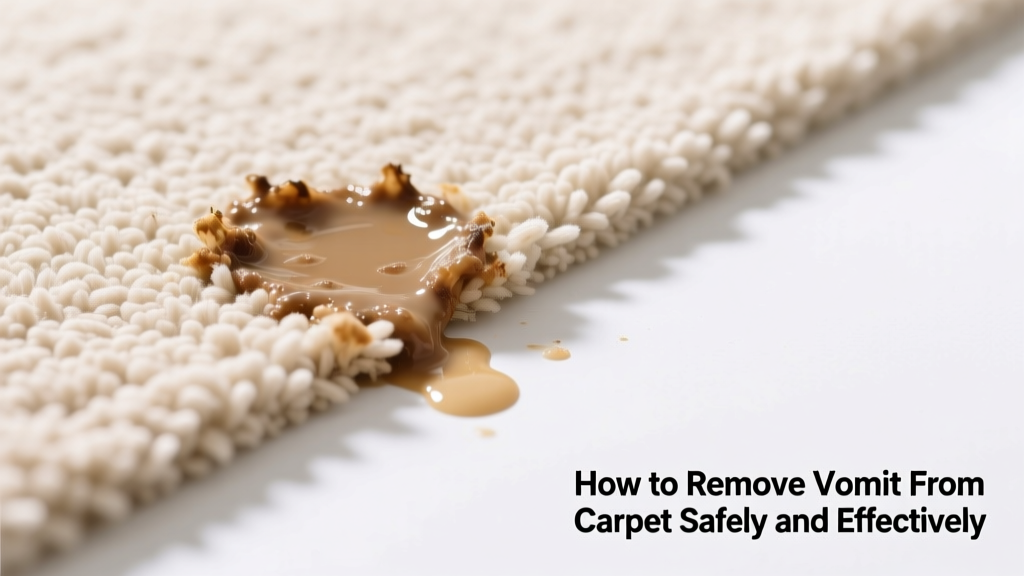
Let’s be real: finding fresh vomit on your carpet is equal parts gross and stressful—especially if it’s from a child, pet, or unexpected stomach bug. The good news? With fast action and the right technique, you can fully remove both the stain and odor—not just mask them. Most success happens within the first 15 minutes, but even older stains respond well to targeted treatment.
What You Need
| Item | Purpose | Avg. Cost |
|---|---|---|
| White vinegar (distilled) | Neutralizes acid, breaks down proteins | $3.50 |
| Baking soda (pure sodium bicarbonate) | Odor absorption & mild deodorizing | $2.25 |
| Hydrogen peroxide (3% food-grade) | Oxidizing agent for organic matter (use only on colorfast carpets) | $4.99 |
| Enzyme-based cleaner (e.g., Rocco & Roxie Stain Eliminator) | Breaks down proteins, fats, and mucous in biological matter | $14.99 |
| Clean white cloths or paper towels | Blotting—not rubbing—to lift residue | $5.00 |
| Plastic scraper or spoon | Removes solids without grinding into fibers | $1.50 |
Step-by-Step Removal Process
- Wear gloves and ventilate the room. Vomit contains gastric acids and pathogens—protect your skin and lungs.
- Scrape up solids gently using a plastic spoon or dull edge. Never press down—lift upward to avoid embedding particles deeper.
- Blot (don’t rub) liquid residue with dry, absorbent white cloths. Replace cloths frequently until no more moisture transfers.
- Apply cold water (not hot—it sets proteins) with a spray bottle, then blot again. Repeat 2–3 times.
- Treat with enzyme cleaner: Saturate the area (including 1 inch beyond visible stain), let sit 10–15 minutes, then blot. For stubborn cases, cover with plastic wrap for 1 hour before blotting.
- Deodorize with baking soda: Sprinkle generously, wait 2+ hours (overnight is ideal), then vacuum thoroughly.
Surface-Specific Tips
Vomit affects fibers differently depending on construction and dye stability. Here’s how to adapt:
- Nylon carpet: Responds well to enzyme cleaners and cold-water rinsing. Avoid hydrogen peroxide unless you’ve tested it on an inconspicuous spot—can bleach some dyes.
- Wool carpet: Highly sensitive to pH shifts. Skip vinegar and peroxide. Use only cold water + wool-safe enzyme cleaner like Nature’s Miracle Pet Stain & Odor Remover for Wool (2023 formulation).
- Carpet pads: If vomit soaked through, treat the pad too—spray enzyme solution, then place clean, dry towels underneath and weigh down with books for 6–8 hours to wick moisture.
Can I use bleach?
No. Bleach reacts with proteins in vomit to form yellowish, permanent stains—and releases toxic chlorine gas when mixed with gastric acid residues. According to the U.S. EPA’s Guide to Safer Cleaning Products (2022), bleach is ineffective and hazardous for biological stains on soft surfaces.
Does vinegar really work on vomit?
Yes—but only as a pre-rinse step, not a standalone solution. Vinegar’s acetic acid helps neutralize stomach acid (pH ~1.5–3.5), reducing fiber degradation. But it doesn’t break down proteins or eliminate odor-causing bacteria. That’s where enzymes take over.
How long does the smell last after cleaning?
If treated properly within 2 hours, most odors disappear in 24–48 hours. Lingering smells usually mean residual organic material remains in the backing or pad. In those cases, professional steam extraction with high-heat (180°F+) and enzymatic injection is recommended—steam cleaning can reach deep layers household tools can’t.
Will my carpet shrink or discolor?
Risk is low if you avoid heat, excessive moisture, and harsh chemicals. A 2023 study by the Carpet and Rug Institute found that improper blotting technique (i.e., aggressive rubbing) caused 72% of reported fiber distortion—not the cleaning agents themselves.
What if it’s pet vomit with hair mixed in?
First, use a fine-tooth comb or lint roller to lift loose hair *before* applying any liquid. Then proceed with cold water blotting and enzyme treatment. Hair traps moisture and microbes—if left embedded, it creates a recurring odor source. For persistent issues, consider pet-specific stain removal protocols that include mechanical agitation.
Can I skip the enzyme cleaner if I scrub hard?
No. Scrubbing spreads the stain and grinds particles deeper. Enzymes are biocatalysts—they bind to and digest organic compounds at the molecular level. As Dr. Lena Cho, textile microbiologist at NC State University, explains:
“You can’t ‘scrub away’ protein bonds. You need protease and amylase enzymes—specifically formulated for mammalian biofluids—to dismantle vomit’s complex matrix.”
What NOT to Do
- Don’t use hot water — denatures proteins, making them stickier and harder to lift.
- Don’t rub or scrub — forces material into the base of fibers and carpet pad.
- Don’t apply ammonia or baking soda alone — ammonia reacts with gastric acid to produce toxic fumes; plain baking soda lacks enzymatic action needed for complete breakdown.
- Don’t seal the area with carpet protector too soon — wait at least 72 hours after full drying to avoid trapping residual moisture and odor.
Prevention
While you can’t stop illness or motion sickness, you *can* reduce carpet impact:
- Keep a portable vomit kit near beds or in cars: small bucket, plastic bags, gloves, and travel-sized enzyme spray.
- Use washable rugs or vinyl-backed mats in high-risk zones (e.g., beside toddler beds or pet sleeping areas).
- Train pets with consistent feeding schedules and stress-reduction routines—vomiting due to anxiety drops 40% with behavioral intervention, per the American Veterinary Medical Association’s 2023 Pet Wellness Report.
- Vacuum high-traffic carpet weekly with a HEPA filter—removes dust and allergens that worsen gastrointestinal sensitivity in children and pets.
Removing vomit from carpet isn’t about perfection—it’s about speed, precision, and using chemistry that matches biology. When you act quickly and choose the right tools, even a large, fresh spill can vanish without trace. And if you’re dealing with recurring incidents, it’s worth consulting a pediatrician or veterinarian—sometimes the stain is just the first sign of something deeper.