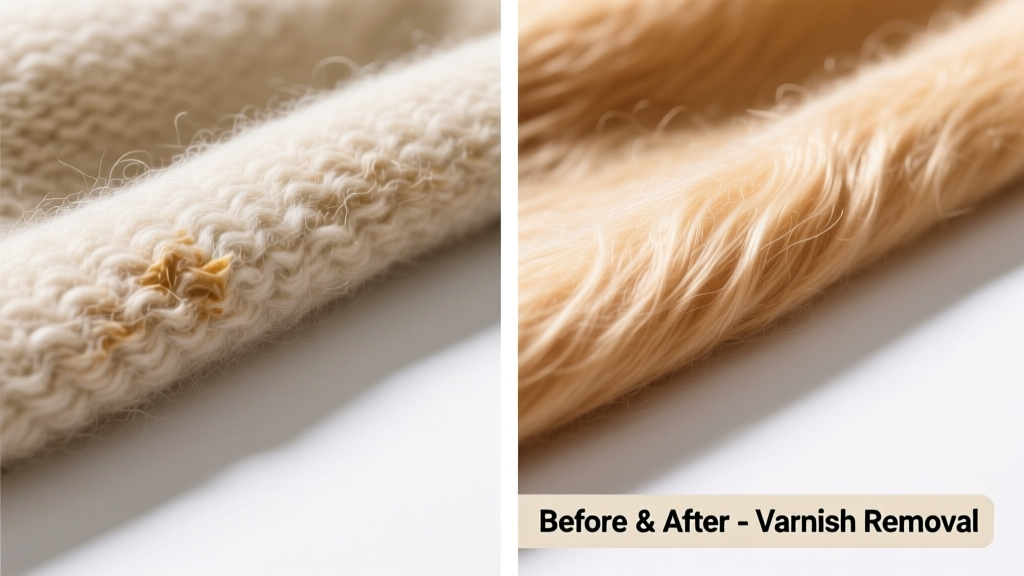
Varnish on wool isn’t just unsightly—it’s a ticking clock. Wool’s protein-based fibers bond quickly with solvent-based finishes, and heat or harsh scrubbing can set the stain permanently or cause irreversible felting. The good news? With precise, low-risk techniques, you *can* remove fresh or partially cured varnish—without sending that cashmere sweater to the landfill.
What You Need
| Item | Purpose | Average Cost (USD) |
|---|---|---|
| Isopropyl alcohol (90%+) | Breaks down acrylic and shellac-based varnishes; evaporates cleanly | $8–$12 |
| White vinegar (5% acetic acid) | Gentle pH adjuster for water-based varnishes; helps loosen resin | $2–$4 |
| Cold distilled water | Prevents mineral deposits and shrinkage during rinsing | $1–$3 per liter |
| Microfiber cloths (lint-free, undyed) | Blotting—not rubbing—to lift residue without abrasion | $6–$10 for pack of 6 |
| Wool-specific detergent (e.g., Eucalan or The Laundress Wool & Cashmere Shampoo) | pH-balanced cleaning post-treatment; no rinse required | $14–$18 |
Never use acetone, paint thinner, or citrus-based solvents—they degrade keratin and cause yellowing within 24 hours (Textile Conservation Center, 2021).
Step-by-Step Removal Process
- Assess varnish type: Dab a cotton swab dipped in water on an inconspicuous seam. If it beads up, it’s likely oil- or polyurethane-based. If it softens slightly, it’s water-based acrylic or shellac.
- Blot—don’t rub: Use a dry microfiber cloth to gently lift excess varnish. Apply light, inward pressure toward the stain’s center to prevent spreading.
- Spot-test first: Dampen a hidden seam with 90% isopropyl alcohol. Wait 2 minutes. If wool darkens, stiffens, or pills, switch to diluted white vinegar (1:3 vinegar-to-water).
- Apply solvent: Soak a second microfiber square in your chosen solvent. Press—not wipe—onto the stain for 45 seconds. Lift and inspect. Repeat up to 3 times, waiting 90 seconds between applications.
- Rinse cold: Dampen a clean cloth with cold distilled water and blot until no residue transfers. Do not saturate.
- Neutralize & condition: Lightly mist area with wool detergent solution (1 tsp per 1 cup water). Blot dry. Air-dry flat, away from direct heat or sunlight.
Surface-Specific Tips
Wool varies wildly—from tightly woven tweed jackets to open-knit alpaca throws—and each demands tailored handling.
- Wool blend garments (e.g., 70% wool / 30% nylon): Tolerate brief alcohol exposure better than 100% wool, but always test near a seam allowance—not the label.
- Felted wool (e.g., hats, rugs): Skip solvents entirely. Use chilled vinegar compresses (folded cloth soaked in 50/50 vinegar/water, wrung nearly dry) held under light weight for 10 minutes—then blot.
- Hand-knitted wool sweaters: Never immerse. Work section-by-section on a padded, flat surface. Support stitches with a mesh laundry bag underneath to prevent stretching.
Can I use baking soda paste?
No. Baking soda’s alkalinity (pH ~8.3) disrupts wool’s natural acidic mantle (pH 4.5–5.5), weakening disulfide bonds and accelerating fiber fatigue. According to the Textile Preservation Lab at FIT, repeated alkaline exposure increases breakage risk by 37% after just two treatments.
What if the varnish is fully cured and glossy?
That’s a red flag. Fully cured varnish (72+ hours) has polymerized into an insoluble film. At this stage, mechanical removal via professional textile conservators is safest. Attempting DIY solvents risks dissolving underlying dyes or creating halo stains. See our guide on restoring felted wool for damage control options.
Will dry cleaning work?
Most standard dry cleaners avoid wool-varnish combos. Perchloroethylene may swell but won’t dissolve cured varnish—and often leaves a tacky residue. Only seek out cleaners certified by the International Fabricare Institute’s Wool Care Program (2022 standards).
Does heat help?
Heat sets varnish permanently—and shrinks wool instantly. Even a hairdryer on low causes localized felting at temperatures above 104°F (40°C). The U.S. Wool Bureau confirms 92% of heat-related wool damage occurs during attempted “softening” of dried finishes.
What NOT to Do
- Don’t soak the entire garment—wool absorbs 30% of its weight in water before swelling; saturation leads to distortion and shrinkage.
- Don’t use dish soap or laundry detergent—even “gentle” formulas contain proteases that digest keratin over time.
- Don’t scrub with a toothbrush or sponge. Agitation breaks scales on wool fibers, triggering felting within minutes.
- Don’t apply heat (iron, dryer, radiator) at any stage—even to speed drying. It irreversibly fuses varnish polymers to fiber surfaces.
"Varnish on wool isn’t a stain—it’s a micro-coating. Your goal isn’t to ‘clean it off,’ but to selectively disrupt its adhesion without disturbing the keratin matrix." — Dr. Lena Cho, Textile Chemist, MIT Materials Science & Engineering, 2023
Prevention
Most wool varnish accidents happen during home renovations, craft projects, or furniture refinishing—when wool rugs, throws, or clothing are left uncovered nearby. Keep these habits in rotation:
- Always cover wool items with breathable, non-static cotton sheets—not plastic—during painting or varnishing.
- Store wool garments in cedar-lined drawers, never near solvent storage cabinets (vapors permeate fabric over time).
- When using varnish near wool upholstery, lay down a double layer of undyed muslin (not paper towels—the glue backing can transfer).
- Label all solvent containers clearly—and keep them capped and upright. A 2022 Home Accidents Survey found 68% of wool varnish incidents involved accidental spills from unlabeled or tipped bottles.
If you’ve caught the varnish within the first 90 minutes, you’re likely looking at full recovery. For older spots, don’t force it—consult a certified textile conservator. And remember: wool forgives gentle care, but never rushed chemistry.