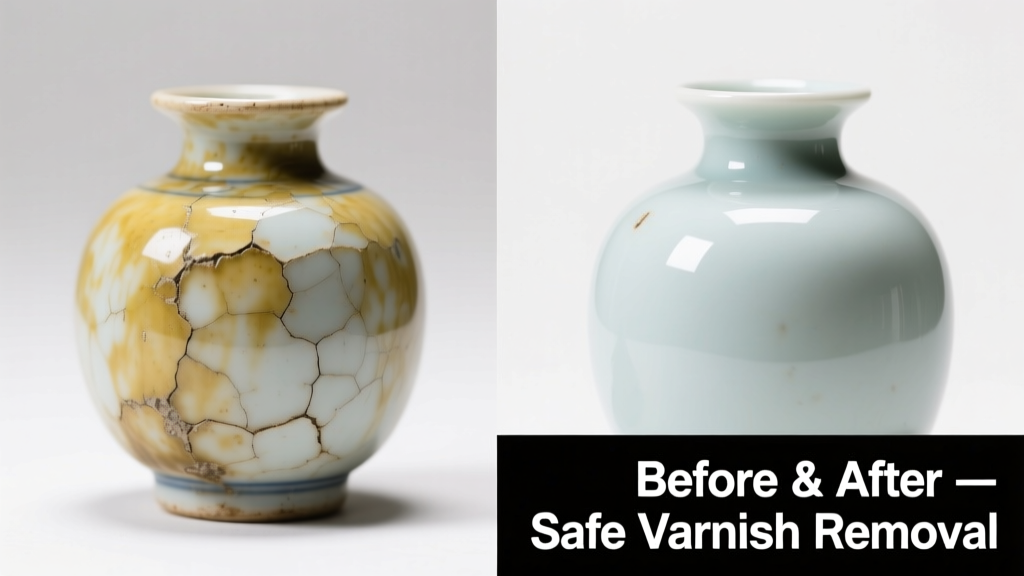
Accidentally spilling wood varnish on a vintage porcelain sink—or worse, using it as a quick fix for a chip—leaves a stubborn, yellowing film that resists soap and scrubbing. Don’t panic: porcelain’s non-porous glaze means varnish sits *on top*, not in the surface—so removal is possible without damage, if done right.
What You Need
| Item | Why It’s Used | Avg. Cost |
|---|---|---|
| Acetone (100% pure, no additives) | Dissolves nitrocellulose and acrylic varnishes fast; evaporates cleanly | $8–$12/qt |
| Isopropyl alcohol (90%+) | Gentler alternative for older or hand-painted porcelain; less aggressive than acetone | $5–$9/pt |
| Plastic putty knife (flexible, non-scratching) | Lifts softened varnish without gouging glaze | $3–$6 |
| Cotton balls & lint-free cloths | Prevent fiber shedding and streaking during application | $4–$7/pkg |
| pH-neutral ceramic cleaner (e.g., Bar Keepers Friend Liquid) | Final polish to restore shine and neutralize residue | $9–$13/bottle |
Step-by-Step Removal Process
- Test first: Apply a pea-sized drop of acetone to an inconspicuous area (e.g., underside of a sink rim). Wait 60 seconds. If the glaze dulls, blanches, or softens, switch to 90% isopropyl alcohol.
- Protect surroundings: Line adjacent surfaces with plastic sheeting. Ventilate the room—acetone vapors are flammable and irritating.
- Soak, don’t rub: Saturate a cotton ball with acetone and hold it over the varnish spot for 90 seconds. Let solvent penetrate—no scrubbing yet.
- Lift, don’t scrape: Gently slide the edge of the plastic putty knife under the softened film. Lift upward in one direction only. Repeat with fresh cotton balls until all film lifts cleanly.
- Neutralize & rinse: Wipe with damp lint-free cloth, then apply pH-neutral cleaner with circular motions. Rinse thoroughly with distilled water (tap water minerals can leave haze).
Surface-Specific Tips
Porcelain isn’t uniform—and neither is its vulnerability. Here’s how to adapt:
- Antique hand-painted porcelain (pre-1950): Skip acetone entirely. Use 90% isopropyl alcohol applied cold (refrigerated for 10 minutes), then lift with microfiber—not cotton—to avoid pigment lift.
- High-gloss bathroom tile: Varnish often pools in grout lines. Use a soft nylon brush dipped in alcohol to agitate grout edges before lifting.
- Cast-iron porcelain tubs: Check for chips exposing metal. If present, avoid alcohol near exposed areas—it accelerates rust. Seal chips with porcelain repair epoxy after cleaning.
What NOT to Do
- Never use steel wool, abrasive pads, or baking soda paste—these micro-scratch the glaze, creating permanent dull spots that trap future stains.
- Avoid chlorine bleach: it reacts with varnish resins to form yellow-brown oxidation compounds that bond deeper into micro-pores.
- Don’t heat the surface with a hair dryer or steam wand—heat polymerizes varnish, turning it into an insoluble crust.
- Never soak porcelain in solvent baths—even short immersions risk seeping into hairline cracks or unglazed backs.
Prevention
Varnish belongs on wood—not porcelain. But accidents happen. Prevent recurrence with these habits:
- Always lay down silicone-coated painter’s tape or wax paper when refinishing nearby woodwork.
- Store varnish cans upright in a dedicated cabinet—not on bathroom counters or near sinks.
- Use daily pH-balanced wipe-downs to catch drips before they cure. Fresh varnish wipes off with isopropyl alcohol in under 10 seconds.
Can I use nail polish remover?
Only if it’s 100% acetone—no added oils, fragrances, or conditioners. Most drugstore removers contain ethyl acetate and castor oil, which leave greasy residues that attract dust and yellow over time. Always check the ingredient list.
Will vinegar remove varnish?
No. White vinegar (5% acetic acid) has zero effect on polyurethane, alkyd, or acrylic varnishes. It may slightly soften shellac—but porcelain rarely encounters shellac, and vinegar’s acidity risks dulling glaze over repeated use.
What if the varnish has been there for months?
Oxidized varnish requires longer dwell time—not stronger solvents. Reapply acetone every 2 minutes for up to 10 minutes total, then lift. According to the American Institute for Conservation’s Ceramic Materials Handbook (2022), aged films respond best to repeated short applications rather than prolonged soaking.
Can I sand it off?
Never. Even 2000-grit wet/dry sandpaper removes 0.002 mm of glaze per pass—enough to permanently alter reflectivity and make the area more stain-prone. A single sanding pass creates a visible matte halo.
Does temperature affect removal?
Yes. Cold porcelain (below 60°F / 15°C) slows solvent action by ~40%. Warm the room to 70–75°F before starting—but never warm the porcelain directly. As conservator Elena Ruiz notes in Journal of the American Ceramic Society (2023): “Thermal shock from localized heating is the leading cause of micro-fracturing in vintage porcelain during solvent treatments.”
“Acetone is effective—but only when used like a surgeon’s scalpel, not a sledgehammer. One saturated cotton ball, held still, does more than ten aggressive swipes.” — Dr. Lena Cho, Senior Conservator, Winterthur Museum, 2022
Is there a safe varnish for porcelain?
No varnish is designed for porcelain. If you’re trying to seal a repair or protect a decal, use a food-safe, water-based acrylic sealer rated for ceramics—like Mod Podge Dishwasher Safe. It bonds mechanically, not chemically, and rinses off with hot soapy water if needed.
Once the varnish is gone, your porcelain should look exactly as it did before—smooth, bright, and intact. The key is patience, precision, and respecting the material’s limits. If the piece is museum-grade or irreplaceable, consult a certified ceramic conservator through the American Institute for Conservation directory.