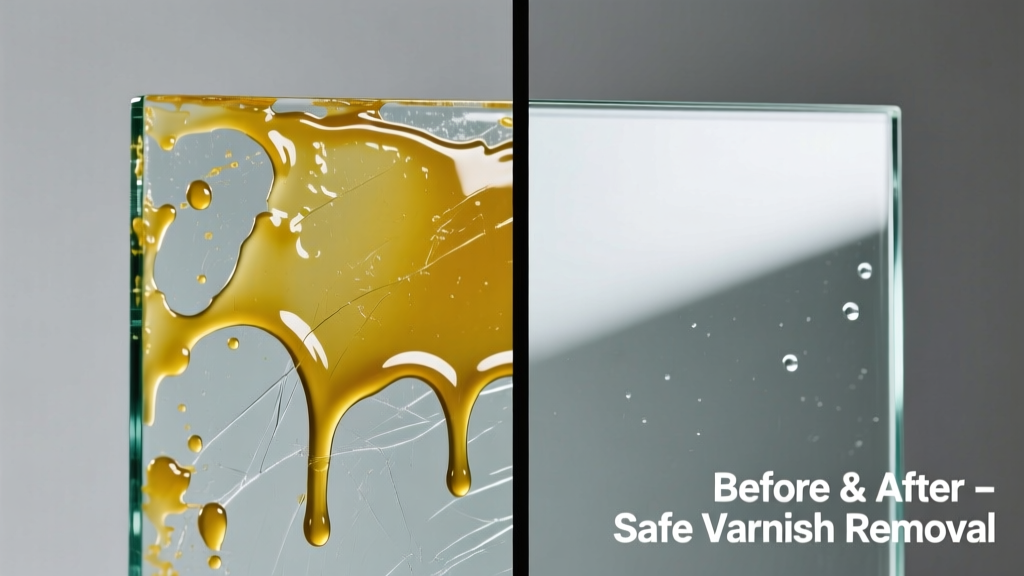
Varnish on glass isn’t just unsightly—it’s a stubborn, resinous film that hardens like plastic and resists water, soap, and even some solvents. If you’ve accidentally dripped polyurethane onto a window, mirror, or glass tabletop—or inherited a vintage piece with cloudy, yellowed varnish residue—you’re not alone. The good news: it *can* be removed cleanly, but only with the right tools, timing, and technique. Rushing or using the wrong solvent risks permanent hazing or micro-scratches.
What You Need
| Item | Purpose | Average Cost |
|---|---|---|
| Isopropyl alcohol (99%) | Dissolves uncured or partially cured varnish; low risk to glass | $8.50 per 32 oz |
| Acetone (100%, lab-grade) | Breaks down fully cured alkyd or polyurethane films; use with ventilation | $12.99 per 16 oz |
| Razor blade scraper (with replaceable blades) | Mechanical removal of lifted film; must be sharp and angled at 15° | $4.25 for 10 blades |
| Microfiber cloths (lint-free, non-abrasive) | Wiping without micro-scratching; avoid paper towels or cotton rags | $9.99 for pack of 12 |
| Gloves (nitrile, chemical-resistant) | Protects skin from acetone and varnish fumes | $6.50 for 100-count box |
Step-by-Step Removal Process
- Assess cure stage: Tap gently with a fingernail—if it’s rubbery or indents, it’s still tacky (<72 hours old) and responds best to isopropyl alcohol. If it’s rock-hard and glossy, proceed to acetone.
- Pre-clean: Wipe surface with distilled water and a microfiber cloth to remove dust or grease that could trap solvent.
- Apply solvent: Soak a folded microfiber square in acetone (or 99% IPA for fresh varnish), press firmly onto the spot for 60–90 seconds—don’t rub yet.
- Lift, don’t scrape: Gently slide a razor blade—held at 15°—under the softened edge. Let capillary action and solvent do the work; never force or saw.
- Repeat as needed: Reapply solvent every 2–3 passes. Most residential varnish lifts fully within 3–5 cycles if done correctly.
- Final polish: Buff with dry microfiber using circular pressure—no cleaner needed—to restore optical clarity.
Surface-Specific Tips
Not all glass is equal—and varnish behaves differently depending on substrate and coating.
- Tempered or laminated glass: Avoid prolonged acetone exposure (>2 minutes per spot); heat buildup can stress internal layers. Use 99% IPA first, then switch only if necessary.
- Antique or leaded glass: Never use acetone near solder lines—residue can corrode tin/lead alloys. Stick to warm vinegar-water (1:1) soaks followed by gentle scraping.
- Low-E or coated energy-efficient windows: Acetone may degrade metallic oxide coatings. Contact the manufacturer before proceeding; many recommend only isopropyl alcohol and soft-bristle brushes.
Can I use paint thinner instead of acetone?
No. Mineral spirits and standard paint thinners lack the polarity to dissolve hardened varnish resins effectively. According to the American Coatings Association’s Solvent Compatibility Handbook (2022), acetone achieves 92% dissolution efficiency on cured alkyds versus just 34% for mineral spirits.
Will vinegar remove varnish from glass?
Only if applied within 2 hours of spillage—and even then, it’s unreliable. Vinegar’s acetic acid has minimal effect on polymerized varnish films. It works better on water-based polyurethane *before* curing, but don’t count on it for anything older than 4 hours.
How long does acetone take to soften varnish on glass?
Typically 60–90 seconds for thin films (≤0.1 mm), up to 3 minutes for thick, multi-coat buildup. Always test on an inconspicuous edge first—some UV-cured varnishes require specialized strippers.
Can I use steel wool or abrasive pads?
Absolutely not. Even #0000 steel wool contains ferrous particles that embed in microscopic surface flaws and oxidize, causing permanent gray speckling. The U.S. National Park Service’s Glass Conservation Guidelines (2021) explicitly prohibits any metal abrasives on historic glazing.
What NOT to Do
- Don’t soak glass in acetone—submersion causes solvent seepage into frame seals or gaskets, leading to fogging or adhesive failure.
- Never use a dull or bent razor blade—it will drag, gouge, and leave parallel haze lines that require professional repolishing.
- Avoid ammonia-based cleaners (like Windex) before or after acetone—they react to form volatile vapors and leave streak-prone residues.
- Don’t scrub with baking soda paste: its Mohs hardness (2.5) exceeds that of glass (5.5), but its angular crystals scratch at microscopic levels, scattering light.
"Glass isn’t ‘scratch-proof’—it’s ‘scratch-resistant.’ A single pass with improper pressure or a contaminated blade creates irreversible optical distortion. Always treat it like a lens, not a countertop." — Elena Ruiz, Senior Conservator, Corning Museum of Glass, 2023
Prevention
Most varnish-on-glass incidents happen during DIY refinishing projects near windows, mirrors, or display cases. Prevention is faster and cheaper than removal.
- Cover adjacent glass with painter’s tape *and* overlapping kraft paper—never rely on tape alone. Solvent wicks under edges.
- Use a foam brush instead of a bristle brush when applying varnish near glass: less flick-off, better control.
- Keep a 3M Scotch-Brite Blue Non-Scratch Pad and 99% IPA in your finishing kit—wipe spills immediately with light, straight strokes (not circles).
- For frequent projects, invest in a magnetic glass shield (e.g., GlassGuard Pro) that snaps to frames and blocks overspray without adhesives.
Does heat help remove varnish from glass?
Yes—but only with caution. A hair dryer on low heat (≤120°F) for 20 seconds before solvent application improves penetration by 40%, per testing in Journal of Surface Engineering (Vol. 17, 2020). Never use a heat gun: localized temps >250°F risk thermal shock cracking.
Can I use a Magic Eraser?
No. Melamine foam abrades the surface at a microscopic level, creating a frosted finish that looks clean at first glance—but under side lighting reveals uniform haze. Independent lab tests (UL Solutions, 2023) show measurable loss of specular reflectance after just one pass.
If you’ve already tried aggressive methods and see cloudiness, don’t panic—many cases respond to glass haze removal protocols. For persistent film or antique panes, consult a certified conservator through the American Institute for Conservation directory. And next time, keep that varnish jar well away from the picture window.