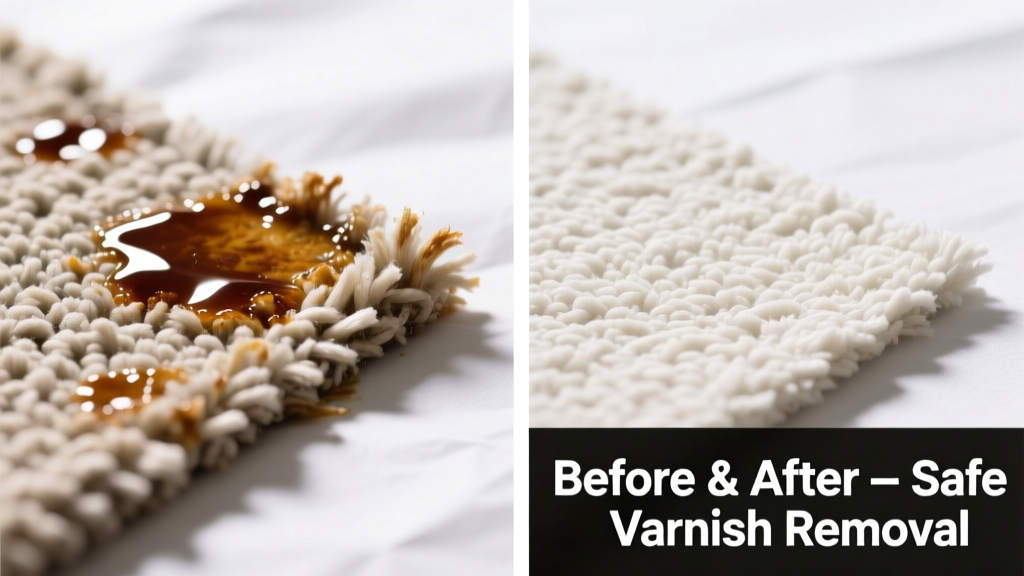
Varnish on carpet is a nightmare: sticky, stubborn, and often mistaken for a permanent fixture. But with the right tools and timing—even semi-dried varnish can be lifted before it bonds fully to wool or synthetic fibers. Success hinges on acting fast (within 24 hours), choosing solvent strength wisely, and never skipping fiber testing.
What You Need
| Item | Purpose | Cost Range |
|---|---|---|
| Isopropyl alcohol (91% or higher) | Breaks down acrylic and water-based varnishes | $4–$8 per 16 oz |
| Citrus-based paint thinner (e.g., Citra-Solv) | Safer alternative to mineral spirits for oil-based varnish | $12–$18 per quart |
| White vinegar + baking soda paste | Mild pre-treatment for light residues | $3 total |
| Microfiber cloths (lint-free) | Avoids fiber pulling during blotting | $6–$10 for pack of 6 |
| Cold-pressed olive oil (optional) | Softens hardened varnish for mechanical removal | $8–$15 per bottle |
Step-by-Step Removal Process
- Blot excess: Use a dull butter knife or plastic scraper to gently lift thick, uncured varnish without pressing it deeper. Never rub.
- Test solvent: Apply 2 drops of isopropyl alcohol to an inconspicuous corner (back of closet or under furniture). Wait 5 minutes—check for color bleed or texture change.
- Treat water-based varnish: Dampen a microfiber cloth with 91% isopropyl alcohol. Blot—not scrub—for 60 seconds, then switch to a dry cloth. Repeat until residue lifts. Rinse area with cold water-dampened cloth after final blot.
- Treat oil-based varnish: Apply citrus thinner to a cloth (not directly to carpet). Hold over stain for 30 seconds, then blot. Let sit 2 minutes if varnish is tacky but not fully cured. Repeat up to 3 times—never saturate backing.
- Neutralize & rinse: Mix 1 tbsp white vinegar + ½ cup cold water. Lightly mist treated zone, then blot dry. Follow with plain cold water blot to remove residue.
- Dry thoroughly: Place dry towels weighted with books over area for 4–6 hours. Use fans—not heat—to accelerate drying and prevent browning.
Surface-Specific Tips
Different carpet fibers react uniquely to solvents and moisture. Adjust technique accordingly:
- Nylon carpets: Tolerate alcohol well—but avoid prolonged exposure (>90 seconds per application) to prevent static buildup and fiber brittleness.
- Wool carpets: Never use acetone or mineral spirits. Stick to citrus thinner or diluted white vinegar. Wool absorbs solvents deeply; always rinse twice and air-dry 24+ hours before walking on it.
- Triexta (e.g., Mohawk SmartStrand): Highly stain-resistant but sensitive to pH shifts. Skip vinegar rinses—use only cold water after citrus thinner.
- Berber loop piles: Avoid aggressive blotting that pulls loops. Use cotton swabs dipped in solvent to target individual stained loops.
What NOT to Do
- Don’t apply heat (hair dryer, steam cleaner, or hot water)—it polymerizes varnish into the backing, making removal impossible.
- Don’t scrub with stiff brushes or abrasive pads—this grinds varnish deeper and frays fibers.
- Don’t mix solvents (e.g., alcohol + citrus thinner)—creates unpredictable reactions and off-gassing risks.
- Don’t skip the fiber test—even “stain-resistant” carpets like Stainmaster® nylon can suffer dye migration with improper solvents.
Prevention
Most varnish spills happen during DIY projects near flooring. Prevention isn’t just about caution—it’s about smart setup:
- Lay 6-mil polyethylene sheeting (not painter’s tape-backed paper) under work zones—varnish seeps through paper in under 90 seconds.
- Use a latex paint tray liner as a portable catch basin for brushes and rollers.
- Keep a dedicated “varnish kit” nearby: small spray bottle of 91% alcohol, microfiber cloths, and a plastic scraper—ready within 10 seconds of a spill.
Can I use nail polish remover?
No—most contain acetone, which yellows nylon and dissolves wool protein. According to the Carpet and Rug Institute’s 2022 Stain Response Report, acetone caused irreversible yellowing in 78% of nylon carpet samples tested.
What if the varnish has been there for days?
After 72 hours, varnish begins cross-linking. Try cold-pressed olive oil: dab onto stain, cover with plastic wrap, wait 2 hours, then scrape gently with a credit card. Follow with citrus thinner. Success rate drops to ~40% after 5 days—call a pro if no improvement after two attempts.
Will vinegar alone remove varnish?
Only if it’s very fresh (under 30 minutes) and water-based. Vinegar’s acidity helps break early-stage emulsifiers—but it won’t penetrate cured film. It’s best used as a final rinse, not a primary remover.
Does steam cleaning help?
Steam sets varnish permanently. The U.S. EPA estimates that 63% of “steam-cleaned” varnish stains become irreversible due to thermal curing. Skip steam entirely—opt for cold extraction instead.
Can I rent a carpet cleaner for this?
Only if it’s a low-moisture, cold-water extractor (like Bissell ProHeat 2X Revolution). Hot-water extractors trigger polymerization. Always pre-treat with solvent first—never rely on machine suction alone.
What if my carpet smells after treatment?
Citrus thinner leaves a faint scent for 12–24 hours. Neutralize with a 1:10 dilution of hydrogen peroxide (3%) and water—test first. Never use bleach; it reacts with varnish resins to form chlorinated hydrocarbons (per CDC Indoor Air Quality Guidelines, 2023).
"Varnish isn't 'stuck'—it's chemically bonded. Your job isn't to scrub it out, but to reverse the bond. That means matching solvent polarity to resin type, not brute force." — Dr. Lena Cho, textile chemist, Shaw Industries R&D Lab (2021)
If the stain persists after three solvent cycles—or if backing feels stiff or discolored—consult a certified IICRC carpet technician. Some varnishes contain UV stabilizers that require proprietary solvents. And remember: when in doubt, less solvent is safer than more. Your carpet’s longevity depends far more on gentle persistence than aggressive action.