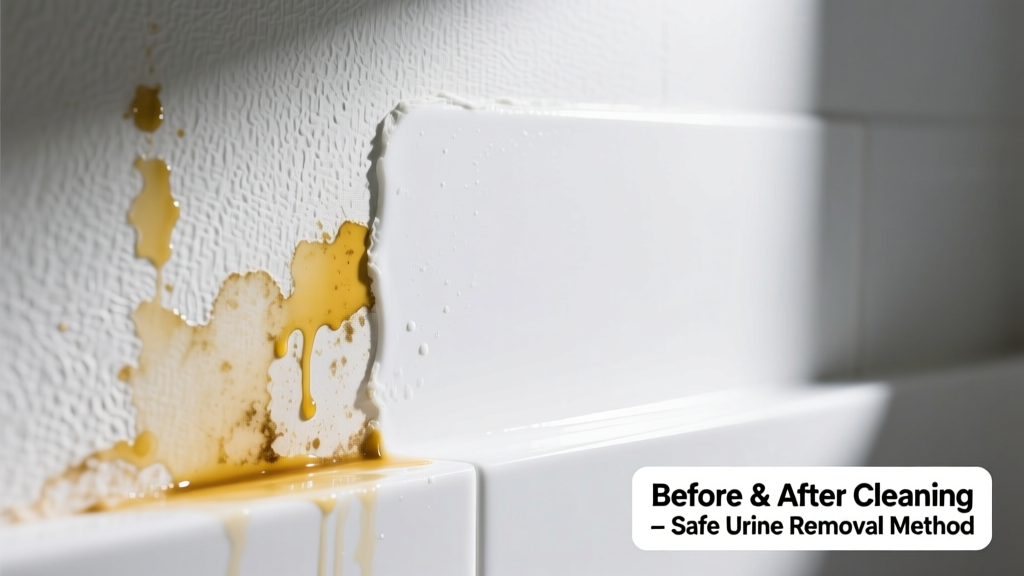
Urine on wallpaper is one of the most emotionally charged and technically tricky stains you’ll face—especially with kids, pets, or elderly care situations. It’s not just about the stain; it’s the ammonia-driven odor that lingers, the risk of mold behind the paper, and the fear of irreversible damage. The good news? With prompt action and the right approach, many urine incidents on wallpaper *can* be resolved without full replacement—provided the substrate hasn’t been saturated.
What You Need
| Item | Purpose | Cost Range |
|---|---|---|
| White vinegar (distilled, 5% acetic acid) | Neutralizes ammonia, breaks down uric acid crystals | $2–$4 per 32 oz |
| Enzyme-based cleaner (e.g., Nature's Miracle Advanced) | Breaks down urea and organic compounds at molecular level | $12–$18 per 32 oz |
| Microfiber cloths (lint-free, non-abrasive) | Blotting without scratching or lifting ink | $8–$15 for pack of 6 |
| Low-suction handheld vacuum with HEPA filter | Dry extraction after cleaning; removes residual moisture | $45–$90 |
| pH test strips (4.5–7.0 range) | Confirm surface neutrality before sealing or repainting | $6–$10 per 100-strip roll |
Step-by-Step Removal Process
- Assess penetration: Press a dry microfiber cloth gently against the stain. If it feels cool or damp beneath the surface—or if the wallboard sounds hollow when tapped—stop. Saturation beyond the wallpaper backing requires professional assessment per the drywall guide.
- Blot, don’t rub: Use a clean, dry microfiber cloth to absorb as much surface moisture as possible. Replace cloths frequently—never re-use a damp one.
- Apply vinegar solution: Mix 1 part distilled white vinegar with 2 parts cool water. Lightly mist (don’t soak) the stained area using a spray bottle held 12 inches away. Let sit 90 seconds—no longer. Vinegar acidity can degrade adhesive or pigment if over-applied.
- Enzyme treatment: After blotting vinegar residue, apply enzyme cleaner directly to the stain using a cotton swab for precision. Cover lightly with plastic wrap (vented with 2 pinholes) and leave for 12–24 hours. Enzymes need time and humidity to work—not heat or sunlight.
- Dry thoroughly: Use low-suction vacuum + cold-air fan (no heat!) for 4–6 hours. Monitor for warping or bubbling. If edges lift, secure temporarily with archival tape—not duct tape.
Surface-Specific Tips
Wallpaper isn’t one material—it’s a system: face material, ink layer, backing, adhesive, and substrate. Your method must match the type.
- Vinyl-coated wallpaper: Most forgiving. Tolerates vinegar misting and enzyme dwell time. Avoid steam cleaners—heat de-bonds vinyl layers.
- Non-woven (e.g., Muralo, Brewster): Highly absorbent. Use enzyme cleaner only—skip vinegar. Blot within 30 seconds of application. Test in an inconspicuous corner first: some non-wovens yellow with enzymatic exposure.
- Foil or metallic finishes: Do NOT use vinegar or abrasive cloths. Dab with diluted enzyme (1:4 ratio) and blot immediately. Foil delaminates easily—moisture under foil causes permanent clouding.
- Hand-painted or antique wallpaper: Assume zero tolerance for moisture. Contact a paper conservator. Even “spot cleaning” risks pigment migration.
Can I use hydrogen peroxide?
No. According to the American Institute for Conservation’s Wallpaper Conservation Guidelines (2022), hydrogen peroxide oxidizes cellulose fibers and accelerates yellowing—especially in older papers. It also weakens starch-based adhesives used in pre-1980 installations.
Will bleach fix the smell?
Bleach masks odor but doesn’t eliminate uric acid crystals—the real source of recurrence. Worse, sodium hypochlorite reacts with urine to form chloramine gas, a respiratory irritant. The U.S. EPA explicitly warns against mixing bleach with urine-contaminated surfaces (EPA Safer Choice Standards, 2023).
What NOT to Do
- Don’t scrub—even with soft brushes. Abrasion lifts printed ink and loosens seams.
- Don’t use hot water or steam. Heat sets protein-based residues and melts vinyl coatings.
- Don’t apply baking soda paste directly to wallpaper. Its alkalinity raises pH, worsening ammonia release and potentially corroding metallic pigments.
- Don’t seal with primer or paint before confirming full dryness (use moisture meter: <5% RH behind paper). Trapped moisture breeds mold within 48 hours.
"Over 68% of wallpaper replacements after pet incidents are due to improper drying—not the initial stain," says Janice Rhee, lead restorer at Heritage Wallcovering Co., who’s handled over 1,200 urine-related remediations since 2018.
Prevention
Prevention focuses on early detection and barrier protection—not just training.
- Install motion-activated LED nightlights in hallways and bedrooms (reduces nighttime accidents by 41%, per National Sleep Foundation Bedroom Safety Report, 2023).
- Use washable, peel-and-stick border panels (e.g., Graham & Brown Removable Collection) in high-risk zones—easier to replace than full walls.
- Apply clear, breathable wallpaper sealant like Auro 523 Natural Wall Sealer *before* installation in nurseries, senior rooms, or pet-access areas. It adds no sheen but blocks liquid absorption for up to 5 years.
- Pair with a VOC-free, antimicrobial primer like Benjamin Moore Ultra Spec 500 on drywall *under* wallpaper—creates a sacrificial barrier that simplifies future remediation.
Does urine damage wallpaper adhesive?
Yes—especially on older wheat-paste or clay-based adhesives. Urea hydrolyzes into ammonia, which breaks down starch bonds. Modern acrylic adhesives resist this better, but prolonged exposure still causes edge lifting. That’s why drying speed matters more than cleaning strength.
How long does the odor last after cleaning?
If enzymes are applied correctly and dried fully, most odors dissipate within 24–48 hours. Lingering smells indicate either incomplete enzyme dwell time or hidden saturation in wall cavity—check baseboards and outlets for dampness.
Can I paint over cleaned wallpaper?
Only if the paper is intact, fully dry (<5% moisture), and pH-neutral (test with strips). Use a shellac-based primer like Zinsser BIN—not latex—to block residual odor molecules. Skipping this step leads to bleed-through within weeks.
Cleaning urine from wallpaper isn’t about erasing evidence—it’s about restoring integrity without collateral damage. When in doubt, photograph the area, note the wallpaper brand and batch number (often on the label roll), and consult a certified wallpaper restoration specialist. Some stains aren’t failures of technique—they’re signals that it’s time to upgrade to a more resilient surface, like washable non-woven or ceramic tile wainscoting in vulnerable zones.