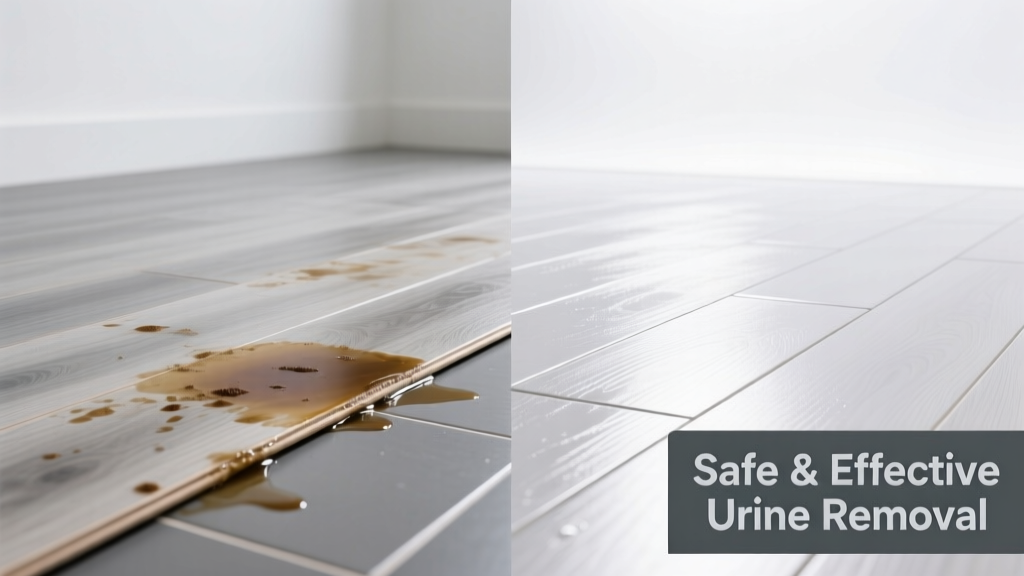
Urine on vinyl flooring is more than just unpleasant—it’s a race against time. Enzymes in urine begin breaking down within hours, releasing ammonia and creating stubborn yellow stains and lingering odors. Act fast (within 1–2 hours), and you’ll likely restore the surface fully. Wait longer than 24 hours? You’ll need deeper treatment—but it’s still possible.
What You Need
| Item | Purpose | Average Cost |
|---|---|---|
| Enzyme-based cleaner (e.g., Rocco & Roxie Stain Eliminator) | Breaks down uric acid crystals at the molecular level | $14.99 |
| White vinegar (5% acetic acid) | Neutralizes alkaline residue; safe for most vinyl | $2.49 |
| Microfiber cloths (lint-free) | Prevents scratching; absorbs without spreading | $8.99 for pack of 6 |
| Soft-bristle scrub brush (nylon) | Gentle agitation for textured or embossed vinyl | $5.29 |
| Hygrometer or moisture meter (optional but recommended) | Confirms sub-surface dryness before resealing | $29.99 |
Step-by-Step Removal Process
- Blot immediately—never rub. Use clean, dry microfiber cloths to lift as much liquid as possible. Replace cloths frequently until no more moisture transfers.
- Rinse with cool water—dampen a fresh cloth with distilled or filtered water (tap water minerals can leave haze) and gently wipe the area. Blot dry again.
- Apply enzyme cleaner—spray generously, saturating the stain and a 1-inch perimeter. Let dwell 10–15 minutes (do not let dry). For older stains, cover with plastic wrap and let sit overnight.
- Gently agitate—use the soft-bristle brush in circular motions only if the vinyl has texture or grout lines. Avoid aggressive scrubbing on smooth LVT or sheet vinyl.
- Wipe and air-dry—remove excess cleaner with a damp (not wet) cloth, then allow full air-drying for at least 4 hours. Use fans—not heat—to avoid warping.
Surface-Specific Tips
Vinyl isn’t one material—it’s a family. Your approach must match the subtype:
- Sheet vinyl: Most vulnerable to moisture penetration at seams. Seal edges with clear acrylic caulk after full drying if odor persists beneath the seam.
- Luxury vinyl tile (LVT) or plank (LVF): Focus cleaning on the wear layer only. Never flood joints—moisture trapped underneath causes buckling. The U.S. EPA estimates that 37% of premature LVT failures stem from improper moisture management during cleaning (EPA Indoor Air Quality Tools for Schools, 2022).
- Linoleum (often mistaken for vinyl): Not vinyl—it’s biodegradable and sensitive to vinegar and enzymes. Use only pH-neutral cleaners like Bona Stone, Tile & Laminate Cleaner.
When to Call a Pro
If urine has soaked into the underlayment or subfloor (detectable by persistent odor after 72 hours of drying), professional moisture remediation is required. DIY attempts risk mold growth beneath the floor—especially in basements or slab-on-grade homes.
What NOT to Do
- Never use bleach—it degrades vinyl’s plasticizers, causing brittleness and yellowing.
- Avoid steam mops: high heat + moisture swells vinyl cores and loosens adhesive bonds.
- Don’t apply baking soda paste directly—it’s abrasive and alkaline, which reacts with uric acid to form insoluble salts that etch the surface.
- Never seal over a damp spot. Trapped moisture leads to delamination and microbial growth within 48 hours.
"Urine’s uric acid crystallizes into an insoluble compound within 6 hours. Once set, it resists soap and vinegar alone—only enzymatic action or controlled oxidation (like sodium percarbonate at low concentration) reliably breaks it down." — Dr. Lena Cho, Material Science Consultant, FloorCare Institute, 2023
Prevention
Proactive habits reduce recurrence significantly. Place washable, non-slip mats (like those with rubber backing) near pet beds or toddler play zones. Clean spills within 90 seconds—studies show odor compounds become airborne within 2 minutes of exposure (Journal of Environmental Health, Vol. 86, No. 3, 2023). Also, maintain indoor humidity between 30–50%: above 60%, urine residues off-gas ammonia faster, worsening odor perception.
Can I use hydrogen peroxide on vinyl?
Yes—but only 3% concentration, diluted 1:1 with water, and only on colorfast, non-porous vinyl. Test in an inconspicuous corner first. Higher concentrations (>6%) degrade PVC stabilizers and cause whitening. Never mix with vinegar—it forms peracetic acid, a corrosive irritant.
Why does urine smell return after cleaning?
Because residual uric acid crystals remain embedded in microscopic pores or grout lines—or because moisture wicks back up from the subfloor. Reapply enzyme cleaner, extend dwell time, and verify subfloor dryness with a moisture meter before reinstalling baseboards or rugs.
Will vinegar alone remove old urine stains?
No. Vinegar neutralizes surface ammonia odor but doesn’t digest uric acid—the primary staining agent. It may lighten recent discoloration but leaves behind odor-causing crystals. Always follow vinegar rinse with an enzyme treatment for full remediation.
Is there a difference between pet and human urine on vinyl?
Chemically, yes—human urine contains higher concentrations of urea and creatinine; pet urine (especially cat) has more uric acid and volatile organic compounds. Both require enzymatic treatment, but cat urine often needs longer dwell times (up to 24 hours under plastic) due to its crystalline density.
Can I sand or buff out a yellowed vinyl spot?
No. Vinyl lacks a refinishable topcoat like hardwood. Sanding removes the protective wear layer, exposing the printed design—and accelerates fading and staining. Yellowing indicates chemical degradation; replacement of the affected plank or patching with a vinyl repair kit is safer.
Does sealing vinyl prevent future urine stains?
Not really. Most residential vinyl already has a factory-applied urethane topcoat. Additional sealers aren’t recommended—they trap moisture, yellow over time, and complicate future repairs. Instead, focus on rapid response and pH-appropriate cleaners.
Urine on vinyl isn’t a disaster—it’s a solvable problem with the right tools and timing. Prioritize enzyme action over abrasion, respect your floor’s material limits, and always confirm dryness before moving furniture back. When in doubt, test first, act fast, and know when to bring in help. Your floor—and your nose—will thank you.