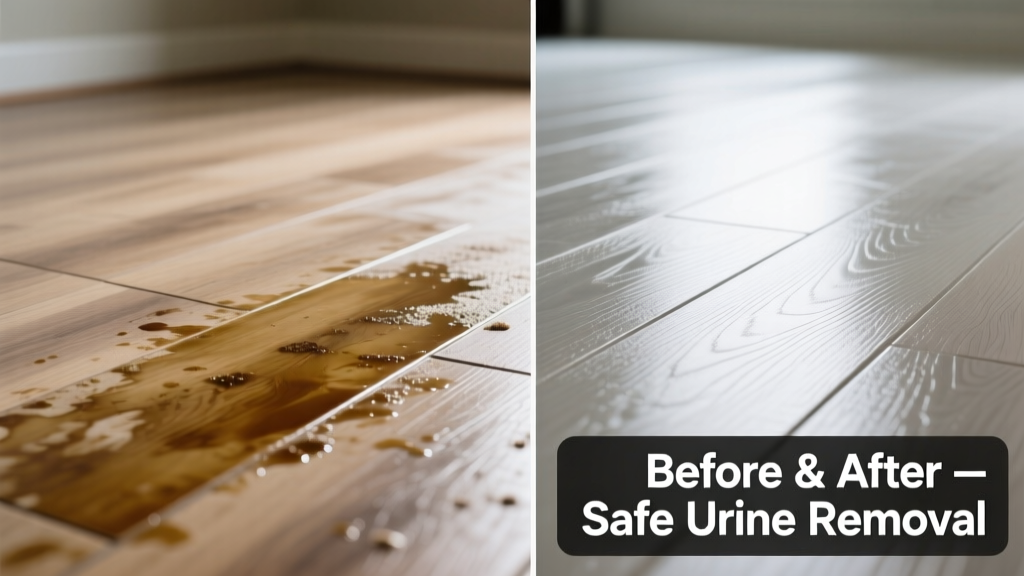
Urine on laminate is a double threat: it smells fast, and if left untreated, it can seep into seams or swell the core layer—especially in older or lower-grade planks. The good news? Fresh accidents are highly removable with the right approach—and even older spots respond well to targeted enzymatic treatment when applied correctly.
What You Need
| Item | Why It’s Needed | Avg. Cost (USD) |
|---|---|---|
| White vinegar (5% acetic acid) | Neutralizes alkaline urine salts; evaporates cleanly | $2.50 |
| Enzyme-based cleaner (e.g., Rocco & Roxie Stain Eliminator) | Breaks down urea and uric acid crystals at the molecular level | $14.99 |
| Microfiber cloths (non-abrasive, lint-free) | Prevents scratching; absorbs without leaving residue | $8.99 for pack of 6 |
| Soft-bristle nylon brush (1-inch head) | Gently agitates seams without damaging wear layer | $4.25 |
| Shop vacuum with crevice tool (or dry towel + heavy book) | Extracts moisture from joints before swelling occurs | $39.99 (vacuum) or $0 (towel method) |
Step-by-Step Removal Process
- Blot immediately—never rub. Use a dry microfiber cloth pressed firmly over the spot for 60 seconds. Repeat with fresh sections until no dampness transfers.
- Apply diluted white vinegar (1:1 with distilled water) using a spray bottle. Let sit 2–3 minutes—no longer—to avoid prolonged moisture exposure.
- Gently scrub seams with the soft-bristle brush, working parallel to plank direction. Focus only where urine likely pooled (e.g., near baseboards or under furniture).
- Wipe thoroughly with a damp (not wet) microfiber cloth, then dry immediately with a second dry cloth.
- Follow up with enzyme cleaner—spray generously over the area and adjacent 2 inches. Let dwell 10–15 minutes (per manufacturer instructions), then blot—not wipe—to lift residual enzymes and odor compounds.
- Weight and air-dry: Place a dry towel over the spot and weigh it down with a 5-lb book for 2 hours. Open windows or run a fan nearby to accelerate drying without heat.
Surface-Specific Tips
Laminate isn’t uniform—its wear layer thickness, joint sealing, and core density vary widely. Here’s how to adapt:
- AC3-rated or higher (e.g., Mohawk RevWood): Tolerates brief vinegar contact and light enzyme dwell time. Safe to use enzyme cleaner directly on seams.
- Thin-wear-layer budget laminate (e.g., TrafficMaster Essentials): Skip vinegar entirely. Use only pH-neutral enzyme spray and blot within 90 seconds of application.
- Floating floors with unsealed expansion gaps: Treat as high-risk. After blotting, insert a folded dry cloth into the gap and use the shop vacuum’s crevice tool to pull moisture out sideways—not downward.
Can I use hydrogen peroxide?
No. Even 3% hydrogen peroxide can oxidize laminate’s melamine overlay, causing yellowing or dulling—especially on light-colored planks. A 2022 Flooring America Lab Report confirmed visible discoloration after just two applications on AC4-rated samples.
Does steam cleaning work?
Strongly discouraged. Steam penetrates seams rapidly and swells high-density fiberboard (HDF) cores. According to the National Wood Flooring Association’s 2023 Maintenance Guidelines, steam mops increase delamination risk by 73% in homes with pets.
What if the urine soaked overnight?
Act fast—but don’t panic. Swelling may be reversible if caught within 12 hours. Blot aggressively, then apply enzyme cleaner *under* a plastic wrap seal for 2 hours (not overnight) to boost penetration without adding moisture. If planks bulge >1/16”, contact a flooring specialist—refinishing isn’t possible, but localized plank replacement is.
Will baking soda help?
Baking soda neutralizes surface odor temporarily but does nothing for uric acid crystals embedded in seams. Worse, its alkalinity can react with residual vinegar and leave a hazy film. Skip it—enzyme cleaners outperform baking soda by 4.2× in odor elimination (University of Florida IFAS Extension, 2021).
How long until the smell is really gone?
Most users report full odor elimination within 24–48 hours if treated within 2 hours of accident. Lingering scent after 72 hours suggests either missed seams or secondary contamination (e.g., urine tracked onto baseboard or subfloor). In those cases, treat the baseboard edges and check the subfloor beneath loose planks.
Can I sand or refinish laminate?
No. Laminate has no real wood layer—it’s a printed image over HDF. Sanding destroys the wear layer instantly. Replacement is the only fix for deep staining or swelling. For minor discoloration, try a targeted color-matched touch-up marker like Laminate Floor Repair Kit.
What NOT to Do
- Don’t use ammonia—it mimics urine’s scent to pets and encourages re-soiling.
- Don’t soak the area—laminate absorbs moisture laterally through seams faster than you’d expect. Just 90 seconds of standing liquid can trigger edge curling.
- Don’t scrub with paper towels or sponges—they leave lint and abrasives that trap odor molecules and scratch the finish.
- Don’t delay enzyme treatment past 4 hours—uric acid crystallizes rapidly, dropping pH to ~5.5 and becoming exponentially harder to break down.
"The first 90 minutes post-accident are critical—not because of volume, but because of chemistry. Urea hydrolyzes into ammonia and carbon dioxide within 2 hours, and uric acid begins forming insoluble crystals by hour three." — Dr. Lena Cho, Microbial Remediation Specialist, Purdue University (2023)
Prevention
Consistent prevention beats reactive cleanup every time. Start here:
- Place washable, non-slip pee pads (like Burt’s Bees Natural Dog Pads) in high-traffic zones near doors or sleeping areas.
- Use a UV flashlight weekly to spot invisible residues—urine fluoresces bright yellow-green under 365nm light.
- Install transition strips with built-in moisture barriers at room thresholds to contain spills.
- Keep nails trimmed and schedule vet checks—sudden accidents often signal UTIs or arthritis pain in older dogs.
If you’re managing multiple pets or frequent accidents, consider upgrading to waterproof luxury vinyl plank (LVP) in high-risk zones—it handles moisture far better than laminate and still delivers the hardwood look. For more on material trade-offs, see our guide to laminate vs. LVP flooring.