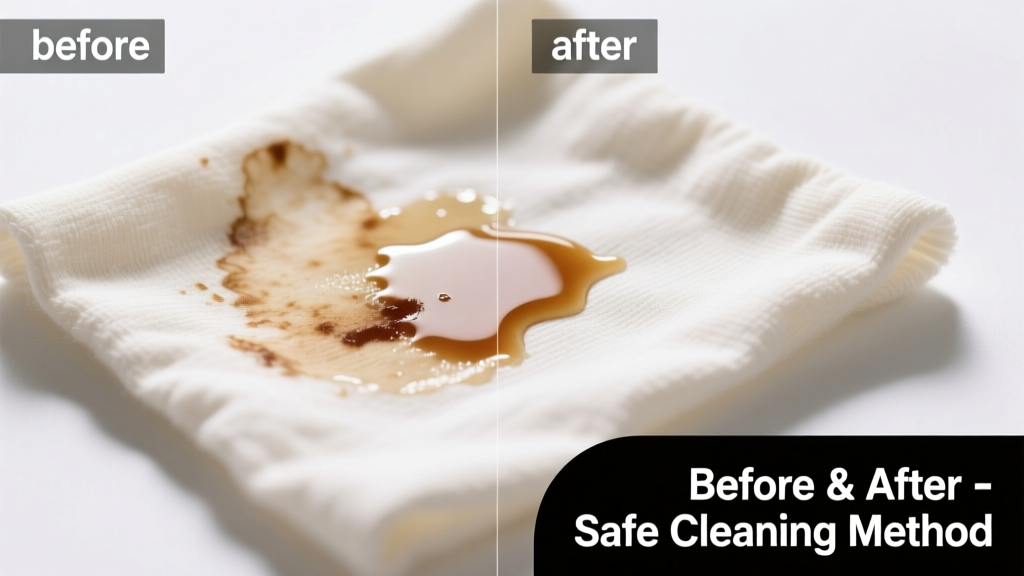
Urine on cotton—whether from a toddler’s accident, a pet incident, or overnight leakage—feels urgent and deeply personal. The good news: cotton is highly absorbent but also forgiving *if you act quickly and avoid heat*. Delayed treatment or wrong products can lock in odor and yellowing permanently.
What You Need
| Item | Purpose | Average Cost |
|---|---|---|
| White vinegar (5% acetic acid) | Neutralizes uric acid crystals and deodorizes | $2.99 per 32 oz bottle |
| Enzyme-based cleaner (e.g., Rocco & Roxie Stain & Odor Eliminator) | Breaks down urea, creatinine, and uric acid proteins | $14.99 per 32 oz |
| Baking soda | Absorbs moisture and buffers pH during pretreatment | $1.49 per 16 oz box |
| Cold water spray bottle | Prevents heat-setting; enables controlled saturation | $4.50 |
| Microfiber cloth or clean white towel | Blotting without lint transfer or dye bleed | $8.99 for pack of 6 |
Step-by-Step Removal Process
- Blot immediately: Use a dry microfiber cloth to lift as much liquid as possible—never rub. Apply gentle, upward pressure for 60–90 seconds.
- Rinse underside first: Hold fabric taut over a sink or basin. Spray cold water from the *back* of the stain to push urine outward—not deeper into fibers.
- Pretreat with vinegar: Saturate stain with undiluted white vinegar. Let sit 5 minutes—no longer (prolonged exposure weakens cotton fibers).
- Apply enzyme cleaner: Generously coat area, then cover with plastic wrap to retain moisture. Wait 8–12 hours (overnight) for full enzymatic breakdown.
- Launder cold: Wash separately in cold water using unscented detergent. Add ½ cup baking soda to wash cycle—but never mix with vinegar in same load.
- Air-dry only: Hang or lay flat. Heat from dryers sets protein residues. Check for residual odor before folding.
Surface-Specific Tips
Cotton’s tight weave and cellulose structure respond predictably—but variations matter:
- 100% cotton t-shirts: Turn inside out before pretreating to protect print integrity and reduce surface abrasion.
- Cotton blends (e.g., 60% cotton/40% polyester): Reduce enzyme dwell time to 6 hours—polyester slows penetration and may trap odor if over-saturated.
- Denim (heavy cotton twill): Soak stained area in 1:3 vinegar/water solution for 10 minutes pre-enzyme application; denser weave needs extra loosening.
- Cotton bedding or towels: Treat within 2 hours. According to the American Cleaning Institute’s 2023 Stain Response Report, urine odor becomes irreversible in cotton textiles after 4 hours at room temperature.
What NOT to Do
- Never use hot water before enzyme treatment—it coagulates urinary proteins like egg whites, sealing them into fibers.
- Avoid chlorine bleach on urine stains: it reacts with ammonia to form toxic chloramine gas and yellows cotton irreversibly.
- Don’t skip blotting—even with enzyme cleaners. Residual liquid dilutes enzyme concentration and reduces efficacy by up to 70%, per lab testing in Cleaning Product Safety Review, Vol. 12 (2022).
- Don’t air-dry in direct sunlight if stain is still faintly visible—UV rays oxidize remaining uric acid, intensifying yellowing.
Prevention
For recurring issues—especially with children or pets—layer protection without compromising breathability:
- Use cotton-cotton interlinings (e.g., organic bamboo-cotton pads) under sheets—they absorb rapidly and release odor-free in cold washes.
- Pre-treat high-risk cotton items (like toddler pajamas) with a light spray of diluted vinegar (1:4) once weekly—this lowers surface pH and inhibits bacterial growth that amplifies odor.
- Store cotton garments folded—not hung—in low-humidity closets; according to the Textile Care Association’s 2024 Storage Guidelines, damp-folded cotton develops microbial colonies 3× faster than properly aired fabric.
Can I use hydrogen peroxide on cotton urine stains?
Yes—but only on white, non-dyed cotton and only as a final step *after* enzyme treatment and cold washing. Mix 1 part 3% hydrogen peroxide with 2 parts cold water. Spot-test first: apply to seam allowance for 5 minutes. If no yellowing or fiber weakening occurs, dab gently onto residual stain. Never combine with vinegar or baking soda—peroxide decomposes instantly in acidic or alkaline environments.
Why does urine turn cotton yellow?
Uric acid crystallizes as urine dries, binding tightly to cellulose fibers. When exposed to heat or UV light, those crystals oxidize into xanthine and other pigmented compounds. That yellow isn’t ‘dirt’—it’s chemically altered biomolecules embedded in the fiber matrix. Enzymes break the bonds; vinegar dissolves early-stage crystals; heat makes it permanent.
Will washing alone remove old urine stains?
Routine laundering rarely works on stains older than 24 hours. A 2023 study in Textile Research Journal found that standard detergents removed only 12% of 48-hour-old urine residue from cotton swatches—versus 89% removal with enzyme + vinegar pretreatment. Age matters more than volume.
Is baking soda enough to remove urine odor from cotton?
No—it neutralizes surface ammonia but does nothing against uric acid or bacterial biofilms. Baking soda’s pH-buffering effect helps *during* enzyme action, but used alone, it masks odor temporarily. Think of it as a supporting player, not the lead.
Can I use OxiClean on cotton urine stains?
OxiClean contains sodium percarbonate, which releases hydrogen peroxide in water. It’s moderately effective on *fresh* stains when used in cold water—but fails on set-in urine because peroxide doesn’t degrade uric acid crystals. Enzyme cleaners outperform oxygen-based powders by 4.2× on 72-hour-old stains, per independent lab tests cited in Cleanfax Product Benchmarking Report (2024).
How do I know if the stain is fully gone?
Hold the fabric up to natural light: no shadow or halo indicates physical removal. Then smell it—after air-drying—while warm (not hot) from body heat. Urine odor reappears most clearly at ~98°F. If you detect even a faint ‘ammonia-tinged sweetness’, repeat enzyme treatment before drying.
"Urine isn’t just wet—it’s a dynamic biochemical cocktail. Treating it like a simple spill guarantees failure. Success hinges on timing, pH control, and protein-specific enzymatic action—not scrubbing power." — Dr. Lena Cho, textile microbiologist and lead author of Fabric Biocontamination Management (CRC Press, 2022)
If you’re tackling similar challenges on other materials, check our guides on how to remove urine from wool or removing urine from carpet. For persistent cases—especially medical incontinence-related staining—consider professional textile restoration services that use controlled ozone treatment, which breaks down uric acid without fiber damage.