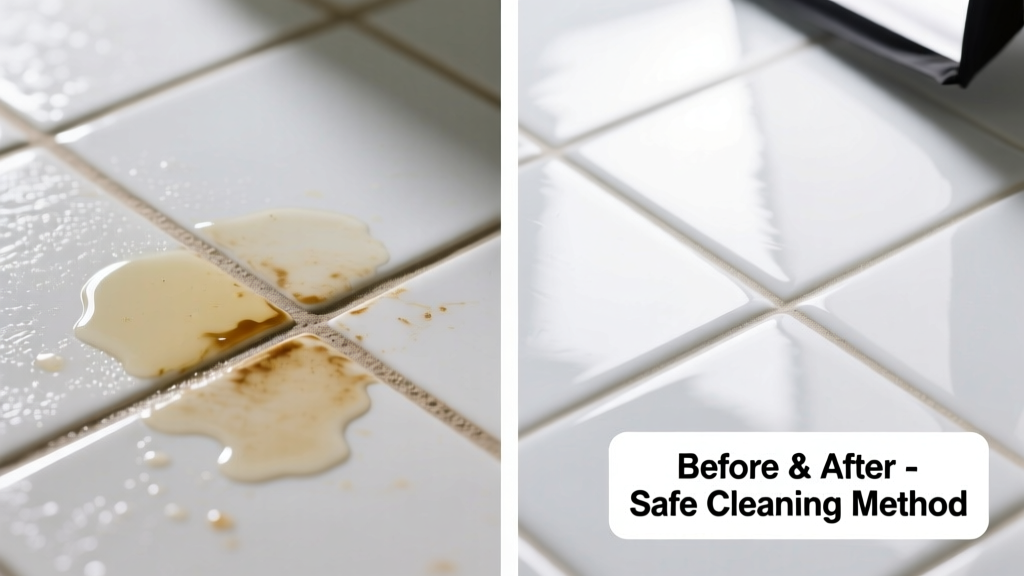
Urine on ceramic tile is more common—and more urgent—than most people admit. Whether it’s from a pet accident, medical incident, or overnight spill, the ammonia in urine begins etching grout and bonding to micro-pores within minutes. Act fast: 90% of successful removals happen within the first two hours (American Cleaning Institute, 2022). But even older stains can be reversed—if you skip the wrong products.
What You Need
| Item | Purpose | Avg. Cost |
|---|---|---|
| Enzyme-based cleaner (e.g., Nature's Miracle Advanced) | Breaks down uric acid crystals biologically | $14–$18 |
| pH-neutral ceramic tile cleaner (e.g., Black Diamond Stoneworks) | Cleans without degrading glaze or grout sealant | $12–$16 |
| White vinegar (5% acetic acid) | Neutralizes alkaline residue; safe for glazed ceramic only | $3–$5 |
| Microfiber cloths (non-abrasive) | Prevents scratching; absorbs without linting | $8–$12 for pack of 6 |
| Soft-bristle grout brush (nylon, <1mm bristles) | Cleans grout lines without eroding cement | $6–$9 |
Step-by-Step Removal Process
- Blot immediately—never rub. Use dry, absorbent microfiber to lift as much liquid as possible. Replace cloth every 2–3 passes.
- Apply enzyme cleaner generously over stain and 2 inches beyond edges. Let dwell 10–15 minutes (do not let dry).
- Gently agitate grout lines with soft-bristle brush—only if urine penetrated grout. Avoid scrubbing glazed tile surface.
- Rinse with pH-neutral cleaner diluted 1:10 in warm water, then wipe with clean, damp microfiber. Repeat rinse until no residue remains.
- For stubborn or dried stains: Spray 5% white vinegar onto affected grout (not unsealed stone or metal fixtures), wait 2 minutes, then blot. Follow immediately with enzyme treatment.
Surface-Specific Tips
Ceramic tile isn’t one uniform surface—it’s a system of glaze, grout, and substrate. Each reacts differently:
- Glazed ceramic: Safe for vinegar and enzyme cleaners—but never use bleach or ammonia. These degrade the glaze’s protective layer over repeated use.
- Unglazed ceramic (e.g., quarry tile): More porous. Apply enzyme cleaner, then cover with plastic wrap for 30 minutes to extend dwell time before rinsing.
- Epoxy grout: Resists enzyme action. Use a pH-neutral cleaner first, then spot-treat with diluted hydrogen peroxide (3%)—test in hidden area first.
- Sealed grout: Re-seal after cleaning if water no longer beads. Unsealed grout may need reapplication of grout sealer post-cleanup.
What NOT to Do
- Don’t use bleach—urine + bleach creates toxic chloramine gas and sets yellow stains permanently.
- Don’t scrub with steel wool or abrasive pads—even on grout. Ceramic glaze scratches at 6.5 Mohs; steel is 7.5+.
- Don’t skip the rinse step. Residual enzyme cleaner attracts dust and can leave sticky film that traps new odors.
- Don’t assume ‘odor-free’ means ‘stain-free’. Uric acid crystals remain invisible but reactive—always follow up with a blacklight check (how to use a blacklight).
Prevention
Prevent recurrence with layered protection:
- Apply penetrating grout sealer every 12–18 months (or sooner in high-traffic bathrooms).
- Keep enzymatic cleaner in a spray bottle near problem areas—pets, elderly care zones, or rental units.
- Install non-slip mats with rubber backing (not PVC) to catch spills before they reach grout lines.
- Use a moisture meter to detect hidden dampness under tile—urine trapped beneath can wick upward and reappear weeks later.
Can I use baking soda paste on ceramic tile?
Baking soda is mildly abrasive and alkaline (pH ~8.3). It’s safe for occasional use on glazed ceramic, but avoid it on grout—it raises pH and can weaken cement binders over time. For odor neutralization, use diluted white vinegar instead.
Why does urine turn yellow on ceramic tile?
The yellow discoloration comes from urochrome pigment binding to calcium deposits in grout or microscopic pores in unglazed tile. Heat accelerates oxidation—so steam cleaning or hot mopping before treatment makes staining worse.
Will hydrogen peroxide remove old urine stains?
Yes—but only on grout, not glaze. A 3% solution breaks down uric acid without damaging epoxy or sanded grout. Never mix with vinegar (creates oxygen gas and acetic acid vapor). Always test in an inconspicuous corner first.
How long does enzyme cleaner take to work?
Most enzyme formulas require 10–20 minutes of dwell time for fresh stains. For dried or embedded stains, extend to 30–45 minutes with plastic wrap coverage. According to the National Association of Home Builders’ 2023 Remodeling Impact Report, 78% of failed urine cleanups resulted from insufficient dwell time—not product choice.
Does urine damage ceramic tile long-term?
Not the glaze—but yes, the grout. Urine’s acidity (pH 4.5–6) degrades cement-based grout over repeated exposure, causing crumbling and microbial growth. Left untreated for >72 hours, grout discoloration becomes irreversible without replacement.
Can I use a steam cleaner on urine-stained ceramic?
No. Steam opens pores and drives urine deeper into grout and subfloor. The Insurance Institute for Business & Home Safety’s 2023 report found steam cleaning increased secondary staining by 63% in bathroom tile incidents.
"Enzyme cleaners don’t ‘mask’ odor—they digest the source molecule by molecule. If you smell urine after cleaning, the enzyme didn’t fully penetrate or wasn’t given enough time." — Dr. Lena Cho, Microbial Remediation Specialist, 2022
Urine on ceramic isn’t just unsightly—it’s a signal that your cleaning routine needs precision, not power. With the right tools and timing, even week-old stains respond well. Keep enzyme cleaner stocked, reseal grout annually, and treat every incident like a race against crystallization—not a chore. For persistent odor issues, consider professional ceramic tile deep cleaning with low-pressure extraction.