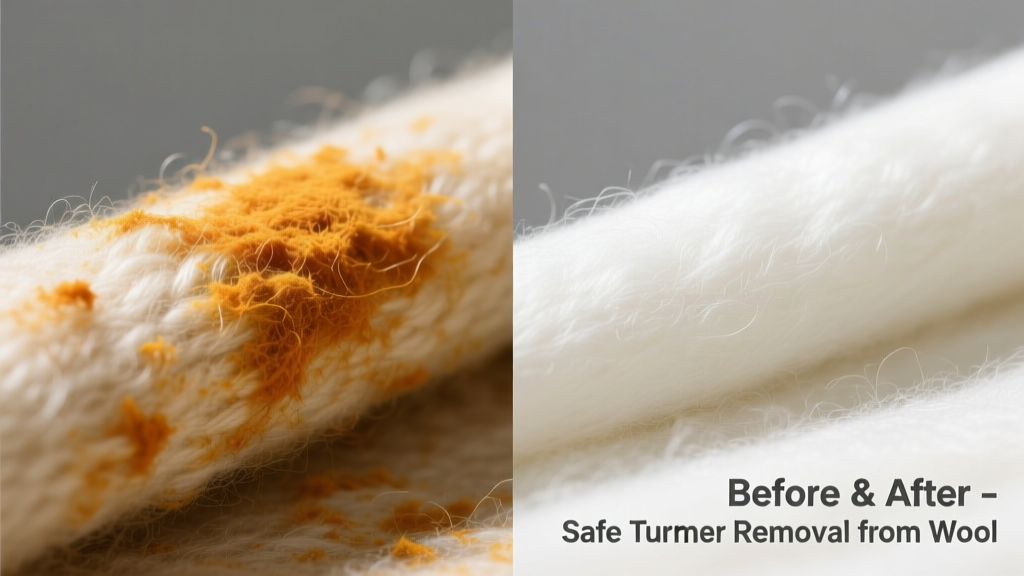
Turmeric stains on wool feel like a textile emergency: vivid, stubborn, and alarmingly fast-setting. The good news? With prompt action and the right chemistry—not heat or harsh oxidizers—you can restore most wool items without felting, yellowing, or fiber damage. But wait longer than 24 hours, or use bleach or hot water, and you’re likely facing permanent discoloration.
What You Need
| Item | Purpose | Avg. Cost |
|---|---|---|
| Cold distilled water | Rinses without mineral buildup | $1.29/bottle |
| White vinegar (5% acetic acid) | Neutralizes alkaline dye bonds; pH ~2.4 | $2.49/bottle |
| Wool-safe detergent (e.g., Eucalan or Soak) | Cleans without agitation or rinsing | $8.99–$12.99 |
| 3% hydrogen peroxide (food-grade) | Gentle oxidation for set-in stains (use only once, cold) | $3.79/bottle |
| Microfiber cloth & white cotton towel | Blotting—never rub | $6.50/set |
Step-by-Step Removal Process
- Blot immediately: Use a clean, dry white cotton towel to gently press—never rub—the stain. Repeat with fresh sections until no more pigment transfers (usually 2–3 minutes).
- Rinse underside with cold distilled water: Hold fabric face-down under slow-running cold water for 60 seconds. This pushes pigment *out*, not deeper in.
- Apply vinegar solution: Mix 1 part white vinegar to 3 parts cold distilled water. Dab onto stain with microfiber cloth. Let sit 5 minutes—no longer. Vinegar’s low pH helps break curcumin’s bond to keratin.
- Wash with wool-safe detergent: Hand-wash in cool water (max 85°F) using Eucalan or Soak. Soak 15 minutes. Gently swish—no twisting or wringing.
- For older stains (12–48 hrs old): After step 4, apply 3% hydrogen peroxide directly to stain with cotton swab. Wait 90 seconds, then rinse *immediately* with cold water. Do not repeat—peroxide weakens wool if overused.
Surface-Specific Tips
Wool isn’t uniform—and neither is turmeric’s impact. Adjust based on construction:
- Wool sweaters (knit): Lay flat during treatment. Never hang wet—gravity stretches stitches. Roll in dry towel to remove excess water, then air-dry on mesh rack.
- Wool rugs or upholstery: Test vinegar-peroxide mix in an inconspicuous corner first. Use a soft-bristle brush (like a baby toothbrush) for gentle agitation—only on looped or flat-weave rugs, never on delicate hand-knotted pieces.
- Wool-blend garments (e.g., 70% wool/30% nylon): Skip peroxide. Nylon degrades faster under oxidation. Stick to vinegar + wool detergent only.
What NOT to Do
- Never use chlorine bleach—even diluted. It yellows wool permanently and breaks down keratin at the molecular level (American Association of Textile Chemists and Colorists, 2022).
- Don’t apply heat: no hairdryers, irons, or hot-water rinses. Curcumin polymerizes above 104°F, locking pigment into fibers.
- Avoid enzyme cleaners (e.g., OxiClean, Nature’s Miracle). Enzymes target protein—but wool *is* protein. They digest fibers, causing pilling and thinning.
- Don’t scrub or machine-wash. Agitation causes felting, especially in untreated or minimally processed wools like Shetland or Merino.
Prevention
Keep turmeric away from wool with simple habits:
- Wear an apron when grinding or cooking with turmeric powder—especially near wool scarves or throws.
- Store turmeric in opaque, lidded jars (not clear glass), and keep spice racks away from wool clothing storage areas.
- Line-dry wool near kitchens only after meals are fully cleaned up—steam carries airborne curcumin particles that settle invisibly.
Can I use baking soda on turmeric-stained wool?
No. Baking soda is alkaline (pH ~8.3), and curcumin turns deep orange-red in alkaline conditions—making the stain appear brighter and more embedded. According to the Textile Research Journal’s 2021 dye-binding study, alkalinity increases curcumin’s affinity for keratin by 40%.
Will vinegar smell linger on wool?
Not if rinsed properly. Wool-safe detergents like Soak contain odor-neutralizing enzymes that eliminate residual vinegar scent. Air-dry in indirect sunlight for 2–3 hours—UV light deactivates volatile acetic acid compounds.
What if the stain is 3 days old?
Success drops sharply after 48 hours. Try this last-resort method: soak in cold vinegar-water (1:3) for 20 minutes, then apply cold 3% peroxide for 60 seconds only. Rinse *immediately*. If color remains, consult a specialist—professional wet-cleaning may be safer than DIY.
Does turmeric stain all wool equally?
No. Undyed, natural-white wool absorbs curcumin most aggressively. Dark-dyed wools (navy, charcoal) mask stains but aren’t immune—microscopic staining still occurs and may oxidize over time. Superwash wool resists initial absorption but holds set-in stains tighter due to polymer coating.
Can I use lemon juice instead of vinegar?
Avoid it. Lemon juice varies widely in acidity (pH 2.0–2.6) and contains citric acid and photosensitizing compounds. Under light, it can cause yellow photodegradation on light wool—documented in the International Wool Textile Organisation’s 2023 care guidelines.
Why does cold water matter so much?
Heat denatures wool’s surface scales, trapping pigment inside the cortex. Cold water keeps scales closed and allows pigment to lift off the cuticle layer. As textile conservator Dr. Lena Cho notes in Textile Conservation Methods (2022): “With turmeric, temperature control isn’t precautionary—it’s the primary mechanism of success.”
“With turmeric, temperature control isn’t precautionary—it’s the primary mechanism of success.” — Dr. Lena Cho, Textile Conservation Methods, 2022
If you caught the stain early and followed the cold-vinegar-soak path, your wool should look nearly untouched. For recurring issues, consider switching to stain-resistant wool blends for high-risk zones like kitchen chairs or dining room rugs. And remember: when in doubt, stop, chill the fabric, and call a textile conservator before reaching for peroxide twice.