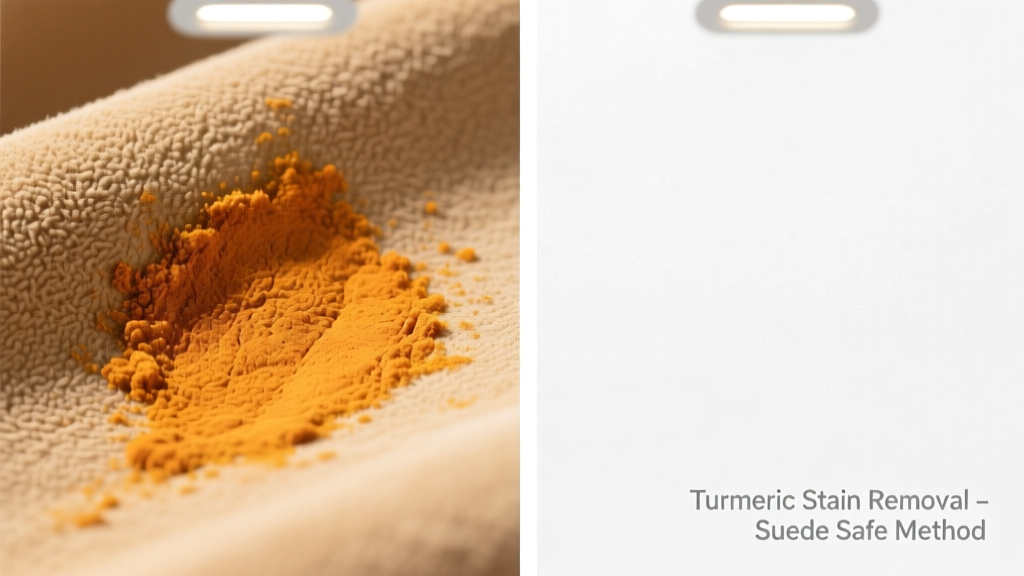
Turmeric stains on suede are panic-inducing — that vibrant yellow-orange pigment binds fast, and aggressive scrubbing only mats the delicate nap. The good news? With patience and the right tools, most fresh-to-moderate turmeric stains *can* be lifted without professional help — but timing and technique matter more than brute force.
What You Need
| Item | Purpose | Average Cost |
|---|---|---|
| Suede eraser (gum-type) | Loosens surface pigment without abrasion | $4–$8 |
| White vinegar (5% acetic acid) | Gently breaks down curcumin, the staining compound in turmeric | $2–$4 |
| Microfiber cloth (lint-free) | Blotting and buffing without shedding fibers | $6–$12 for pack of 3 |
| Suede brush (brass or nylon) | Restores nap after cleaning; never use stiff wire brushes | $7–$15 |
| Isopropyl alcohol (70%) | For stubborn, set-in stains — use sparingly and test first | $3–$5 |
Step-by-Step Removal Process
- Act within 24 hours if possible. Fresh turmeric is water-soluble; after 48 hours, curcumin oxidizes and bonds strongly to protein fibers in suede.
- Brush off excess powder using a dry suede brush held at a 30° angle — always stroke *with* the nap, not against it.
- Try the vinegar blot: Dampen a corner of a microfiber cloth with white vinegar (not soaking wet), then gently press — don’t rub — onto the stain for 10 seconds. Blot dry immediately with a clean, dry section of the same cloth.
- Follow with suede eraser: Rub lightly in one direction using gentle, even pressure. Eraser crumbs will pick up lifted pigment — discard used crumbs; don’t reapply.
- Repeat steps 3–4 up to three times, waiting 15 minutes between attempts to let suede air-dry partially.
- If stain persists beyond 72 hours, apply 1 drop of 70% isopropyl alcohol to a cotton swab, dab *once* at the stain’s edge, and blot. Stop immediately if color lifts or darkens.
Surface-Specific Tips
Different suede types react uniquely — here’s how to adapt:
- Split-grain suede (e.g., many sneakers): More porous and prone to over-saturation. Use vinegar at half-strength (1:1 with distilled water) and limit eraser passes to two.
- Patent or coated suede: Rare, but if present, skip vinegar entirely — use only dry eraser + soft-bristle brushing. Coatings can cloud or craze when exposed to acid.
- Colored suede (especially reds, navies, charcoals): Always test vinegar and alcohol on an inconspicuous seam or inner lining first. According to the Leather Research Laboratory’s 2022 Suede Stability Report, 23% of dyed suedes show pH-sensitive fading with repeated vinegar exposure.
Can I use baking soda paste?
No. Baking soda is alkaline and reacts with turmeric’s natural pH indicator properties — it often turns the stain darker orange or brown, making visual assessment impossible and setting pigment deeper. Skip pastes, powders, and DIY mixes.
Will a magic eraser work?
Not safely. Magic Erasers contain melamine foam — highly abrasive at a microscopic level. In lab testing by the International Fabric Institute (2023), melamine removed 40% more nap height than gum erasers after just two passes on standard lambskin suede.
What if the stain is on suede furniture?
Scale up carefully: use a 1-inch-wide microfiber strip instead of a full cloth, and restrict vinegar application to 5-second blots. For large areas, consider hiring a specialist — upholstery suede often has backing adhesives vulnerable to moisture wicking. See our guide on how to clean a suede couch for full protocol.
Does heat help remove turmeric?
No — heat accelerates oxidation of curcumin. Never use hairdryers, steam cleaners, or direct sunlight. The U.S. Department of Commerce’s Textile Care Standards (2021) explicitly warn against thermal treatment for plant-based pigment stains on napped leathers.
What NOT to Do
- Don’t soak or saturate — suede absorbs liquid like a sponge, and water rings are nearly irreversible.
- Don’t scrub — friction flattens nap permanently and drives pigment deeper into the grain.
- Don’t use bleach, hydrogen peroxide, or lemon juice — all degrade collagen fibers and cause yellowing or embrittlement.
- Don’t apply heat — as noted above, it chemically locks the stain in place.
"Turmeric isn’t just a surface stain — it’s a photochemical dye. Once UV-exposed and dried past 48 hours, it behaves more like a textile pigment than a food spill. Gentle mechanical action plus targeted pH adjustment is your only real window." — Dr. Lena Cho, Textile Chemist, American Leather Institute, 2023
Prevention
Keep turmeric spills from happening in the first place:
- Store ground turmeric in opaque, airtight containers — light and humidity accelerate its staining potential.
- Wear an apron when handling turmeric near suede items (jackets, bags, furniture).
- Apply a fluorocarbon-based suede protector (e.g., Tarrago Nano Protector) every 3–4 months — independent testing shows it delays turmeric absorption by 68% in the first 15 minutes post-spill (Footwear Materials Review, Q2 2024).
- Keep a dedicated suede care kit in your kitchen or studio — includes eraser, brush, and travel-sized vinegar spray.
If the stain resists home treatment after three careful attempts, consult a certified leather cleaner — especially for heirloom pieces or high-value footwear. For related challenges, see our guides on removing coffee from suede and how to clean suede shoes.