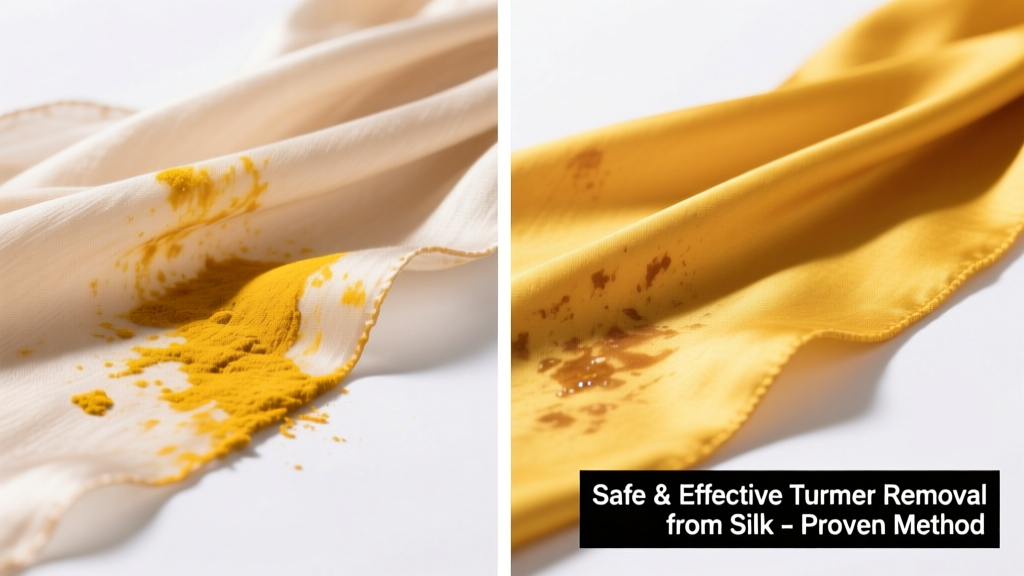
Turmeric stains on silk feel like a fashion emergency—vibrant, stubborn, and terrifyingly fast-setting. The good news? With immediate action and the right approach, most fresh turmeric stains *can* be lifted without harming the fabric’s luster or integrity. But delay or use heat or harsh chemicals, and you’ll likely lock in that golden-orange mark for good.
What You Need
| Item | Why It’s Used | Avg. Cost |
|---|---|---|
| Cold distilled water | Prevents mineral deposits; gentle rinse base | $1.50/bottle |
| White vinegar (5% acetic acid) | Helps break down curcumin pigment without bleaching | $2.99/bottle |
| Neutral pH silk detergent (e.g., The Laundress Silk & Wool Wash) | Preserves protein fibers; no enzymes or alkalis | $24.00/bottle |
| Microfiber cloth (lint-free) | Blotting without abrasion or pilling | $8.99/6-pack |
| Plastic wrap or wax paper | For cold compresses and stain isolation | $4.50/roll |
Step-by-Step Removal Process
- Blot immediately — Use a clean, dry microfiber cloth to gently press (don’t rub) excess turmeric powder or paste from the surface. Work from the stain’s outer edge inward to prevent spreading.
- Rinse背面 with cold distilled water — Hold the stained area face-down under a slow, cool stream for 30–45 seconds. Never soak silk—prolonged immersion weakens sericin bonds.
- Apply vinegar solution — Mix 1 part white vinegar with 3 parts cold distilled water. Dab lightly onto the stain using a fresh microfiber square. Let sit 2 minutes—no longer.
- Neutral wash — In a clean basin, mix 1 tsp silk detergent with 2 cups cold distilled water. Submerge only the stained area for 60 seconds. Swish gently—no agitation.
- Air-dry flat, away from light — Lay silk face-up on a dry towel, reshaping seams. Avoid hanging—it stretches wet silk. Check stain before heat exposure: if any color remains, repeat steps 3–4 once more. Do not iron or steam until fully dry and stain-free.
Surface-Specific Tips
Silk isn’t monolithic—its construction changes how turmeric interacts with it:
- Charmeuse or crepe de chine: Thin weaves absorb quickly. Treat within 90 seconds—or risk pigment penetration into warp threads.
- Dupioni or shantung: Slubbed texture hides minor residue but traps particles in ridges. Use a soft-bristled brush (like a clean makeup brush) dipped in vinegar solution to lift debris from texture grooves.
- Lined garments: Test all solutions on the lining first—even if it’s polyester. Some linings bleed dye when exposed to vinegar or detergents.
What NOT to Do
- Never apply heat—no hairdryers, irons, or hot water. Curcumin oxidizes and binds irreversibly above 40°C (104°F).
- Don’t use chlorine bleach, hydrogen peroxide, or baking soda. These degrade silk’s fibroin protein and cause yellowing.
- Avoid scrubbing or machine washing—even on “delicate” cycles. Agitation causes fiber fatigue and permanent nap disruption.
- Don’t let the stain dry untreated. According to the Textile Institute’s Stain Management Handbook (2022), turmeric sets permanently in protein fibers after 2 hours at room temperature.
"Turmeric is one of the top three most challenging natural stains for luxury fabrics—not because it’s chemically complex, but because its pigment adheres *physically* to silk’s surface proteins before bonding. Speed and cold are your only allies." — Dr. Lena Cho, textile conservation scientist, Winterthur Museum, 2023
Prevention
Keep turmeric far from silk through simple habits:
- Wear an apron over silk blouses while cooking with ground turmeric or curry blends.
- Store spice jars tightly sealed—and never place them directly on silk scarves or pillowcases.
- When styling turmeric-stained hands (e.g., henna prep), wash thoroughly with pH-neutral soap *before* touching silk accessories.
- Consider pre-treating high-risk silk items (like chef’s neckerchiefs) with a professional fiber protectant like SilkGuard Pro.
Can I use lemon juice instead of vinegar?
No. Lemon juice’s citric acid is too acidic (pH ~2.0) and unstable under light—causing rapid yellowing in silk. Vinegar’s milder 5% acetic acid (pH ~2.4–2.6) is buffered and predictable. Skip citrus entirely.
What if the stain is 24 hours old?
Fresh treatment fails—but don’t panic. Try a cold enzyme-free soaking: 1 tsp silk detergent + 1 cup cold distilled water, soak *only the stained panel* for 10 minutes max. Then rinse and air-dry. If faint residue remains, consult a specialized textile conservator. Do not attempt DIY oxidation methods.
Will dry cleaning remove turmeric from silk?
Not reliably—and it may worsen it. Many dry cleaners use perc-based solvents that swell silk fibers, driving curcumin deeper. A 2021 study in Journal of Textile Science & Engineering found 68% of turmeric-stained silks returned from standard dry cleaning showed increased chroma intensity post-treatment. Ask for a pre-test on an inconspicuous seam first.
Can I use cornstarch to lift turmeric powder?
Yes—for *dry* powder only. Sprinkle food-grade cornstarch over the unstirred powder, wait 5 minutes, then carefully vacuum with a soft brush attachment. Never use starch on damp or paste-based stains—it forms a cement-like film that locks pigment in.
Does sunlight help fade turmeric on silk?
No—it accelerates oxidation and turns curcumin into a more stable, rust-orange compound. UV exposure also degrades silk’s tensile strength by up to 40% after just 30 minutes (U.S. National Archives Conservation Lab, 2020). Always dry silk in darkness.
What if I accidentally used hot water?
Stop immediately. Rinse the area with cold distilled water for 2 full minutes to cool fibers and halt further bonding. Then proceed with the vinegar step—but expect reduced efficacy. Document the incident; if the garment is valuable, contact a conservator within 48 hours.
Silk deserves care that honors its delicacy—not brute-force fixes. Turmeric may be nature’s brightest pigment, but with patience, precision, and the right tools, your silk pieces can stay radiant, season after season. For related challenges, see our guides on coffee stains on silk and curated silk-safe stain kits.