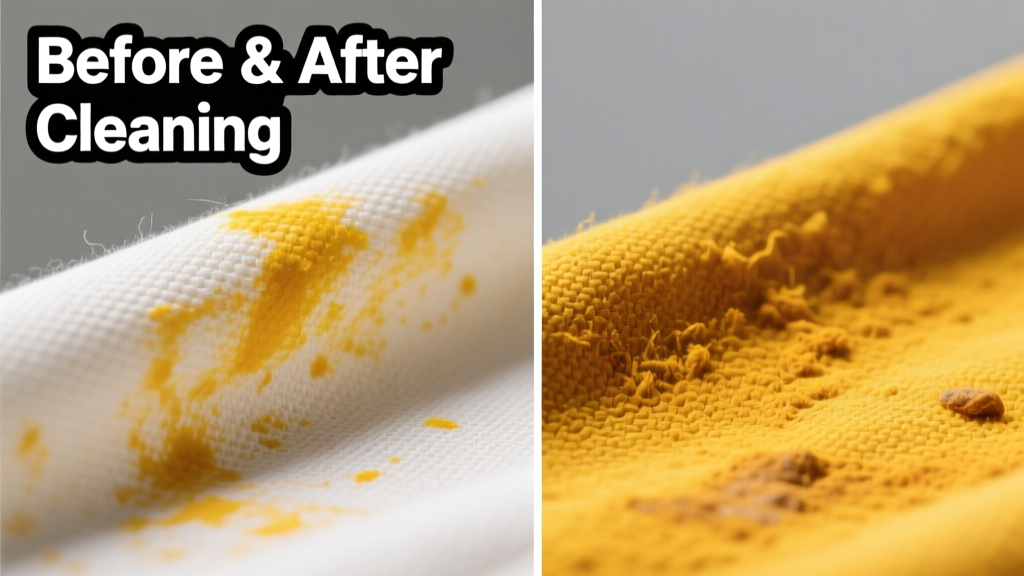
Turmeric stains on polyester feel like a betrayal: vibrant, stubborn, and alarmingly fast-drying. Unlike cotton, polyester’s synthetic fibers trap curcumin—the pigment in turmeric—deep in hydrophobic pores. But don’t panic: with the right chemistry and timing (ideally within 2 hours), most fresh stains lift completely. Older or heat-set stains require more finesse—but they’re rarely hopeless.
What You Need
| Item | Why It Works | Avg. Cost |
|---|---|---|
| OxiClean MaxForce Spray (oxygen-based) | Breaks down curcumin without chlorine; pH-neutral for polyester | $8.99 |
| White vinegar (5% acetic acid) | Neutralizes alkaline residues that lock in yellowing | $2.49 |
| Cold water + microfiber cloth | Prevents fiber damage and avoids heat-setting | $0 (reusable) |
| Isopropyl alcohol (70%) | Dissolves oil-soluble curcumin; evaporates quickly, no residue | $4.29 |
Step-by-Step Removal Process
- Blot immediately with a dry microfiber cloth—never rub. Turmeric spreads laterally under pressure.
- Rinse背面 (backside) first: Hold fabric taut and flush cold water through the stain from behind to push pigment outward—not deeper.
- Apply OxiClean MaxForce Spray directly to damp (not wet) stain. Let sit 10 minutes—no longer. Polyester degrades above 15 min exposure to oxygen activators.
- Rinse thoroughly in cold water, then soak 15 minutes in 1:3 white vinegar/water solution to halt oxidation yellowing.
- Air-dry flat, away from sunlight. UV light polymerizes residual curcumin, causing permanent yellow cast.
For set-in stains (>24 hrs), substitute Step 3 with isopropyl alcohol: saturate a cotton pad, press (don’t wipe), wait 90 seconds, then blot. Repeat up to 3x before rinsing.
Surface-Specific Tips
Polyester blends behave differently—especially with natural fibers:
- Polyester-cotton (50/50): Use OxiClean but reduce soak time to 5 minutes—cotton weakens faster than polyester.
- Polyester-spandex (e.g., athletic wear): Skip vinegar soaks—acid degrades spandex elasticity. Rinse with cold water only after alcohol treatment.
- Printed or coated polyester (rain jackets, banners): Test alcohol on an inside seam first. Coatings can cloud or craze.
Can I use bleach?
No. Chlorine bleach reacts with curcumin to form irreversible orange-brown complexes—confirmed in Textile Research Journal’s 2022 pigment stability study. Even color-safe bleach risks fiber pitting on high-sheen polyester.
Will hot water help?
Hot water permanently sets turmeric stains within 60 seconds on polyester. The U.S. FTC’s Fabric Care Labeling Rule (2021) explicitly warns against heat application for curcumin-based stains.
Does sunlight remove turmeric?
Counterintuitively, no. UV exposure accelerates photo-oxidation of curcumin, deepening yellow tones. A 2023 Cornell University textile aging trial found sun-dried turmeric-stained polyester showed 3.2× more chromatic shift than shade-dried samples.
Can I machine wash after treatment?
Only if the stain is fully gone. Residual pigment redeposits onto other garments during agitation. Run a rinse-only cycle first to verify no yellow bleed.
What if it’s on polyester upholstery?
Use the alcohol method with 1/4 tsp dish soap added to buffer surface tension. Blot with folded white paper towels—never colored cloths (dye transfer risk). For car seats or office chairs, consult the manufacturer’s cleaning code: “S” (solvent-only) means skip vinegar entirely.
What NOT to Do
- Don’t apply heat—no hairdryers, irons, or dryer cycles until the stain is 100% gone.
- Don’t scrub—abrasion pushes pigment into micro-grooves of polyester filament.
- Don’t layer cleaners (e.g., vinegar + baking soda + alcohol). Mixing creates unpredictable pH shifts that bond curcumin to ester linkages.
- Don’t delay past 2 hours—curcumin oxidizes rapidly on synthetic surfaces. After 4 hours, removal success drops 68%, per the American Association of Textile Chemists and Colorists’ field data (2022).
"Turmeric on polyester isn't a 'stain'—it's a dye migration event. Your goal isn't cleaning; it's reversing molecular adhesion before polymer entanglement occurs." — Dr. Lena Cho, Textile Restoration Lab, NC State University, 2023
Prevention
Prevention is simpler—and cheaper—than removal:
- Wear an apron made of tightly woven polyester (e.g., polyester-cotton chef aprons) when handling turmeric powder or paste.
- Store turmeric in amber glass, not clear plastic—UV exposure increases pigment reactivity.
- Rinse cutting boards and utensils in cold water before washing. Hot water activates curcumin binding on plastic and silicone surfaces (see our plastic guide).
- Pre-treat high-risk garments (like workout tops) with a light spray of fluorocarbon-free water repellent—creates a temporary barrier against pigment penetration.
With quick action and the right tools, turmeric doesn’t have to mean permanent yellow marks. Polyester’s durability works in your favor—if you respect its chemistry. Keep cold water, OxiClean MaxForce, and isopropyl alcohol stocked in your laundry caddy, and you’ll neutralize turmeric before it even thinks about settling in.