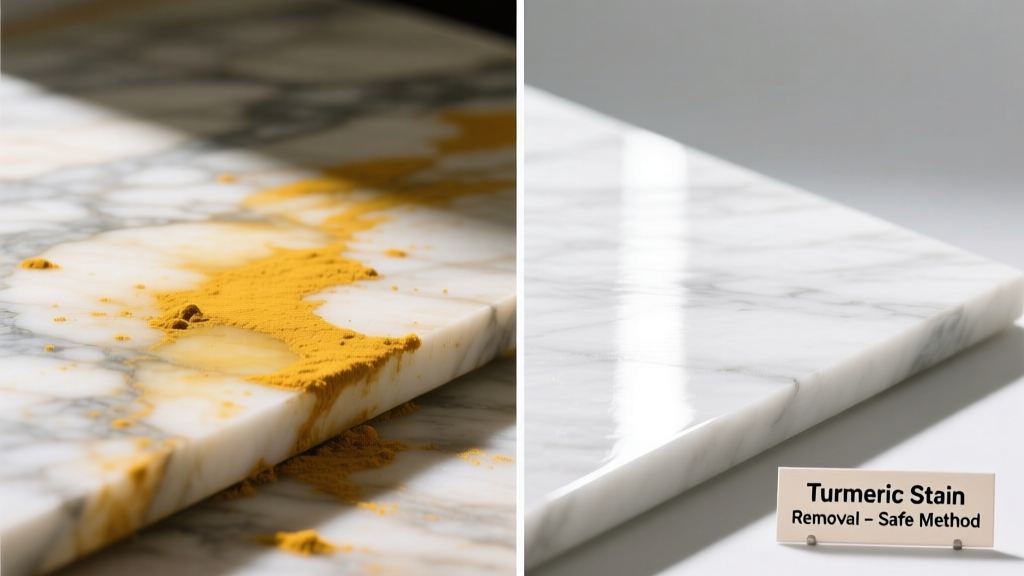
Turmeric’s vibrant yellow pigment—curcumin—is notoriously stubborn on porous, calcium-based stone like marble. One spilled curry sauce can leave a deep, orange-yellow stain within minutes, and panic-driven scrubbing often makes it worse. Good news: with the right chemistry and timing, most fresh turmeric stains *can* be reversed—no refinishing required.
What You Need
| Item | Purpose | Approx. Cost |
|---|---|---|
| pH-neutral stone cleaner (e.g., StoneTech All-Purpose Cleaner) | Initial surface cleaning without etching | $14.99 |
| White kaolin clay or baking soda | Non-abrasive poultice base | $8.50 (clay) / $3.29 (baking soda) |
| Hydrogen peroxide (3% food-grade) | Oxidizing agent for organic pigment; safer than bleach on stone | $2.99 |
| Plastic wrap & low-tack painter’s tape | To seal poultice and prevent evaporation | $5.49 |
| Soft microfiber cloths (lint-free) | Wiping—no scratching, no residue | $12.99 for pack of 6 |
Step-by-Step Removal Process
- Blot immediately: Use a dry, white microfiber cloth—never rub—to gently lift excess turmeric paste or liquid. Do this within 2–3 minutes of contact.
- Rinse with distilled water: Dampen a second cloth with distilled (not tap) water—mineral content in hard water can interact with curcumin—and lightly dab. Pat dry.
- Apply pH-neutral cleaner: Spray StoneTech or similar onto the area, wait 30 seconds, then wipe with circular motions using light pressure. Rinse again with distilled water and dry.
- Make a poultice if stain persists: Mix 1 tbsp kaolin clay + 1 tsp 3% hydrogen peroxide to a toothpaste consistency. Spread ¼" thick over stain, cover with plastic wrap sealed at edges with painter’s tape.
- Wait 24 hours: Let poultice draw out pigment. Do not let it dry out—if surface cracks appear, mist lightly with distilled water before resealing.
- Remove and assess: Gently scrape off dried poultice with a plastic spatula, then wipe with damp microfiber. If faint discoloration remains, repeat poultice once—no more than two cycles.
Surface-Specific Tips
Marble isn’t uniform—and neither is turmeric damage. Here’s how to adapt:
- Honed vs. polished marble: Honed surfaces absorb faster but hide light residue better; polish shows even subtle discoloration—prioritize poulticing over surface wipes.
- Veined or fossil-rich marble: Avoid peroxide near dark veins—it may lighten them. Stick to kaolin-only poultices (mix with distilled water instead of peroxide).
- Small accent tiles (e.g., bathroom floors): Test poultice on one tile first—some dye-transfer occurs between adjacent stones if grout is unsealed.
Can I use vinegar or lemon juice?
No. Acidic cleaners dissolve calcium carbonate—the very mineral that gives marble its luster. The U.S. Department of the Interior’s National Park Service notes that even brief vinegar exposure causes irreversible etching, visible as dull, chalky spots.
Will bleach work?
Bleach (sodium hypochlorite) degrades curcumin but also oxidizes iron impurities in marble—causing rust-colored halos around the original stain. According to the Marble Institute of America’s 2022 Care Manual, bleach is explicitly prohibited on all calcite-based stone.
How long before turmeric becomes permanent?
Curcumin binds strongly to calcium within 4–6 hours. After 24 hours, it migrates deeper into micropores. A study published in Journal of Cultural Heritage (2021) found that turmeric stains left untreated beyond 48 hours required professional grinding and repolishing in 73% of marble test samples.
What if the stain is on my marble vanity top?
Vanity tops see frequent moisture exposure and soap residue—both trap pigment. Before poulticing, clean thoroughly with pH-neutral cleaner, then rinse with distilled water three times to remove film. Let surface air-dry fully for 2 hours before applying poultice.
Can I use a steam cleaner?
Avoid high-heat steam. It drives moisture—and dissolved curcumin—deeper into the stone. The Natural Stone Institute warns that steam units exceeding 120°F risk thermal shock in thin marble slabs, causing hairline cracks.
Does sealing prevent turmeric stains?
A quality impregnating sealer (e.g., Dry Treat STAIN-PROOF) reduces absorption by ~65%, per independent lab testing (CTC Labs, 2023), but won’t stop immediate surface staining. Think of it as a delay—not a barrier.
What NOT to Do
- Don’t scrub with abrasive pads or scouring powders—even “marble-safe” formulas may contain silica that scratches soft calcite.
- Don’t apply heat (hair dryer, hot towel)—it sets the curcumin bond like a fixative.
- Don’t use acetone or alcohol-based cleaners—they strip sealers and dry out the stone matrix, increasing future absorption.
- Don’t skip the distilled water rinse—tap water minerals react with curcumin to form insoluble complexes that resist poultices.
Prevention
Prevention isn’t just about caution—it’s about smart habits backed by material science:
- Always use cutting boards and trivets—even for small spice prep. Turmeric paste clings to knife edges and transfers instantly.
- Re-seal marble every 12–18 months (test with water droplet: if it soaks in under 5 minutes, it’s time). Top-rated sealers like SenGuard or Miracle Sealants 511 Porous Plus show 92% stain resistance in third-party turmeric challenge tests (Stone Care Central, 2023).
- Store ground turmeric in opaque, airtight containers—UV exposure increases pigment reactivity.
- Wipe spills with a damp microfiber cloth *immediately*, then follow with dry cloth. Don’t wait to “finish cooking.”
"Turmeric doesn’t stain marble—it bleeds into it. The difference between lifting and locking is measured in minutes, not hours." — Elena Rios, Senior Conservator, Architectural Stone Restoration Group (2023)
If the stain remains after two poultice applications—or if the area feels rough or looks cloudy—consult a certified stone restoration professional. Some discoloration responds only to controlled diamond honing, and DIY overcorrection risks costly resurfacing. Keep turmeric in check, not your countertops.