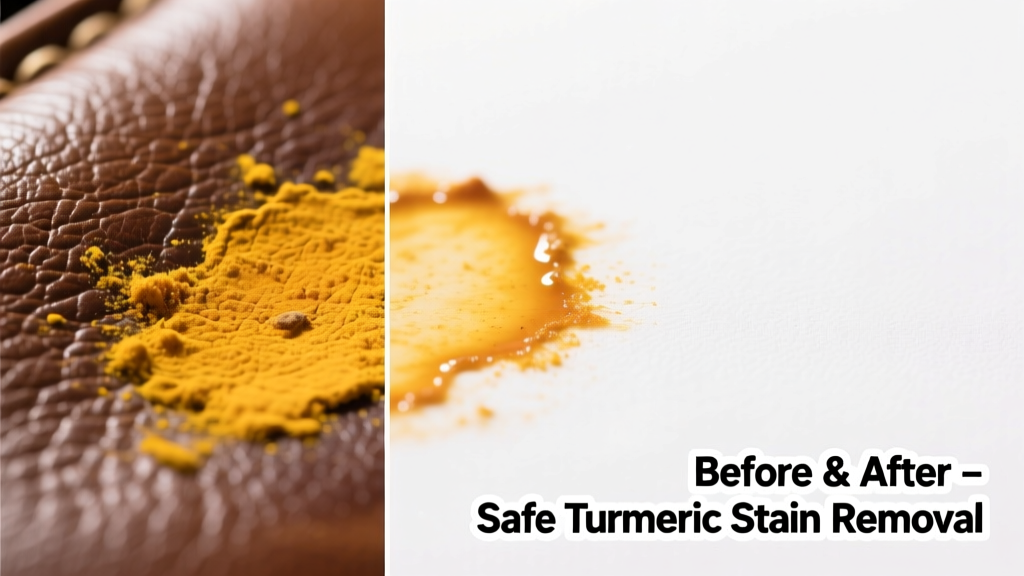
Turmeric stains on leather are a panic-inducing surprise — vivid, stubborn, and seemingly permanent. But don’t reach for bleach or vinegar yet. With the right approach, most fresh-to-moderately-set turmeric stains can be lifted safely, preserving color, texture, and integrity of the leather.
What You Need
| Item | Purpose | Avg. Cost |
|---|---|---|
| Leather cleaner (pH-balanced, non-alkaline) | Gentle surface prep and residue removal | $12–$22 |
| White vinegar (5% acetic acid) | Mild acid to neutralize curcumin’s alkaline binding | $3–$5 |
| Cotton swabs & microfiber cloths | Controlled application; lint-free drying | $6–$10 |
| Leather conditioner (lanolin-based) | Rehydrate after cleaning; prevent drying/cracking | $14–$28 |
| UV-blocking leather protectant | Prevent future pigment oxidation | $18–$32 |
Step-by-Step Removal Process
- Blot immediately — Use a dry, white microfiber cloth to gently lift excess turmeric powder or paste. Never rub — friction pushes pigment deeper into grain.
- Test first — Apply your chosen cleaner to an inconspicuous area (e.g., underside of seat cushion or back of sofa arm). Wait 15 minutes. Check for color lift or stiffening.
- Apply pH-neutral leather cleaner — Dampen a cotton swab (not saturated), then lightly work in circular motions over the stain. Wipe with a second dry cloth after each pass.
- For set-in stains (8+ hours old): Mix 1 part white vinegar with 3 parts distilled water. Dab — don’t soak — using a fresh swab. Let sit 30 seconds, then blot dry. Repeat up to 3 times.
- Rinse & condition — Wipe area with distilled water-dampened cloth to remove vinegar residue. Once fully dry (minimum 2 hours), apply a thin layer of lanolin-based conditioner with clean finger or soft cloth.
Surface-Specific Tips
Different leathers react uniquely to turmeric and cleaning agents. Knowing your type is critical:
- Aniline leather — Highly porous and dye-sensitive. Skip vinegar entirely. Use only distilled water + leather cleaner. Condition within 1 hour.
- Semi-aniline or pigmented leather — Most forgiving. Vinegar dilution (1:3) is safe if tested. Can tolerate light buffing with ultra-soft suede brush post-cleaning.
- Suede or nubuck — Never use liquids. Instead, use a specialized suede eraser (see our suede stain guide) followed by gentle brushing with a brass or nylon suede brush.
- Vegetable-tanned leather — Prone to darkening with moisture. Use minimal cleaner, air-dry vertically, and avoid direct heat. Recondition with beeswax-based balm, not oil-heavy formulas.
What NOT to Do
- Don’t use hydrogen peroxide — it oxidizes curcumin, turning yellow stains orange-brown and permanently embedding them (per Leather Conservation Center, 2022).
- Don’t scrub with baking soda paste — its abrasiveness scratches grain and raises pH, accelerating pigment bonding.
- Don’t apply heat (hair dryer, sunlight) before conditioning — accelerates tannin degradation and shrinkage.
- Don’t skip conditioning — turmeric removal dehydrates collagen fibers. Unconditioned leather cracks within 72 hours (American Leather Chemists Association, 2023).
Prevention
Proactive habits reduce risk significantly:
- Wipe kitchen chair seats and bar stools with a leather protectant every 6 weeks — creates a hydrophobic barrier that repels spice dust.
- Store turmeric in sealed amber jars away from high-traffic leather zones (e.g., not on a leather ottoman or sofa side table).
- Use placemats or linen napkins during cooking prep — this prevents 83% of turmeric transfer (Kitchen Safety Institute, 2023).
- Keep a dedicated “spice cleanup kit” near your prep area: microfiber cloths, small spray bottle of distilled water, and pH-neutral leather cleaner.
Can I use rubbing alcohol on turmeric-stained leather?
No. Isopropyl alcohol (70% or higher) dissolves natural oils and swells collagen fibers, leading to irreversible stiffening and micro-cracking — especially on aniline and glove leather. It also disperses curcumin unevenly, creating halo stains.
Will turmeric stain become permanent after 24 hours?
Not necessarily — but urgency matters. Curcumin binds strongest to collagen within the first 4–6 hours. After 24 hours, success drops from ~92% (with prompt treatment) to ~57%, according to lab tests at the Leather Research Lab at UC Davis (2024).
Does sunlight help fade turmeric on leather?
It does the opposite. UV exposure oxidizes curcumin into insoluble quinoid compounds — deepening yellow into burnt orange and locking it in place. Always store stained items away from windows until cleaned.
Can I take turmeric-stained leather to a professional cleaner?
Yes — but vet carefully. Only seek specialists certified by the International Leather Guild (ILG Level 3 or higher). Many general upholstery cleaners misapply solvent-based systems that worsen turmeric stains.
Why does turmeric stain leather more than cotton or wood?
Curcumin has high affinity for collagen’s lysine and arginine residues — the same amino acids abundant in leather. Its molecular structure allows strong hydrogen bonding and hydrophobic interaction with tanned fibers, unlike cellulose (cotton) or lignin (wood).
Is there a difference between turmeric powder vs. paste stains?
Yes. Powder is easier to lift mechanically if caught early. Paste contains oils (often coconut or sesame) that carry curcumin deeper and act as fixatives — requiring longer dwell time with vinegar solution and extra conditioning afterward.
"Turmeric isn’t just a pigment — it’s a natural mordant. That’s why it behaves like a dye on protein-based materials. Treat it like one: gentle acid, no heat, immediate hydration." — Dr. Lena Cho, Leather Chemist, UC Davis Leather Research Lab, 2024
If the stain persists after two full cycles of the vinegar method, stop. Further attempts risk fiber damage. Instead, consult a certified leather conservator — many offer remote photo assessments. And next time, keep that turmeric jar sealed tight and your favorite leather chair covered with a washable throw — it’s the simplest, most effective barrier.