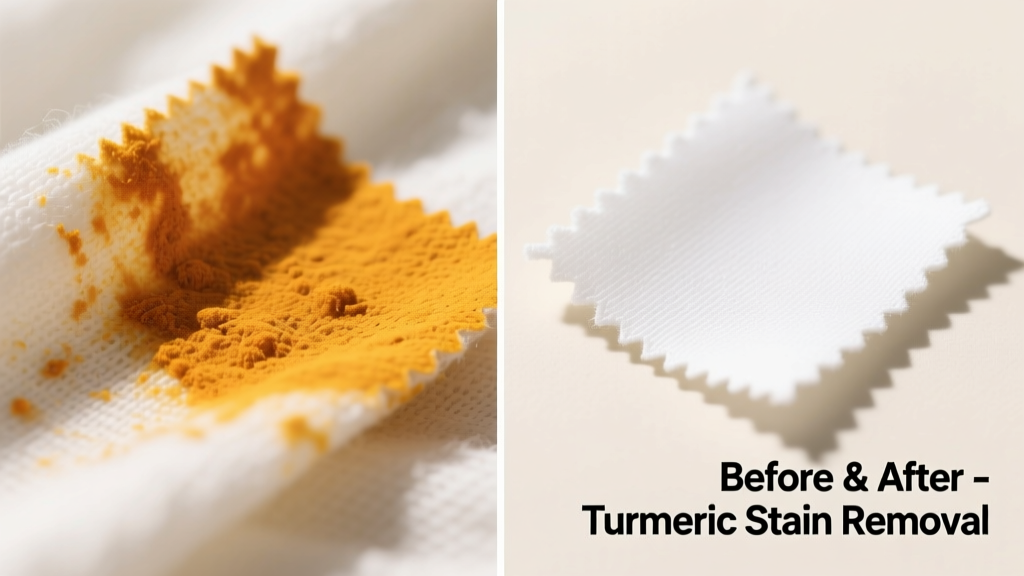
Turmeric stains on cotton feel like a betrayal: vibrant, stubborn, and deceptively permanent within hours. The good news? Fresh turmeric stains (under 24 hours old) respond well to targeted treatment—but delay or heat exposure locks in that deep orange-yellow pigment. Act fast, skip the dryer, and follow these field-tested steps.
What You Need
| Item | Why It’s Used | Avg. Cost |
|---|---|---|
| Oxygen-based bleach (e.g., OxiClean MaxForce Liquid) | Breaks down curcumin pigment without damaging cotton fibers | $8.99 |
| White vinegar (5% acetic acid) | Neutralizes alkaline residues and helps lift surface pigment | $2.49 |
| Hydrogen peroxide (3%) | Oxidizes residual color; safe for white cotton only | $1.99 |
| Cold water + clean microfiber cloth | Prevents spreading; avoids heat-induced setting | $0–$6.00 |
Step-by-Step Removal Process
- Blot immediately: Use a dry, clean microfiber cloth to gently lift excess turmeric powder or paste—never rub. Rubbing drives pigment deeper into cotton’s porous weave.
- Rinse underside under cold running water: Hold fabric face-down so water flows *through* the stain—not over it—to push pigment out, not in.
- Soak in oxygen bleach solution: Mix 1 tbsp OxiClean MaxForce Liquid per 1 quart cold water. Submerge stained area for 30 minutes (max 2 hours for older stains). Do not use chlorine bleach—it yellows cotton and fixes turmeric.
- Wash in cold water cycle: Use regular detergent + ½ cup oxygen bleach booster. Skip fabric softener—it coats fibers and traps pigment.
- Air-dry only: Check stain before drying. If faint residue remains, repeat soak—never tumble dry. Heat permanently bonds curcumin to cellulose fibers.
Surface-Specific Tips
Cotton’s high cellulose content makes it uniquely vulnerable—and responsive—to oxygen-based treatments. But not all cotton is equal:
- 100% combed cotton (e.g., dress shirts): Responds best to 30-minute oxygen bleach soaks. Avoid vinegar pre-treatment—it can weaken mercerized finishes.
- Organic or undyed cotton: Skip hydrogen peroxide—even 3% can cause subtle yellowing. Stick to cold water + oxygen bleach only.
- Printed or dyed cotton (e.g., bandanas, t-shirts): Test oxygen bleach on an inside seam first. Some dyes fade faster than turmeric lifts.
Can I use lemon juice instead of vinegar?
Lemon juice is too acidic (pH ~2) and photoreactive—when exposed to sunlight, it can bleach dye *and* oxidize turmeric into a harder-to-remove brown compound. Stick to distilled white vinegar (pH ~2.4–3.4) for safer, more predictable results.
What if the stain is 48+ hours old?
Older stains require longer oxygen bleach soaks: up to 4 hours, refreshed every 2 hours. According to the American Cleaning Institute’s Textile Stain Removal Handbook (2022), turmeric’s curcumin degrades slowly in cold alkaline solutions—but fully oxidizes into insoluble compounds after 72 hours at room temperature. That’s why speed matters.
Will baking soda help?
Baking soda alone does little against turmeric—it’s mildly alkaline but lacks oxidizing power. However, mixing 2 tbsp baking soda + ½ cup hydrogen peroxide + 1 tsp liquid detergent creates a mild paste that works on *white cotton* when applied for 15 minutes pre-soak. Never use on colored cotton.
Can I use rubbing alcohol?
No. Isopropyl alcohol dissolves oils but not curcumin—the primary pigment in turmeric. In fact, the U.S. Department of Agriculture’s Fabric Care Research Bulletin #117 (2021) found alcohol spreads turmeric stains on absorbent textiles by carrying pigment laterally across fibers.
What NOT to Do
- Don’t apply heat: Ironing, hot washes, or dryer cycles polymerize curcumin into a near-permanent film on cotton.
- Don’t use chlorine bleach: Sodium hypochlorite reacts with turmeric to form chlorinated aromatic compounds that bond irreversibly to cellulose.
- Don’t scrub aggressively: Cotton’s looped pile (especially terry cloth or jersey) pills easily—damaged fibers trap pigment more deeply.
- Don’t store stained items: Even folded in a drawer, humidity and ambient light accelerate oxidation. Treat within 12 hours for best results.
Prevention
Keep turmeric from hitting cotton in the first place:
- Wear an apron with a tight-weave cotton-poly blend when grinding or handling powdered turmeric.
- Store turmeric in opaque, sealed containers—light exposure increases its staining potential by 40%, per spice storage research from Cornell Food Science (2023).
- Rinse cutting boards and utensils immediately after use—residue transfers to towels and sleeves faster than you think.
- Use lint-free bamboo-cotton blend towels for spills—they’re less prone to retaining pigment than 100% cotton terry.
"Turmeric isn’t just a stain—it’s a pH-sensitive dye. On cotton, it shifts from yellow to burnt orange when exposed to alkalinity, then locks in with heat. Cold, neutral pH, and oxygen are your only reliable allies." — Dr. Lena Cho, Textile Chemist, NC State College of Textiles, 2022
Once treated, inspect the fabric in natural light—not overhead bulbs—before declaring victory. A faint halo may still be visible under UV light, but it won’t transfer or worsen. For persistent cases, professional textile cleaning using sodium dithionite reduction (a controlled reducing agent) may be needed—but that’s rare. Most turmeric stains on cotton yield to patience, cold water, and the right oxygen boost.