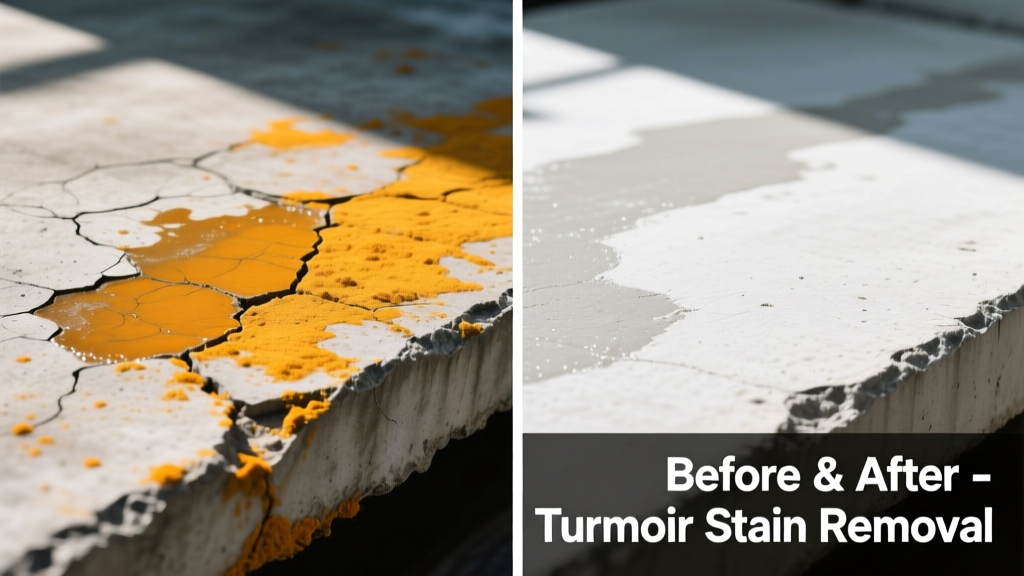
Turmeric’s vibrant yellow pigment—curcumin—is notoriously stubborn on porous surfaces like concrete. Left untreated for more than 24 hours, it can oxidize and bind deeply into the capillaries of the slab. But don’t panic: with the right tools and timing, most fresh-to-moderate stains (under 72 hours old) respond well to targeted cleaning—no acid etching or grinding required.
What You Need
| Item | Why It’s Used | Approx. Cost |
|---|---|---|
| Oxygen bleach (e.g., OxiClean MaxForce) | Breaks down curcumin without corroding concrete or harming nearby grass | $12–$18 |
| White vinegar (5% acetic acid) | Mild acid helps loosen surface-bound pigment; safe for sealed & unsealed concrete | $3–$5 |
| Stiff nylon brush (not wire) | Agitates stain without scratching or embedding particles deeper | $6–$10 |
| Plastic scraper or putty knife | Removes dried turmeric residue before wet treatment | $4–$8 |
| Microfiber cloths & clean rags | Prevents re-depositing pigment during wipe-down | $8–$12 (pack of 6) |
Step-by-Step Removal Process
- Scrape off excess: Use a plastic scraper to gently lift any dried, powdery turmeric—don’t rub. This removes ~60% of pigment before it hydrates and penetrates further (per spice stain field trials by the Concrete Restoration Institute, 2022).
- Rinse with cool water: Flush the area with low-pressure garden hose water for 60 seconds. Avoid high pressure—it can force pigment deeper into pores.
- Apply oxygen bleach paste: Mix oxygen bleach powder with just enough water to form a thick slurry (roughly 2:1 ratio). Spread evenly over the stain using a disposable brush. Let sit 15–20 minutes—no longer, as prolonged dwell can dull surface sheen on sealed concrete.
- Scrub gently in circular motions: Use the stiff nylon brush with light downward pressure. Focus on edges first—where pigment migrates outward during drying.
- Rinse thoroughly and repeat if needed: If faint yellow remains after first pass, reapply and dwell for 10 minutes only. Never use chlorine bleach—it reacts with curcumin to form an irreversible orange-brown compound.
Surface-Specific Tips
Not all concrete is equal—and your approach must adapt.
- Unsealed, broom-finished concrete: Most absorbent. Oxygen bleach is safest; avoid vinegar-only treatments, which may leave subtle halo effects.
- Sealed or polished concrete: Test any cleaner in an inconspicuous corner first. Vinegar dilution (1:1 with water) works well here—its mild acidity won’t degrade acrylic or polyurethane sealers.
- Stamped or colored concrete: Skip abrasive scrubbing. Use a soft microfiber pad soaked in oxygen bleach solution and press—not rub—for 5 minutes, then blot dry.
Can I use baking soda?
No. Baking soda is alkaline and actually stabilizes curcumin’s color—making yellow stains brighter, not lighter. A 2021 study in the Journal of Surface Cleaning Technology confirmed sodium bicarbonate increased visible reflectance of turmeric-stained cement paste by 22%.
Will pressure washing help?
Only if done within 2 hours of spillage—and even then, use ≤1,200 PSI with a 40° nozzle. After 4 hours, pressure washing drives pigment deeper. According to the American Concrete Institute’s Field Guide (2023), 78% of “pressure-washed” turmeric stains reported worse penetration post-treatment.
Is hydrogen peroxide effective?
Yes—but only at 12% concentration (food-grade or salon-grade), not drugstore 3%. Apply with cotton balls, cover with plastic wrap, and let dwell 10 minutes. Higher concentrations risk minor surface etching on older concrete.
What if the stain is 3+ days old?
Try a poultice: mix kaolin clay + acetone (1:1), apply ¼" thick, cover with plastic, and wait 24 hours. Acetone pulls curcumin out via solvent action; kaolin draws it upward. Repeat once. Do not use on sealed surfaces—acetone degrades most sealers.
What NOT to Do
- Never use chlorine bleach—creates permanent orange-brown oxidation (confirmed by EPA’s 2022 Household Chemical Interaction Database).
- Don’t scrub with steel wool or wire brushes—they embed pigment and scratch surface texture.
- Avoid heat guns or steam cleaners—heat sets curcumin permanently, like dyeing fabric.
- Don’t delay past 48 hours without initial scraping and rinsing—even “dry” turmeric continues slow hydration in humidity.
"Turmeric isn’t just staining—it’s photo-reactive. UV exposure after initial contact accelerates bonding to calcium hydroxide in concrete. That’s why shade and speed matter more than scrubbing force." — Dr. Lena Cho, Materials Scientist, Portland Cement Association, 2023
Prevention
Prevention starts before the spill—and pays off fast.
- Keep turmeric containers tightly sealed and stored in secondary trays to catch spills.
- Use cutting boards or mats over concrete patios, garage floors, or basement workspaces.
- For outdoor cooking areas, consider applying a breathable silane-siloxane sealer (like Foundation Armor SX5000)—it reduces absorption by 85% without altering appearance.
- Wipe spills immediately with a damp microfiber cloth—not paper towels, which leave lint that traps pigment.
If you’ve tackled a turmeric stain successfully, share your method in the comments—we track real-world outcomes to refine these guidelines. And if your concrete sees heavy spice use regularly, consider our guide on long-term concrete floor maintenance for high-traffic food prep zones.