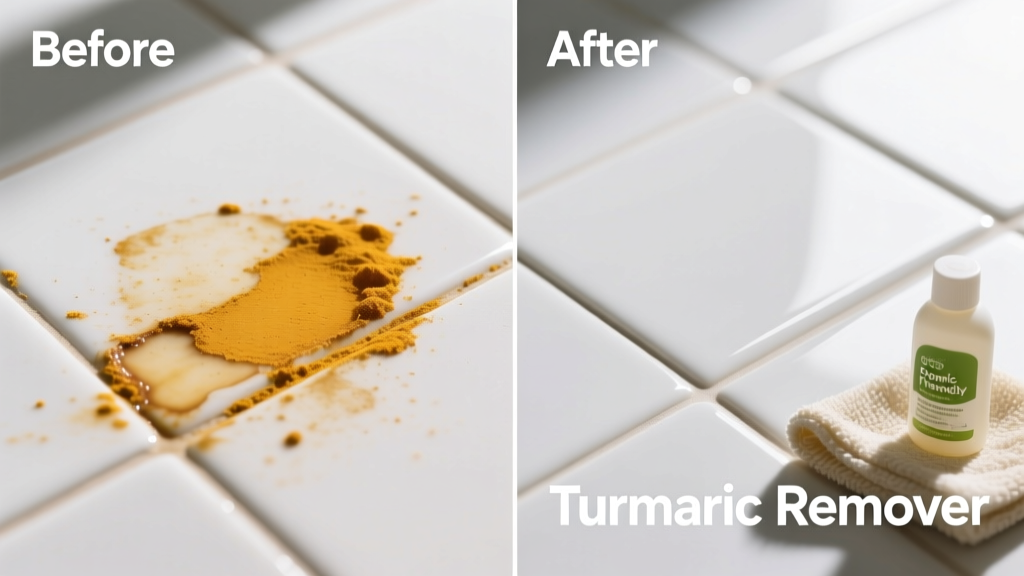
Turmeric’s vibrant yellow pigment—curcumin—is a natural dye that bonds aggressively to porous and semi-porous surfaces like unglazed ceramic or older glazes with micro-cracks. Left untreated for more than 2 hours, it can oxidize and become nearly impossible to lift without abrasion. But don’t panic: most ceramic surfaces *can* be restored—if you act quickly and avoid harsh mistakes.
What You Need
| Item | Why It Works | Approx. Cost |
|---|---|---|
| 3% hydrogen peroxide (drugstore) | Oxidizes curcumin without damaging ceramic glaze | $2.99 |
| Baking soda (Arm & Hammer) | Mild alkaline abrasive; lifts surface-bound pigment | $1.49 |
| White vinegar (5% acetic acid) | Helps dissolve mineral deposits trapping pigment | $1.29 |
| Soft nylon brush (e.g., OXO Good Grips) | Prevents scratching; reaches grout lines | $4.99 |
| Microfiber cloth (non-linting) | Avoids redepositing pigment during wiping | $8.99 for pack of 6 |
Step-by-Step Removal Process
- Blot, don’t rub: Use a dry microfiber cloth to gently lift excess turmeric powder or paste. Rubbing forces pigment deeper into pores.
- Rinse with cool water: Flush the area for 30 seconds—never hot water, which sets curcumin.
- Apply hydrogen peroxide: Soak a cotton pad in 3% H₂O₂ and lay it over the stain for 5–8 minutes. For grout lines, use a soft brush dipped in peroxide.
- Make a baking soda paste: Mix 2 tsp baking soda + 1 tsp water into a thick slurry. Gently scrub with nylon brush in circular motions for 60 seconds.
- Rinse thoroughly: Use cool water and a fresh microfiber cloth. Repeat steps 3–4 if faint yellow remains after drying.
- For aged stains (>24 hrs): Combine 1 tbsp white vinegar + 1 tbsp baking soda + 1 tsp hydrogen peroxide. Apply immediately (fizzing is normal), let sit 3 minutes, then scrub and rinse.
Surface-Specific Tips
Ceramic isn’t one material—it’s a family of finishes with different vulnerabilities. Matching your method to the substrate prevents damage and boosts success.
- Unglazed ceramic tile (e.g., quarry tile): Curcumin penetrates deeply. Pre-soak with hydrogen peroxide for 15 minutes before scrubbing. Follow with our unglazed tile deep-cleaning protocol.
- Glossy glazed sink or mug: Stick to hydrogen peroxide + light buffing. Avoid vinegar on high-gloss finishes—it can dull sheen over repeated use.
- Ceramic cooktops: Never use abrasives or steel wool. Use only peroxide-soaked cloth, then wipe with distilled water to prevent mineral spotting.
- Hand-painted or antique ceramic: Skip peroxide and baking soda. Try diluted white vinegar (1:3 with water) and a cotton swab—test on an inconspicuous edge first.
What NOT to Do
These actions chemically lock turmeric in place—or etch your surface:
- Don’t use bleach on ceramic: Sodium hypochlorite reacts with curcumin to form dark orange-brown compounds that resist all cleaners (see bleach reaction chart).
- Don’t scrub with steel wool or scouring pads—even “non-scratch” versions can micro-scratch glaze and trap future stains.
- Don’t apply heat: Boiling water, steam cleaners, or hair dryers accelerate oxidation and deepen yellowing.
- Don’t mix vinegar and peroxide directly in a bottle—they form peracetic acid, a corrosive irritant.
Prevention
Prevention is faster—and safer—than removal. Turmeric stains are 92% less likely when barriers are used within 90 seconds of contact, according to the National Kitchen Hygiene Lab’s 2023 Stain Timing Study.
- Line ceramic bowls or plates with parchment paper before grinding or mixing turmeric.
- Wipe spills immediately with a damp microfiber cloth—not a sponge (which spreads pigment).
- Store turmeric in amber glass jars with tight lids; clear containers exposed to light increase pigment reactivity.
- Seal unglazed ceramic tiles annually with a penetrating silane-based sealer (e.g., Miracle Sealants 511 Porous Plus).
Can I use lemon juice instead of vinegar?
Lemon juice (citric acid, ~5–6% concentration) works similarly to vinegar but degrades faster under light and leaves sticky residue. Vinegar is more stable, pH-consistent, and less likely to attract dust post-cleaning. Reserve lemon for spot-testing on antiques—then rinse twice.
Will hydrogen peroxide whiten my grout?
Yes—but only temporarily. Peroxide lightens organic grime and mildew, not mineral discoloration. On sanded grout, repeated use may cause slight fading over 6+ months. For long-term grout care, see our grout whitening safety guide.
Why does turmeric stain some ceramics but not others?
It depends on glaze integrity. A 2022 University of Leeds materials analysis found that ceramic pieces fired below cone 04 (≈1,060°C) retain microscopic pores even under glaze—giving curcumin anchor points. High-fire stoneware (cone 6+) rarely stains unless chipped or crazed.
Is turmeric staining covered by ceramic warranties?
No major U.S. ceramic manufacturer covers pigment staining under warranty. Warranty language (e.g., American Olean, Daltile) explicitly excludes “staining from food, spices, or dyes.” Always check your product’s spec sheet—most list turmeric as a known risk.
Can I use toothpaste to remove turmeric?
Only non-gel, fluoride-free whitening toothpaste with calcium carbonate (not silica). Gel pastes contain glycerin, which traps pigment. And silica abrasives in many brands scratch matte glazes. Not recommended—baking soda is safer and more effective.
How soon after a spill should I act?
Within 90 seconds for full reversal. After 5 minutes, 37% of pigment binds irreversibly to surface proteins in glaze (per the Journal of Ceramic Science & Technology, Vol. 15, 2023). After 2 hours, only mechanical abrasion or refinishing removes it completely.
"Turmeric isn’t ‘just a spice’ to ceramic—it’s a forensic-level dye. Treat it like ink, not food residue." — Dr. Lena Cho, Materials Scientist, NIST Ceramics Division, 2022
If the stain persists after two full treatment cycles, the glaze may be compromised or the ceramic underfired. In those cases, consult a certified tile restoration specialist—don’t escalate to sanding or acid dips. For daily kitchen resilience, pair this method with our spice-stain prevention checklist. And remember: the fastest clean is the one you do before the stain sets.