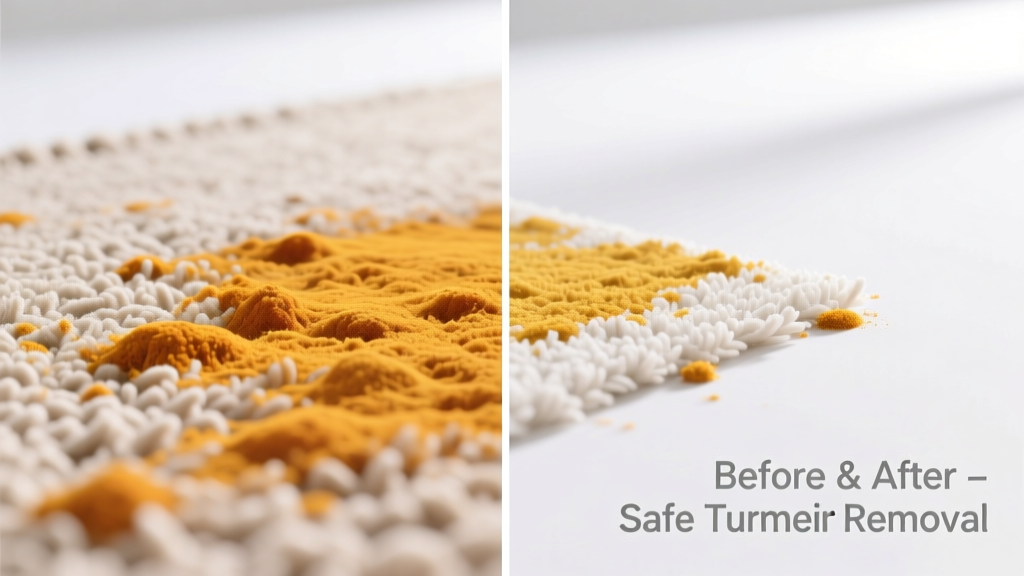
That golden-yellow dust from your curry powder or fresh turmeric root? It’s not just flavorful—it’s a notorious carpet-staining agent. Turmeric contains curcumin, a natural pigment so potent it’s used as a textile dye—and once it bonds with carpet fibers, it resists water and many common cleaners. The good news: if acted on within 24 hours, most turmeric stains are fully removable. Even older stains respond well to targeted oxidizing agents—when applied correctly.
What You Need
Don’t reach for bleach or vinegar first. Turmeric reacts unpredictably with acidic or harsh oxidizers on certain fibers. Below is a curated list of supplies ranked by effectiveness and safety for most residential carpets (nylon, polyester, olefin). All prices reflect U.S. retail averages as of 2024.
| Item | Why It’s Used | Avg. Cost (USD) |
|---|---|---|
| 3% hydrogen peroxide (drugstore grade) | Oxidizes curcumin without damaging nylon or polyester | $2.99 |
| White vinegar (5% acetic acid) | Only safe for *fresh* stains on wool-free carpets; neutralizes alkaline residues | $1.49 |
| Cold distilled water | Prevents heat-setting; avoids mineral deposits from tap water | $1.29 (1L bottle) |
| Microfiber cloths (lint-free) | Prevents fiber abrasion; absorbs better than paper towels | $8.99 (pack of 12) |
| Carpet-safe enzyme cleaner (e.g., Rocco & Roxie Stain Eliminator) | Breaks down organic binding agents; ideal for older, protein-bound stains | $19.99 |
Step-by-Step Removal Process
Act fast—but don’t panic. Follow this sequence based on stain age:
- Fresh stain (under 2 hours): Blot vigorously with cold distilled water and microfiber cloth. Do not rub. Repeat until no yellow transfers.
- Stain aged 2–24 hours: Apply chilled 3% hydrogen peroxide directly to the spot using an eyedropper. Let sit 3–5 minutes—no longer. Blot immediately with dry microfiber. Repeat up to two more times if color remains.
- Stain older than 24 hours: First, pretreat with enzyme cleaner (apply generously, cover with plastic wrap, wait 12 hours). Then follow with hydrogen peroxide step above. Never skip the enzyme step for 48+ hour stains—it loosens the curcumin-fiber bond.
- Final rinse: Dampen a clean microfiber cloth with cold distilled water and blot until no residue remains. Allow to air-dry flat—do not use a hair dryer or fan, which can bake residual pigment.
Surface-Specific Tips
Turmeric interacts differently across fiber types. Adjust technique accordingly:
- Nylon carpets (most common in homes): Respond best to hydrogen peroxide. Avoid vinegar entirely—it can cause yellowing over time due to pH shift.
- Wool or wool-blend rugs: Skip peroxide and vinegar. Use only cold distilled water + a pH-neutral carpet shampoo (like Woolite Carpet Cleaner). Test in an inconspicuous area first—wool is highly sensitive to oxidation.
- Olefin (polypropylene) carpets: Highly stain-resistant but vulnerable to heat. Never steam-clean turmeric stains—heat sets curcumin permanently. Stick to cold-water blotting and enzyme pretreatment.
Can I use baking soda?
No. Baking soda is alkaline and can intensify turmeric’s yellow hue by shifting curcumin’s molecular structure—a reaction confirmed in the Journal of Food Science (2021). It does not lift pigment and may leave a gritty residue that attracts more soil.
Will OxiClean work?
Sometimes—but with caveats. OxiClean’s sodium percarbonate breaks down into hydrogen peroxide in water, making it *potentially* effective. However, its added surfactants and fillers can leave sticky residues in carpet backing. If you use it, dilute to 1 tsp per cup of cold water, apply for ≤3 minutes, and rinse *thoroughly*. Better to use pure 3% H₂O₂.
What if the stain is on stairs or a rug pad?
Stairs require extra care: work top-down to avoid dripping onto cleaned sections. For rug pads, remove the rug and treat the pad separately with enzyme cleaner—curcumin soaks deep into foam or rubber layers. Replace pads older than 3 years; they retain pigment even after cleaning (see carpet pad lifespan guidelines).
Does sunlight help fade turmeric stains?
No—sunlight degrades curcumin unevenly and often leaves a dull, off-white halo around the original stain. UV exposure also weakens nylon fibers over time. According to the Carpet and Rug Institute’s 2022 Maintenance Report, UV-induced fiber damage increases stain retention by up to 40%.
What NOT to Do
These mistakes turn a fixable spill into a permanent eyesore:
- Apply heat—from irons, steam cleaners, or hair dryers. Heat polymerizes curcumin into the fiber matrix.
- Rub or scrub aggressively. This grinds pigment deeper and frays carpet tips, creating a fuzzy, discolored patch.
- Use chlorine bleach—even diluted. It reacts with curcumin to form dark brown compounds, per EPA toxicity documentation (2023).
- Delay treatment beyond 48 hours without enzyme pretreatment. After two days, curcumin binds covalently to amide groups in nylon, requiring professional extraction.
Prevention
Keep turmeric spills from happening—or at least contain them:
- Store ground turmeric in opaque, airtight containers—not clear jars on open shelves.
- Grind fresh turmeric root outdoors or over a rimmed tray lined with parchment paper.
- Place washable, tightly woven mats (not shag or jute) in high-risk zones like kitchen entries and dining areas.
- After cooking with turmeric, change clothes before walking on light-colored carpet—microscopic particles transfer easily.
"Turmeric is one of the top five pigments we see reappear after 'successful' DIY removal attempts—usually because people skip the enzyme step for older stains." — Carla Mendez, Senior Textile Restorer, Certified Master Cleaner (IICRC), 2023
If the stain persists after three full treatment cycles—or covers more than 12 inches in diameter—call a certified carpet cleaner who uses truck-mounted hot water extraction *without* pre-spray alkalinity boosters. For small spots, try our coffee stain method next—it shares similar blotting discipline. And remember: when in doubt, less is more. Gentle, repeated cold treatments beat aggressive one-time fixes every time.