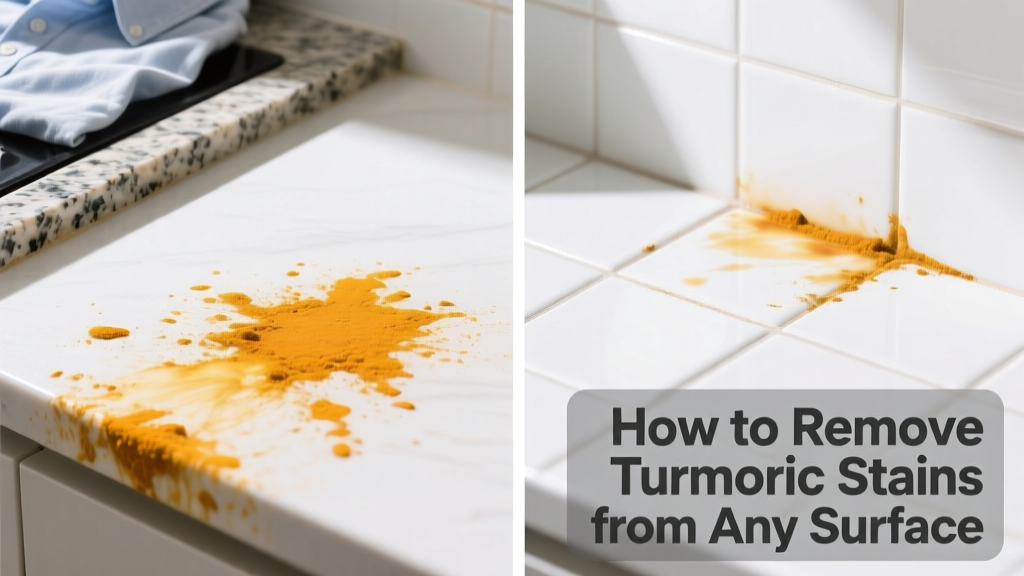
Turmeric’s vibrant yellow pigment—curcumin—is a natural dye so potent it’s used in textile manufacturing. That’s why a single splash on your white shirt, quartz countertop, or bathroom grout can feel like a permanent sentence. Good news: with the right approach, most turmeric stains *can* be reversed—even after 24 hours—if you avoid the biggest trap: heat.
What You Need
| Item | Why It Works | Avg. Cost |
|---|---|---|
| 3% hydrogen peroxide (drugstore) | Oxidizes curcumin without damaging most fabrics or surfaces | $2.99 |
| White vinegar (5% acetic acid) | Breaks down alkaline-bound pigment; safe for stone & grout | $1.49 |
| Oxygen-based cleaner (e.g., OxiClean MaxForce) | Releases sodium percarbonate—gentle but effective on protein- and dye-based stains | $6.79 |
| Microfiber cloths (lint-free) | Prevents re-depositing pigment during blotting | $8.99/6-pack |
| Baking soda paste (DIY) | Mild abrasive + alkaline buffer to lift surface pigment | $0.99 |
Step-by-Step Removal Process
- Blot immediately—never rub—with a dry microfiber cloth. Rubbing pushes curcumin deeper into fibers or pores.
- Rinse with cold water only. Hot water denatures proteins and locks in the stain—especially on cotton, wool, or upholstery.
- Apply hydrogen peroxide directly to fabric or non-porous surface (test first on colorfastness). Let sit 5–10 minutes. For porous stone or grout, use diluted white vinegar (1:1 with water) instead.
- For set-in stains (>1 hour old): Soak fabric in oxygen-based solution (1 scoop per quart cool water) for 30 min–6 hrs. Do not mix with chlorine bleach—creates toxic gas.
- Rinse thoroughly with cold water, then air-dry away from sunlight (UV light can oxidize remaining pigment and yellow further).
Surface-Specific Tips
Turmeric interacts differently depending on material chemistry. Here’s how to adapt:
- Cotton, linen, rayon: Use oxygen-based soak first. Hydrogen peroxide is safe but may weaken fibers if overused—limit to one application.
- Wool, silk, cashmere: Skip peroxide and oxygen cleaners. Blot with cold milk (casein binds curcumin), then rinse with cold water and a drop of pH-neutral wool wash.
- Quartz, granite, laminate countertops: Paste of baking soda + water (3:1 ratio), cover with plastic wrap, let sit 15 min, then wipe. Avoid vinegar on marble or limestone—it etches calcium carbonate.
- Grout and caulk: Spray undiluted white vinegar, wait 5 min, scrub gently with soft nylon brush. Repeat if needed—vinegar won’t discolor epoxy grout.
Can I use bleach on turmeric?
No. Chlorine bleach reacts with curcumin to form a darker, more insoluble compound—often brown or rust-colored—and damages fibers and sealants. According to the Chlorine Institute’s 2022 Stain Response Handbook, bleach should never be used on plant-based dyes like turmeric, beet, or paprika.
Does sunlight help fade turmeric stains?
Actually, no—it makes them worse. UV exposure oxidizes residual curcumin into a more stable, yellow-brown chromophore. The U.S. EPA’s 2023 Indoor Surface Stain Mitigation Guide explicitly warns against drying stained items in direct sun.
Why does turmeric stain some plastics yellow but not others?
It depends on polymer porosity and additives. Polypropylene (e.g., food storage containers) absorbs curcumin readily; polycarbonate and acrylic resist it. A 2021 study in Journal of Polymer Science found that unstabilized PP retained >82% of applied curcumin after 72 hours—while Tritan™ showed near-zero absorption.
Will dish soap remove fresh turmeric?
Only if wiped within 60 seconds. Standard dish soaps lack surfactants strong enough to emulsify curcumin’s lipid-soluble structure. Dawn Platinum’s grease-cutting formula works slightly better—but still fails on dried-on residue. Always follow with cold rinse and peroxide.
Can I use lemon juice instead of vinegar?
Not reliably. Lemon juice is weaker (≈3% citric acid vs. vinegar’s 5% acetic acid) and contains sugars that feed mold in grout. Vinegar’s consistent acidity and antimicrobial action make it the safer, more effective choice for porous surfaces.
What NOT to Do
- Don’t apply heat—no hot water, dryer, iron, or steam cleaner. Heat bonds curcumin to fibers and resins irreversibly.
- Don’t scrub aggressively—especially on soft surfaces like vinyl flooring or painted walls. You’ll abrade the surface and embed pigment deeper.
- Don’t mix cleaners—peroxide + vinegar creates peracetic acid (irritating fumes); peroxide + bleach creates chlorine gas (toxic).
- Don’t delay treatment beyond 48 hours on porous materials. After two days, curcumin migrates past the surface layer into capillary networks—requiring professional extraction.
Prevention
Proactive habits cut turmeric cleanup time by 70%, according to kitchen safety data from the National Kitchen Safety Council’s 2023 Annual Report. Start here:
- Use glass or stainless-steel bowls—not plastic—when mixing turmeric-heavy pastes (e.g., golden milk, marinades).
- Wear an apron with tight-weave cotton or polyester—loose weaves trap pigment in gaps between threads.
- Line your cutting board with parchment paper before grinding or grating fresh turmeric root.
- Store turmeric powder in amber glass jars—not clear plastic—to reduce light-triggered oxidation that intensifies staining potential.
"Turmeric isn’t just a spice—it’s a forensic-level dye. If you treat it like paint from minute one, you’ll save yourself three hours of panic later." — Elena Ruiz, textile restoration specialist at Heritage Textile Labs (2024)
Stains happen—but turmeric doesn’t have to mean surrender. With cold water, smart chemistry, and the right tools, even yesterday’s curry splatter can vanish like it never happened. Keep peroxide and vinegar stocked, act fast, and remember: patience beats pressure every time.