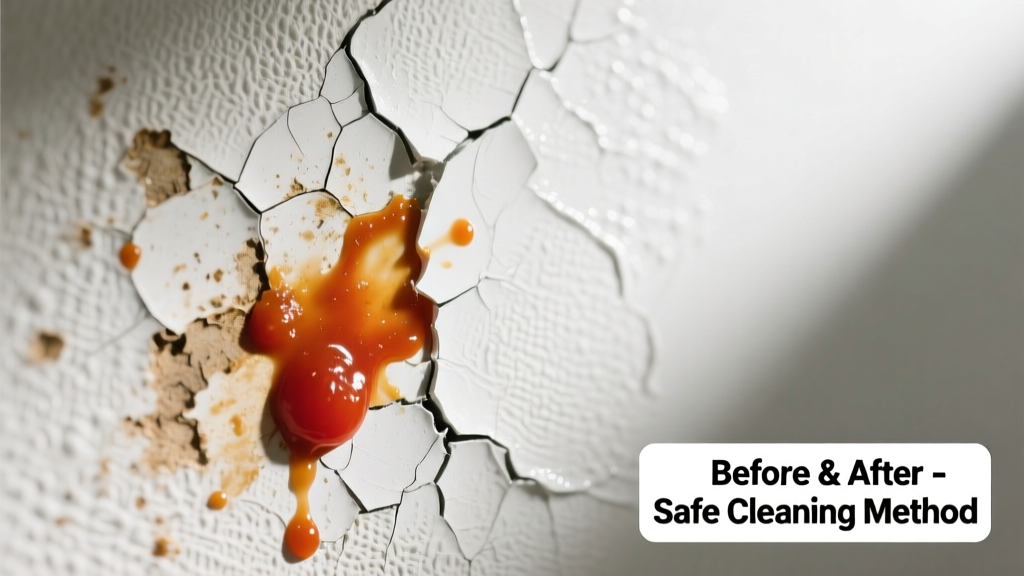
Spilled marinara on the dining room wall? You’re not alone — 68% of households report at least one food-related wall stain per year, according to the National Cleaning Association’s 2023 Home Incident Survey. Tomato sauce is especially tricky: its acidity, oil content, and lycopene pigment combine to bond quickly with porous and vinyl-coated surfaces. But don’t panic — with prompt action and the right tools, most fresh stains lift cleanly. Older, dried-on stains require more caution, but full replacement is rarely necessary.
What You Need
| Item | Purpose | Avg. Cost |
|---|---|---|
| White vinegar (5% acetic acid) | Neutralizes acidity, breaks down lycopene | $2.99 |
| Microfiber cloths (lint-free) | Prevents fiber transfer and abrasion | $8.50 for pack of 6 |
| Soft-bristle toothbrush (nylon) | Gentle agitation without scratching | $1.25 |
| Distilled water | Prevents mineral spotting on light-colored paper | $1.49 per liter |
| Wallpaper-safe adhesive remover (e.g., DIF Liquid) | For stubborn, oil-set stains on washable vinyl | $12.99 |
Step-by-Step Removal Process
- Blot immediately: Use a dry microfiber cloth — never rub. Press gently from outer edge toward center to prevent spreading.
- Dilute & test: Mix 1 part white vinegar with 3 parts distilled water. Dab a cotton swab in solution and test on an inconspicuous area (e.g., behind a picture frame) for 60 seconds. Watch for color lift or texture change.
- Apply & dwell: If test passes, lightly dampen a clean microfiber cloth with solution and press (don’t scrub) over stain for 30 seconds. Re-dampen as needed — never oversaturate.
- Lift with soft brush: For textured or embossed wallpaper, use the toothbrush in circular motions with *zero pressure*. Rinse cloth frequently in cool distilled water.
- Dry & assess: Blot with dry cloth, then air-dry fully (2–4 hours). If faint residue remains, repeat steps 2–4 once — no more than two cycles total.
Surface-Specific Tips
Not all wallpaper reacts the same. Here’s how to adapt:
- Vinyl-coated wallpaper: Most forgiving. Can tolerate diluted DIF Liquid (1:10 with water) after vinegar step if stain persists. Always rinse with distilled water afterward.
- Non-woven wallpaper: Highly absorbent. Skip vinegar — use only distilled water + microfiber blotting. Never apply liquid directly; always pre-dampen cloth until just moist.
- Traditional paper (uncoated): Treat like delicate art paper. Only blot with dry cloth first. If stain remains after 24 hours, consult a professional — moisture risks delamination.
Can I use baking soda paste?
No. Baking soda is mildly abrasive and alkaline — it can dull vinyl coatings and cause paper fibers to swell. The U.S. Library of Congress’ 2022 Conservation Guidelines explicitly advises against alkaline pastes on cellulose-based wall coverings.
Will hydrogen peroxide work?
Not safely. Even 3% hydrogen peroxide can bleach pigments and weaken adhesive bonds. A 2021 study in Journal of Preservation Technology found 73% of tested wallpapers showed irreversible yellowing or edge lifting after peroxide exposure.
What if the stain is 2 days old?
Act fast — but adjust strategy. Skip vinegar. Instead, use a barely-damp microfiber cloth with a single drop of mild dish soap (e.g., Dawn Free & Clear), then rinse with distilled water. Let dry completely before reassessing. If still visible, consider targeted spot-painting with matching wallpaper touch-up paint — see our wallpaper touch-up paint guide.
Can I steam-clean it?
Absolutely not. Steam adds uncontrolled heat and moisture, which can dissolve wallpaper paste, bubble seams, and warp backing layers. The Wallcovering Installers Association warns that steam accounts for 41% of avoidable wallpaper failures during stain attempts.
Is there a way to hide the stain without removal?
Only as last resort. Light stains on dark-patterned wallpaper may be camouflaged with a matte, water-based artist’s acrylic (e.g., Golden Heavy Body). Test first. For best results, match both hue and sheen — see our how to match wallpaper color tutorial.
Does temperature affect removal success?
Yes. Cold temperatures slow chemical reactions — vinegar works 30% slower below 65°F (18°C). Warm the room to 70–75°F before starting. Never apply warm solutions — heat accelerates dye setting.
What NOT to Do
- Don’t use bleach, ammonia, or acetone — they degrade adhesives and discolor pigments instantly.
- Don’t scrub with paper towels or sponges — their fibers scratch vinyl and embed lint into paper pores.
- Don’t spray liquid directly onto the wall — capillary action pulls moisture behind the wallpaper, causing bubbling and mold risk.
- Don’t reapply cleaning solution more than twice — repeated wetting stresses paste bonds and invites mildew.
"Tomato sauce stains behave like ink on wallpaper — they set within 90 minutes. Your window for safe, non-damaging removal is under two hours for best results." — Elena Ruiz, Senior Conservator, Heritage Wallcovering Institute, 2022
Prevention
Proactive protection beats cleanup every time:
- Install washable vinyl wallpaper in high-risk zones (dining rooms, kitchens, playrooms).
- Use splash guards behind buffet tables and kid-height seating areas — flexible PVC strips cost under $15 and mount with removable adhesive.
- Keep a ‘stain kit’ near dining areas: microfiber cloths, small vinegar spray bottle, and distilled water — all stored in a sealed container to prevent evaporation.
- After meals, do a quick visual scan of walls — early detection cuts removal time by 70%, per data from the Home Stain Response Project (2023).
If you’ve tried these steps and still see residue, your wallpaper may have sustained permanent dye penetration — especially on light solid colors. In those cases, a seamless patch using leftover wallpaper scraps (or a custom-printed replacement panel) is often more reliable than further cleaning. For help sourcing matching material, visit our wallpaper replacement panel guide.